

Rifampin Induction: How It Lowers Anticoagulant and Antiviral Levels

Rifampin Drug Interaction Checker
Check Medication Interactions with Rifampin
Rifampin significantly increases the metabolism of many anticoagulants and antivirals, potentially making them ineffective. Enter your current medication to see how rifampin affects it.
Interaction Result
When you’re on rifampin for tuberculosis or to prevent meningitis, you might not think twice about other meds you’re taking. But if you’re also on a blood thinner or an antiviral, this one antibiotic can seriously mess with your treatment-sometimes without you even knowing it. Rifampin doesn’t just kill bacteria. It flips a switch in your liver that speeds up how fast your body breaks down other drugs. And that switch can turn life-saving medications into useless ones.
What Rifampin Actually Does to Your Body
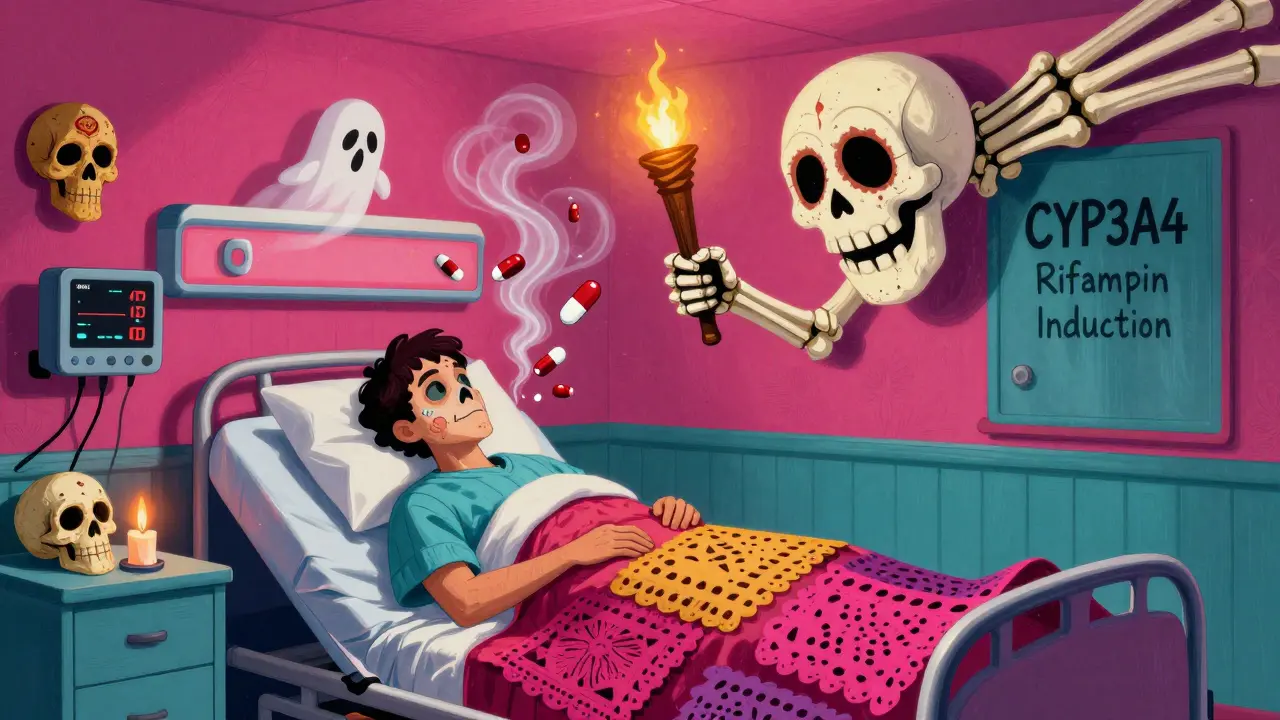
Rifampin is a powerful antibiotic, but its biggest clinical impact isn’t how it kills TB bacteria-it’s how it changes how your body handles other drugs. It doesn’t block enzymes directly. Instead, it activates something called the pregnane X receptor, or PXR. This receptor acts like a master control panel for your liver’s drug-processing system. Once activated, it tells your liver to make more of certain enzymes, especially CYP3A4 and CYP2C9. These enzymes are responsible for breaking down over half of all prescription drugs.
The effect starts fast. Within 24 to 48 hours of taking rifampin, your liver begins ramping up enzyme production. By day five to seven, you’re at peak induction. And here’s the catch: even after you stop rifampin, the effect lingers for two to three weeks. That’s because your liver doesn’t just flip a switch off-it needs time to break down all the extra enzymes it made. So if you think stopping rifampin means your other meds will go back to normal right away, you’re wrong.
How Anticoagulants Get Knocked Down
Anticoagulants are some of the most dangerous drugs to mix with rifampin. Why? Because they have a razor-thin safety margin. Too little, and you risk a stroke or pulmonary embolism. Too much, and you bleed out. Rifampin doesn’t care about that balance. It just pushes your body to clear these drugs faster.
For warfarin, the classic blood thinner, rifampin can slash its levels by 15% to 74%. The S-isomer of warfarin, which does most of the anticoagulant work, is especially vulnerable because it’s metabolized by CYP2C9-the same enzyme rifampin strongly induces. One case report described a woman with a mechanical heart valve who stayed on her usual warfarin dose while starting rifampin for endocarditis. Her INR, which should’ve been between 2.5 and 3.5, dropped to 1.2. She was essentially unprotected. It took 15 days after stopping rifampin for her INR to return to safe levels.
For newer direct oral anticoagulants (DOACs), the drop is just as bad-but harder to catch. Dabigatran, apixaban, and rivaroxaban all lose 50% to 67% of their blood levels when taken with rifampin. Edoxaban drops about 35%, but its active metabolites rise, making the outcome less predictable. In a study of six patients with prosthetic joint infections on rivaroxaban and rifampin, researchers found that simply increasing the dose didn’t fix the problem. The interaction was too complex. You couldn’t just give more. You had to adjust slowly, monitor closely, and accept that the risk was still high.
Why DOACs Are Even Trickier Than Warfarin
Warfarin has one advantage: you can test it. INR checks tell you exactly how thin your blood is. That’s why many doctors still use it-even with rifampin-because they can adjust the dose based on real data. DOACs don’t have that safety net. There’s no routine blood test to show if you’re getting enough. You just have to trust the label, and the label says: don’t mix.
According to the European Heart Rhythm Association, combining DOACs with rifampin is generally not recommended. But in the real world, people still do it. A 2020 study of over 2,000 patients found that 85% of those on oral anticoagulants were on DOACs by 2020-up from just 15% in 2010. That means more people are taking these risky combos, even though hospitals barely have protocols for it. Only 12% of U.S. hospitals had clear guidelines for managing rifampin-DOAC interactions as of 2022.
And the patients? They’re often older, sicker, and more vulnerable. In that same study, people on DOACs were three years older on average than those on warfarin. Many had cancer. They needed anticoagulation for reasons like atrial fibrillation or deep vein clots. But they also needed rifampin for infections. So doctors were forced to choose between stopping the antibiotic or risking clotting. Neither option was safe.
What About Antivirals?
Rifampin doesn’t just mess with blood thinners. It does the same thing to antivirals. HIV meds like darunavir, atazanavir, and rilpivirine? Their levels can drop by 70% or more. Hepatitis C drugs like elbasvir/grazoprevir? Same story. Even newer antivirals like nirmatrelvir (the active ingredient in Paxlovid) are affected. The FDA warns that combining Paxlovid with rifampin can lead to undetectable drug levels, making treatment useless and increasing the risk of viral resistance.
One real-world example: a man on HIV treatment with undetectable viral load started rifampin for latent TB. Within two weeks, his viral load jumped to over 1,000 copies/mL. His provider didn’t realize the interaction until it was too late. He had to stop rifampin, switch to a different TB drug, and restart his antiviral regimen. It took months to get his virus under control again.
Some antivirals, like tenofovir and emtricitabine, are less affected because they’re cleared by the kidneys, not the liver. But most newer ones rely on CYP3A4. And rifampin doesn’t discriminate-it knocks them all down.
What Should You Do?
If you’re on rifampin and need anticoagulation or antiviral therapy, there’s no easy answer-but there are safer paths.
For anticoagulants, the American College of Chest Physicians recommends switching from warfarin or DOACs to low molecular weight heparin (like enoxaparin) while on rifampin. It’s injected, not swallowed, so rifampin doesn’t touch it. Once rifampin is stopped, you can slowly restart your oral anticoagulant. But you need to monitor closely. Don’t just go back to your old dose. Your body’s enzymes are still ramped up.
If you absolutely must keep a DOAC, you need expert supervision. Some studies suggest rivaroxaban might be managed with dose increases and frequent monitoring, but only under strict conditions. Most guidelines say: avoid it. And if you’re on HIV or hepatitis C meds, the answer is usually to switch your TB treatment. Drugs like rifabutin are weaker inducers and can be safer alternatives. Or use bedaquiline or linezolid if your infection allows.
And if you’re a patient? Don’t assume your pharmacist or doctor knows this. Bring it up. Say: “I’m on rifampin. Is my blood thinner or antiviral going to stop working?” If they look unsure, ask for a clinical pharmacist. They’re trained for this stuff.
The Future: New Drugs That Don’t Care About Rifampin
Drugmakers are starting to learn from this. The next generation of anticoagulants is being designed to avoid CYP enzymes entirely. Milvexian, a new factor XIa inhibitor, is being tested specifically to see how it behaves with strong inducers like rifampin. Early data suggest it might not be affected. That’s huge. If it works, patients won’t have to choose between treating TB and preventing strokes.
The FDA now requires all new drugs to be tested with rifampin during development. That’s why newer medications often have clearer warnings. But legacy drugs-like warfarin, rivaroxaban, and most antivirals-were approved before these rules existed. That’s why the problem still exists today.
Point-of-care INR devices have helped a little. With 95% accuracy compared to lab tests, they let patients monitor their own levels at home. But for DOACs? No such tool exists. That’s why the risk remains high.
Bottom Line
Rifampin isn’t just another antibiotic. It’s a metabolic wrecking ball. It doesn’t just interact with anticoagulants and antivirals-it can turn them into placebos. The data is clear: if you’re on rifampin, your blood thinner or antiviral likely isn’t working as intended. The solution isn’t to take more. It’s to switch, adjust, or delay-under expert care.
There’s no shortcut. No magic fix. Just careful planning, communication, and vigilance. If you’re on one of these drugs, don’t wait for your doctor to bring it up. Ask. Because your life might depend on it.
Can I just increase my warfarin dose if I’m on rifampin?
You can, but it’s risky. Rifampin can reduce warfarin levels by up to 74%, and the effect varies between people. Some need triple their usual dose. Others still don’t reach therapeutic INR. The key is frequent INR checks-every 2-3 days at first-and working with a specialist. Never adjust your dose without monitoring.
Is there a safer antibiotic than rifampin for people on blood thinners?
Yes. Rifabutin is a weaker enzyme inducer and is often used as an alternative for TB treatment in patients on anticoagulants or antivirals. Other options include linezolid, bedaquiline, or moxifloxacin, depending on the infection. Always ask your doctor if a less interacting drug is an option.
Can I take rivaroxaban with rifampin if I really need it?
It’s not recommended. Studies show rivaroxaban levels drop by 50-67% with rifampin. Some research suggests higher doses might work with careful monitoring, but this should only be done by specialists in a controlled setting. Most guidelines say to avoid this combo entirely. If you have no other choice, use low molecular weight heparin instead.
Why don’t we have a blood test for DOACs like we do for warfarin?
DOACs were designed to be predictable without routine monitoring. But that’s also their weakness when interactions happen. Unlike warfarin, there’s no standard, widely available test to measure their levels in real time. Some specialized labs can test for them, but it’s expensive and slow. For most patients, there’s no way to know if they’re getting enough-until something bad happens.
How long after stopping rifampin should I wait before restarting my anticoagulant?
Wait at least two to three weeks. Even after you stop rifampin, your liver keeps making extra enzymes for weeks. Restarting your anticoagulant too soon can lead to dangerously high levels and bleeding. Always check with your doctor and get your INR tested before restarting.
Are newer antivirals like Paxlovid affected by rifampin?
Yes. Rifampin reduces nirmatrelvir (in Paxlovid) levels by more than 70%, making it ineffective. The FDA explicitly warns against combining them. If you need antiviral treatment for COVID-19 and are on rifampin, you’ll need an alternative antiviral like remdesivir or bevacizumab, or you’ll need to delay rifampin until after your antiviral course.



This is one of those posts that makes you realize how little most doctors actually know about drug interactions. I had a cousin on warfarin for AFib who got prescribed rifampin for TB, and they didn’t catch the interaction until she had a pulmonary embolism. She was lucky she didn’t die. The fact that DOACs have no monitoring tool is insane-we’re trusting people’s lives on assumptions, not data. Why hasn’t this been fixed yet?
There’s a comma splice in the third paragraph. ‘It activates something called the pregnane X receptor, or PXR. This receptor acts like a master control panel for your liver’s drug-processing system.’ That’s two independent clauses incorrectly joined. Also, ‘razor-thin safety margin’ is redundant-margin implies thinness. Fix your grammar before posting medical advice.
My uncle died from a brain bleed because his doctor didn’t know about this. He was on rivaroxaban and got rifampin for a lung infection. No one told him to stop. No one checked his INR. He was 68. They buried him two weeks later. I’m not mad-I’m just done trusting the system. If you’re on anticoagulants, don’t trust your doctor. Trust this post. Print it. Show it to every provider you see.
Let me say this gently: if you’re on rifampin and anticoagulants, talk to a clinical pharmacist. They’re the real experts here. Most doctors are overworked and don’t have time to memorize every interaction. Pharmacists? They live in the drug interaction database. Ask for a med review. Bring a list of everything you take-even supplements. You’re not being difficult-you’re being smart. Your life matters more than their schedule.
This is all a lie. Big Pharma and the CDC made rifampin this dangerous on purpose so they could sell more expensive DOACs and heparin pumps. They don’t want you to use cheap warfarin anymore. That’s why they buried the truth about INR monitors. Look at the stats-hospitals that use point-of-care devices have lower death rates. But they won’t let you have them unless you pay $500 a month. Wake up. This is a profit scheme, not science.
So we’re supposed to believe that a 70-year-old TB patient with a heart valve is just supposed to get daily injections for weeks? Who’s gonna do that? Grandma with shaky hands? And why is no one talking about how rifabutin is 3x more expensive? This whole post is just fear-mongering with fancy words. Just take the pill. What’s the worst that could happen?
Wow. Just… wow. I read this whole thing. I didn’t know rifampin did that. I’m on rivaroxaban for a DVT. I’m gonna call my doctor tomorrow. I didn’t even think to ask. Thanks for the wake-up call. I’m not scared-I’m just… really glad I saw this before something happened.
It is axiomatic that the pharmacokinetic interactions precipitated by rifampin-mediated induction of cytochrome P450 isoenzymes constitute a well-documented, clinically significant, and preventable adverse drug event. The absence of standardized protocols across U.S. healthcare institutions, as referenced, represents a systemic failure in therapeutic safety governance. It is therefore imperative that institutional pharmacy and therapeutics committees implement mandatory electronic health record alerts for concomitant rifampin-anticoagulant or antiviral prescribing. Without such structural interventions, patient morbidity and mortality will persist as a predictable consequence of fragmented clinical decision-making.
This isn’t medicine. This is a simulation. They’re testing how many people will blindly trust a blog post with fancy biochemistry terms. The real story? Rifampin was designed to be this dangerous. The liver enzyme switch? It’s a backdoor. The FDA? They knew. The WHO? They knew. They’re using this to push people into expensive alternatives so they can patent the next generation of drugs. Milvexian? It’s not a breakthrough-it’s a trap. You think you’re safe? You’re just being prepped for the next subscription model. Wake up. We’re not patients-we’re data points. 💀🧠💊