

Vitamin K Supplements and Warfarin: How to Keep INR Stable

Vitamin K Supplement Calculator for Warfarin Patients
This tool helps determine if you might benefit from consistent vitamin K1 supplementation based on your INR stability and other factors.
Results
If you're on warfarin, you know how frustrating it can be to get your INR numbers all over the place. One week you're at 2.1, next week you're at 4.5, and your doctor has to tweak your dose again. It’s not just annoying-it’s dangerous. Too low, and you risk a clot. Too high, and you could bleed internally. For many people, this rollercoaster isn’t caused by missing a pill or eating too much kale. It’s because their vitamin K intake is inconsistent. And here’s the surprising part: taking a daily low-dose vitamin K supplement might be the key to stopping the swings.
Why Warfarin and Vitamin K Are a Delicate Balance
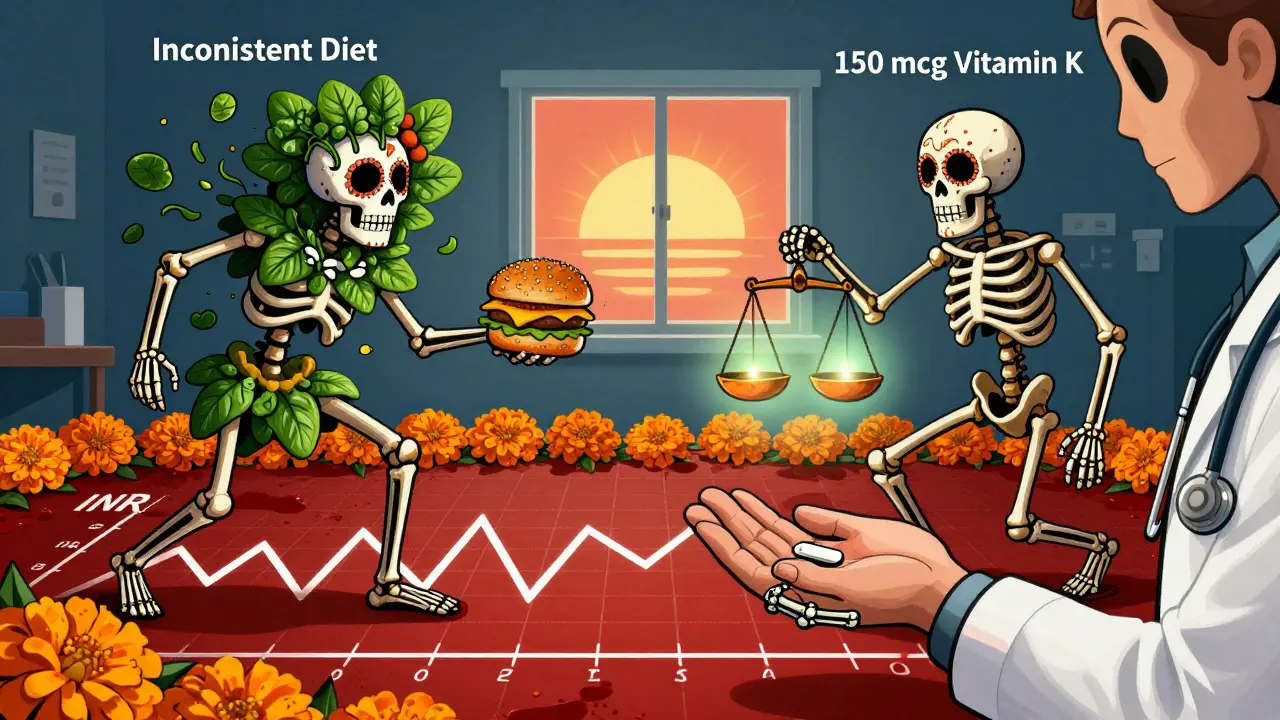
Warfarin doesn’t thin your blood directly. Instead, it blocks vitamin K from doing its job-activating clotting factors in your liver. Think of vitamin K as the switch that turns on your body’s ability to form clots. Warfarin flips that switch off. But your body doesn’t need to be completely out of vitamin K. It just needs to be steady. If you eat a big salad one day and a cheeseburger the next, your vitamin K levels jump around. That makes warfarin’s effect unpredictable. Your INR goes up and down because your body’s vitamin K supply is inconsistent.
Studies show that people with unstable INR often get far less vitamin K daily than those who stay stable. One 2007 study found that stable patients averaged 293 micrograms of vitamin K per day, while unstable patients got only 109. That’s a huge gap. And it’s not about eating more greens. It’s about eating the same amount every day.
The 150 mcg Rule: What Works in Clinical Trials
Research has tested a simple solution: give people on warfarin a consistent 150 micrograms of vitamin K1 every day. That’s about 1.5 times the recommended daily intake for adults, but still far below any toxic level. This dose isn’t magic-it’s math. It’s enough to smooth out the daily fluctuations without overpowering warfarin.
In the landmark Canadian trial published in 2016, patients taking 150 mcg daily saw their extreme INR spikes (above 4.0 or below 1.5) drop from 9.4% to 5.4%. That’s a 4% absolute reduction. Sounds small? It’s not. For someone with 50 INR checks a year, that’s 2 fewer dangerous readings. That’s one less trip to the ER, one less hospital stay.
And here’s the kicker: it didn’t make people’s INR consistently higher or lower. It just made them more predictable. That’s the goal-not to fix the number, but to stop the chaos.
Who Benefits Most?
This isn’t for everyone. If your INR is stable, you don’t need it. If you have a mechanical heart valve in your mitral position, you’re usually excluded from these studies because your target INR is higher (2.5-3.5), and adding vitamin K could make control harder.
The best candidates are people who:
- Have a history of INR levels outside the therapeutic range (2.0-3.0) more than 30% of the time
- Follow their warfarin schedule perfectly
- Don’t have major dietary swings (like going from zero greens to a huge spinach salad every weekend)
- Have tried everything else-consistent dosing, regular monitoring, avoiding new meds-and still can’t stabilize
One case study followed a 68-year-old man with a mechanical aortic valve. Over 18 months, his INR was stable less than half the time. After starting 150 mcg of vitamin K daily, his stability jumped to 71% over the next six months. His warfarin dose only changed twice during that period-down from 17 adjustments in the year before.

What Happens When You Start?
Don’t expect instant results. Vitamin K doesn’t work like a painkiller. It takes 4 to 8 weeks for your INR pattern to settle. In the first few weeks, your INR might dip lower than usual. That’s normal. Your body is adjusting to the steady supply of vitamin K, so warfarin becomes slightly more effective. Your doctor will likely increase your warfarin dose by 0.5 to 1.5 mg during this time.
Some patients report needing a higher warfarin dose after starting vitamin K. One Reddit user said his dose went from 3 mg to 4.5 mg. That doesn’t mean vitamin K didn’t help. It means his body finally had enough vitamin K to respond predictably to the higher warfarin dose. The trade-off? Fewer dangerous spikes.
Doctors who use this approach follow a clear protocol: one month of baseline INR tracking, then start the supplement. Weekly INR checks for the first month, then every two weeks. Dose changes are made based on actual INR results-not guesswork.
How It Compares to Other Options
There are other ways to manage warfarin instability. One is frequent INR testing with a home monitor like CoaguChek. These devices cost $500-$1,000 and require training. They give you immediate feedback, but they don’t fix the root cause: inconsistent vitamin K.
Then there are DOACs-drugs like apixaban or rivaroxaban. They don’t need INR monitoring at all. But they’re not for everyone. People with mechanical valves, antiphospholipid syndrome, or severe kidney disease still need warfarin. That’s about 20% of anticoagulated patients in the U.S.-over 2 million people.
Vitamin K supplementation is dirt cheap. A 5 mg tablet costs about $0.08. You only need 150 mcg a day-that’s $0.004 per dose. No equipment. No training. Just a daily pill.
What Could Go Wrong?
It’s not risk-free. If you’re already eating 500+ mcg of vitamin K daily from greens and supplements, adding more can make things worse. That’s why trials exclude people with extreme dietary swings.
Another risk? Masking the real problem. If your INR is unstable because you forget your warfarin, or you’re taking antibiotics that interfere, vitamin K might make your numbers look better while the real issue hides. That’s why doctors only recommend it after ruling out adherence problems and drug interactions.
And it doesn’t work for everyone. About 10% of patients in the Anticoagulation Forum’s survey reported worse control after starting vitamin K. One case report described a woman whose INR became more erratic after starting the supplement. She had to stop.
What Experts Say
Dr. Elaine Hylek from Boston University calls it one of the most promising approaches for warfarin stability. Dr. Jacob Siegel at Johns Hopkins says the 4% drop in dangerous INR spikes is clinically meaningful-enough to prevent thousands of bleeding events each year.
But not everyone’s convinced. Dr. Daniel Witt, who helped write the official guidelines, warns it might hide poor adherence. The European Heart Rhythm Association gives it a Class IIb recommendation-meaning it’s reasonable to try, but not a standard of care.
And here’s what’s coming: new trials are testing whether combining vitamin K with genetic testing (for VKORC1 gene variants) can make it even more effective. If those results pan out, personalized vitamin K dosing could become routine by 2026.
Bottom Line: Is It Worth Trying?
If you’re on warfarin and your INR is all over the map-despite doing everything right-it’s worth asking your doctor about vitamin K. Not as a cure-all. Not as a replacement for monitoring. But as a tool to reduce the noise.
It’s low cost. Low risk. And for the right person, it can turn a weekly panic over INR results into a predictable rhythm. You still need to get your INR checked. You still need to take warfarin. But with vitamin K, you might finally stop feeling like your blood is on a rollercoaster.
Start the conversation. Bring the data. Ask if your INR instability fits the profile. And if your doctor says no, ask why. There’s growing evidence-and it’s not just theory anymore.
Can I just eat more leafy greens instead of taking a vitamin K supplement?
No. Eating more greens won’t help if your intake is inconsistent. A spinach salad one day and no greens the next creates bigger INR swings than a steady 150 mcg supplement. The goal isn’t to increase vitamin K-it’s to make it predictable. Supplements give you exact, daily doses. Food doesn’t.
Will vitamin K make my blood thicker and increase my risk of clots?
No. At 150 mcg daily, vitamin K doesn’t override warfarin. It just makes warfarin’s effect more consistent. In clinical trials, patients didn’t have more clots-they had fewer dangerous INR spikes. The dose is carefully chosen to stabilize, not to reverse anticoagulation.
How long does it take to see results with vitamin K supplementation?
It takes 4 to 8 weeks for your INR pattern to stabilize. Don’t expect changes in the first week. Your body needs time to adjust to the steady vitamin K supply. Most studies measure outcomes after 3-6 months. Patience is key.
Can I take vitamin K with other supplements or medications?
Avoid other vitamin K supplements or multivitamins with high vitamin K content. Also, avoid herbal products like ginseng, green tea extract, or St. John’s wort-they can interfere with warfarin. Always tell your doctor about everything you’re taking. Even over-the-counter pain relievers can affect your INR.
Is vitamin K supplementation covered by insurance?
Usually not. Since vitamin K1 is sold as a supplement, not a prescription drug, most insurance plans won’t cover it. But it’s so inexpensive-less than $0.01 per day-that cost isn’t a barrier. You can buy it at any pharmacy or online without a prescription.
What if my INR gets too low after starting vitamin K?
That’s common in the first few weeks. Your doctor will likely increase your warfarin dose by 0.5 to 1.5 mg to compensate. Don’t stop the vitamin K. Don’t skip your warfarin. Keep monitoring your INR and follow your provider’s instructions. This is part of the adjustment process.
Does vitamin K work for people on dialysis?
Early evidence suggests it might. People on hemodialysis have extremely unstable INR levels-up to 70% of the time outside target range. A major trial (NCT02324686) is testing whether 150 mcg daily helps this group. Results are expected in 2025. For now, it’s considered experimental in this population, but promising.
Should I stop vitamin K if I switch to a DOAC like apixaban?
Yes. DOACs don’t interact with vitamin K, so there’s no benefit-and no need. If you switch from warfarin to a DOAC, your doctor will tell you to stop the supplement. Continuing it won’t hurt, but it’s unnecessary.






I've been on warfarin for 7 years and my INR was all over the place until I started the 150 mcg vitamin K. No more panic calls to my doctor. It’s not magic, but it’s the closest thing I’ve found to peace of mind.
OMG THIS IS A SCAM!!1! vitamin K is just plant juice and your blood is a temple!!! why are you giving your body poison to make it calm?? I stopped eating greens and now my INR is 8.2 and I’m crying in the shower and my cat is judging me!!
Interesting data. The 2016 Canadian trial is solid, but I’d like to see more long-term outcomes beyond 12 months. Also, the cost argument is compelling, but access to consistent supplements isn’t universal. In rural areas, even $0.01/day can be a barrier if pharmacies don’t stock it.
This isn’t just about chemistry-it’s about rhythm. Our bodies crave consistency, not extremes. Warfarin is already a dance with uncertainty; adding a daily vitamin K pill is like finding the metronome in a jazz solo. It doesn’t change the melody, but it lets you breathe through the notes. For anyone who’s ever stared at an INR result and felt like their body betrayed them-this might be the quiet ally you didn’t know you needed.
More studies needed. Also why are you giving people pills instead of teaching them to eat the same damn salad every day?
Let me tell you, I was skeptical-until I saw my own INR graph. For 18 months, it looked like a stock market crash during a pandemic. Then I started the 150 mcg. Month one: INR dipped to 1.8. I panicked. Month two: doctor upped my warfarin by 1 mg. Month three: my numbers flatlined like a calm ocean under a full moon. I cried. Not because I was scared-but because for the first time in years, I didn’t have to check my INR like a gambler waiting for the dice to roll. This isn’t a hack. It’s a lifeline.
YES. This is the kind of info we need to spread. So many people suffer in silence thinking they’re doing something wrong. You’re not failing-you’re just missing the right tool. Tell your doctor. Bring this article. You deserve stability. You deserve to sleep without wondering if you’re bleeding inside.
150 mcg? lol. I took 200 and my INR dropped to 1.1. My doc was like 'uh... maybe don't do that.' so now I'm back to 150. point is: don't be a hero. just follow the numbers.
I’ve been on warfarin since 2019, and I’ve tried everything-home monitors, diet logs, even a nutritionist. Nothing worked until vitamin K. I was skeptical too, but after 6 weeks, my INR went from a wild rollercoaster to a straight line. I’m not saying it’s perfect-but it’s the first thing that actually made me feel like I had control again. Thank you for sharing this.
Let’s be real: the real win here isn’t the supplement-it’s that someone finally wrote this in plain English. Most medical advice reads like a contract written by a robot with a grudge. This? This feels like a friend handing you a flashlight in the dark. And yes, the cost is laughably low. But the peace? Priceless.
I’ve seen patients in India struggle with warfarin because they think ‘natural’ means ‘variable.’ One man ate spinach every Monday, nothing else all week. His INR was always off. When we started him on 150 mcg daily, his numbers stabilized within weeks. It’s not about replacing food-it’s about replacing chaos with calm. Simple. Effective. Human.
How quaint-another reductionist, pharmaceutical-adjacent solution masquerading as a ‘lifestyle hack.’ You’re reducing the intricate, systemic interplay of coagulation, genetics, and dietary ecology to a single, monetized micronutrient. Where’s the epistemological humility? Where’s the recognition that biology resists quantification? And yet… I’ve seen it work. So I suppose even a broken clock is right twice a day.