

Peripheral Artery Disease: Symptoms, Diagnosis, and Treatment Options

Peripheral Artery Disease is a condition where plaque builds up in your arteries, blocking blood flow to your legs and arms. It affects 8.5 million Americans, yet most people don’t know they have it until serious problems arise. Left untreated, PAD can lead to amputations or even fatal heart attacks. The good news? Early action can stop it in its tracks. Let’s break down what you need to know.
Common Symptoms of Peripheral Artery Disease
Many people with PAD don’t feel any symptoms at first. But when they do, the most classic sign is claudication-pain in your calves, thighs, or buttocks while walking that goes away after resting. About 10% of PAD patients experience this. If you’ve ever had to stop walking because of leg cramps, only to feel better after a few minutes, that’s claudication in action.
More severe symptoms include sores on your feet or toes that won’t heal, cold or numb legs, shiny skin on your lower legs, and loss of leg hair. Men with PAD often report erectile dysfunction, affecting 45-75% of male patients. In critical cases, rest pain (pain even when not moving) or gangrene can occur. These signs mean immediate medical attention is needed to prevent amputation.
Physical exams often reveal cool skin temperature (seen in 32% of cases), weak or absent pulses in the feet, slow capillary refill (>3 seconds in 28% of patients), and non-healing wounds (15% of advanced cases). These clues help doctors spot PAD before it becomes life-threatening.
How Doctors Diagnose PAD
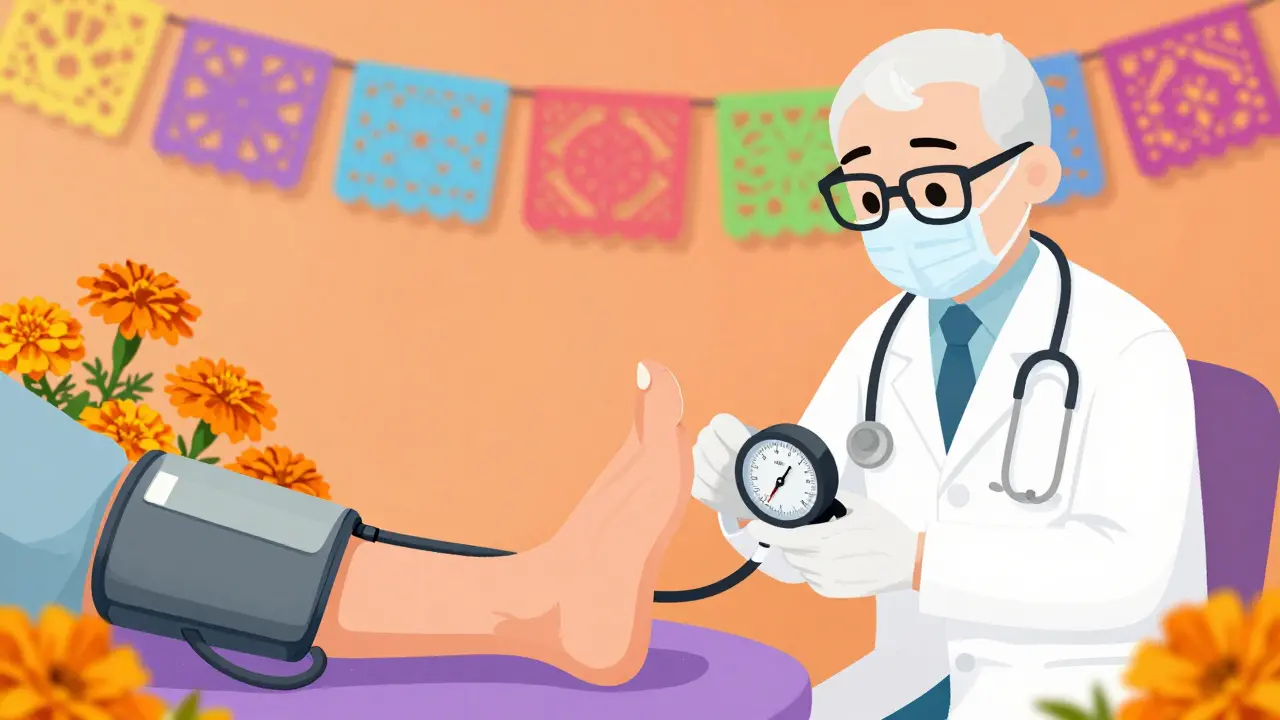
The ankle-brachial index (ABI) test is the gold standard for diagnosing PAD. It’s simple: your doctor measures blood pressure in your ankle and arm, then compares the two. An ABI of 0.90 or lower confirms PAD in 95% of cases. Values between 0.41-0.90 indicate mild to moderate disease, while 0.40 or lower signals severe blockage.
| Test Type | How It Works | Accuracy | Pros | Cons |
|---|---|---|---|---|
| ankle-brachial index (ABI) | Measures blood pressure in ankle vs arm | 95% accurate for PAD confirmation | Non-invasive, quick, low cost | Less accurate in diabetics with calcified arteries |
| toe-brachial index (TBI) | Measures pressure in toe vs arm | Validates PAD in calcified vessels | More reliable for diabetics | Less commonly used |
| Doppler ultrasound | Uses sound waves to visualize blood flow | 90-95% sensitivity | No radiation, real-time imaging | Operator-dependent |
| CT angiography (CTA) | X-ray imaging with contrast dye | 97% accuracy for stenosis | Detailed 3D images | Radiation exposure, kidney risk |
| MRI angiography (MRA) | Magnetic fields for imaging | 94% sensitivity | No radiation | Expensive, not widely available |
| Angiography | Catheter-based imaging with dye | 100% accuracy | Gold standard for precise diagnosis | Invasive, risk of complications |
For diabetics or those with kidney disease, the toe-brachial index (TBI) is used instead. A TBI below 0.70 confirms PAD when ABI results are unreliable. Doppler ultrasound checks blood flow speed and identifies plaque locations with 90-95% sensitivity. For detailed imaging, CT or MRI angiography shows blockages clearly, though they carry radiation or cost risks. Angiography remains the most accurate but is invasive, with a 5-10% risk of kidney damage from contrast dye.
Treatment Options That Work
Treatment starts with lifestyle changes. Quitting smoking is non-negotiable-smokers with PAD have an 8-fold higher amputation risk than those who quit. A supervised walking program is the first-line treatment for claudication. Walking 30-45 minutes, 3-5 times weekly, improves pain-free walking distance by 150-200% in just 12 weeks. This isn’t just a walk in the park; it’s structured exercise under medical supervision to rebuild blood flow.
Medications play a key role. Antiplatelet therapy like aspirin (81 mg daily) or clopidogrel (75 mg daily) reduces heart attack and stroke risk. Clopidogrel is slightly better, lowering cardiovascular events by 20.5% compared to aspirin. Statins lower LDL cholesterol to below 70 mg/dL, cutting cardiovascular events by 25-30%. If walking pain is severe, cilostazol (100 mg twice daily) can boost walking distance by 50-100%, but it’s unsafe for heart failure patients.
For advanced cases, procedures may be needed. Angioplasty uses a balloon to open blocked arteries, working well for short blockages (90% success). Stents keep arteries open, with 80% patency at one year for femoral artery blockages. Bypass surgery reroutes blood flow using a vein graft, offering 80% long-term patency for leg arteries. Atherectomy removes plaque buildup for calcified arteries, with 75% technical success. The choice depends on blockage location, severity, and overall health.

Why Early Detection Saves Lives
PAD is often called a "silent killer" because only 20% of eligible patients get screened. Yet it’s a major red flag for heart disease. Patients with PAD have a 3-5 times higher risk of heart attack or stroke. The 5-year mortality rate for PAD is 30-40%-worse than many cancers. Early diagnosis isn’t just about saving legs; it’s about preventing fatal heart events.
Screening is simple: get an ABI test if you’re over 65, over 50 with diabetes or smoking history, or over 40 with multiple risk factors like high blood pressure or high cholesterol. The PAD Awareness Act of 2022 allocates $5 million annually for free screening programs in high-risk communities. Despite this, Black and Hispanic patients are 30-40% less likely to receive timely treatment, even with similar disease severity. Closing this gap is critical for equitable care.
What to Do If You Suspect PAD
If you notice leg pain while walking, slow-healing sores, or cold feet, see a doctor immediately. Don’t wait for symptoms to worsen. Ask for an ABI test-it takes 5 minutes and costs less than $50. Quit smoking today; it’s the single most impactful change you can make. Start a walking routine, even if it’s just 10 minutes a day. Manage blood pressure and cholesterol with medication if needed.
For those with diagnosed PAD, stick to your treatment plan. Take medications consistently, attend follow-ups, and report new symptoms like foot sores or sudden pain. The WIfI classification system (wound, ischemia, foot infection) helps doctors assess severity and plan care. Stage 4 WIfI patients have a 48% amputation risk within a year without intervention, so timing matters.
Can PAD be cured?
No, PAD cannot be cured, but it can be effectively managed. With lifestyle changes, medications, and procedures, symptoms improve, and complications like heart attacks or amputations can be prevented. The goal is long-term control, not a permanent fix.
Is walking good for PAD?
Yes, walking is one of the best treatments. Supervised walking therapy increases blood flow and improves walking distance by 150-200% in 12 weeks. Start with short sessions, gradually increasing time and intensity. Always follow your doctor’s guidance for a safe routine.
What happens if PAD is left untreated?
Untreated PAD can lead to critical limb ischemia, where tissues die from lack of blood flow. This causes severe pain, non-healing wounds, infections, and gangrene. Amputation becomes likely, and heart attack or stroke risk skyrockets. Early action is crucial to avoid these outcomes.
How is ABI measured?
The ABI test compares blood pressure in your ankle and arm. A cuff is placed on your ankle and arm, then inflated to measure systolic pressure. The ankle pressure is divided by the arm pressure. An ABI of 0.90 or lower confirms PAD. It’s painless, takes 5 minutes, and requires no special prep.
Are there non-surgical treatments for PAD?
Yes, most cases start with non-surgical options. Lifestyle changes like quitting smoking and walking programs, plus medications (antiplatelets, statins, cilostazol), are first-line treatments. Procedures like angioplasty or stents are less invasive than surgery and often used before bypass grafting.






Ugh another 'health crisis' article. They're just trying to scare people into buying drugs. The real solution is to stop eating processed food and quit smoking. But they won't tell you that. Pharma companies own the FDA. It's all about the money. Wake up people!
Listen up, folks! The medical establishment is hiding the truth about PAD. It's all about the pharmaceutical companies making billions off your fear. They don't want you to know about the real solution: eating raw garlic and drinking apple cider vinegar. Trust me, I've read every study. They're all fake! #WakeUp
Thank you for sharing this. I work with patients who have PAD, and structured walking programs really help. It's not about running marathons, just consistent effort. Even 10 minutes a day can improve circulation. Patience and persistence pay off.
Wow, another 'serious health issue' article. But hey, at least it's not cancer! Jokes aside, this is solid info. Quit smoking, walk, and stay positive. You got this!
PAD is a threat to national health. We need stricter screening. Stop ignoring this. Americans must act now.
Interesting! 🤔 PAD is serious but manageable. Walking helps a lot. I'll share this with my family. 👍
Eh, I don't care.
America needs to focus on PAD. It's a silent killer. Let's get everyone screened. Our health is worth it!
Most people ignore PAD until it's too late. You should get tested if you're over 50. Ignorance is not bliss.
It is imperative that all individuals with risk factors undergo immediate screening. Failure to do so is negligent and endangers public health.
Ugh this is sooo overdone. But yeah smokign bad. Quit it. Farma is evil. #StopTheLie
PAD pathophysiology complex vascular endothelial dysfunction plaque buildup. Antiplatelet therapy crucial. Statins reduce LDL. Cilostazol improves walking distance. Many patients non-adherent.
PAD awareness is critical across diverse populations. Screening programs should be accessible to all communities. Early detection saves lives.
This is great information. I've seen patients thrive with structured exercise. Consistency and support make all the difference. Keep pushing forward!
This article is superficial. Real PAD management requires more than walking. You need real medical expertise. Most doctors don't know the nuances. It's all about the right pharmaceuticals.