

Keratosis Pilaris: Rough Bumps and Smoothing Treatments

Keratosis pilaris isn't an infection, an allergy, or a sign of poor hygiene. It's just your skin doing something unusual-building up too much keratin around hair follicles and creating tiny, rough bumps that feel like sandpaper. You see them on your upper arms, maybe your thighs or buttocks. They don’t hurt, but they can be frustrating. And if you’ve tried scrubs, exfoliators, or fancy creams only to see them come back a week later, you’re not alone. Millions of people deal with this, and the good news is: you can make a real difference with the right routine.
What Keratosis Pilaris Actually Looks Like
Keratosis pilaris, or KP, shows up as small, raised bumps-usually skin-colored, red, or sometimes brown. Each one is about the size of a pinhead, and they cluster together to create a rough, bumpy texture. It’s often called "chicken skin," and while that sounds silly, it’s surprisingly accurate. The bumps aren’t pimples. They don’t fill with pus. They’re not caused by dirt or clogged pores. They’re caused by keratin, a protein your skin naturally produces, getting stuck in hair follicles instead of shedding like it should.
This condition hits most often on the outer sides of the upper arms-92% of cases show it there. Thighs come next, then buttocks. It’s rare on the face, but it can happen. It usually starts in childhood, gets worse during the teen years, and often fades by your 30s. But not always. About a third of adults still have noticeable KP. And it gets worse in winter. Why? Dry air. When humidity drops below 40%, your skin loses moisture faster, and that makes the bumps more obvious and rougher to the touch.
Why It Happens: Genetics and Skin Barrier Trouble
KP isn’t random. There’s a strong genetic link. If one of your parents had it, you have a 50-70% chance of developing it too. Research points to mutations in the filaggrin gene, which helps your skin stay hydrated and protected. When that gene doesn’t work right, your skin barrier gets weak. That means it loses water easily and builds up keratin the wrong way.
It’s also tied to other skin conditions. Half to 80% of people with eczema have KP. About 30% of people with ichthyosis-a condition that causes very dry, scaly skin-also have it. That connection tells you something important: KP isn’t just about bumps. It’s about your skin’s ability to hold onto moisture and shed dead cells properly.
What Doesn’t Work (And Why)
Let’s clear up some myths. Scrubbing harder won’t help. In fact, using harsh loofahs, body brushes, or gritty scrubs makes KP worse. A 2022 study found that 68% of people who used aggressive exfoliation ended up with more redness, irritation, and even dark spots from inflammation. KP isn’t dirt under the skin-it’s a plug of keratin. Scrubbing just tears up the skin around it.
Same goes for acne treatments. KP is not acne. Using benzoyl peroxide or salicylic acid face washes meant for zits won’t fix KP. They might dry out your skin even more, making the bumps look worse. And no, there’s no cure. You can’t make KP disappear forever. But you can make it much less noticeable-and keep it that way.
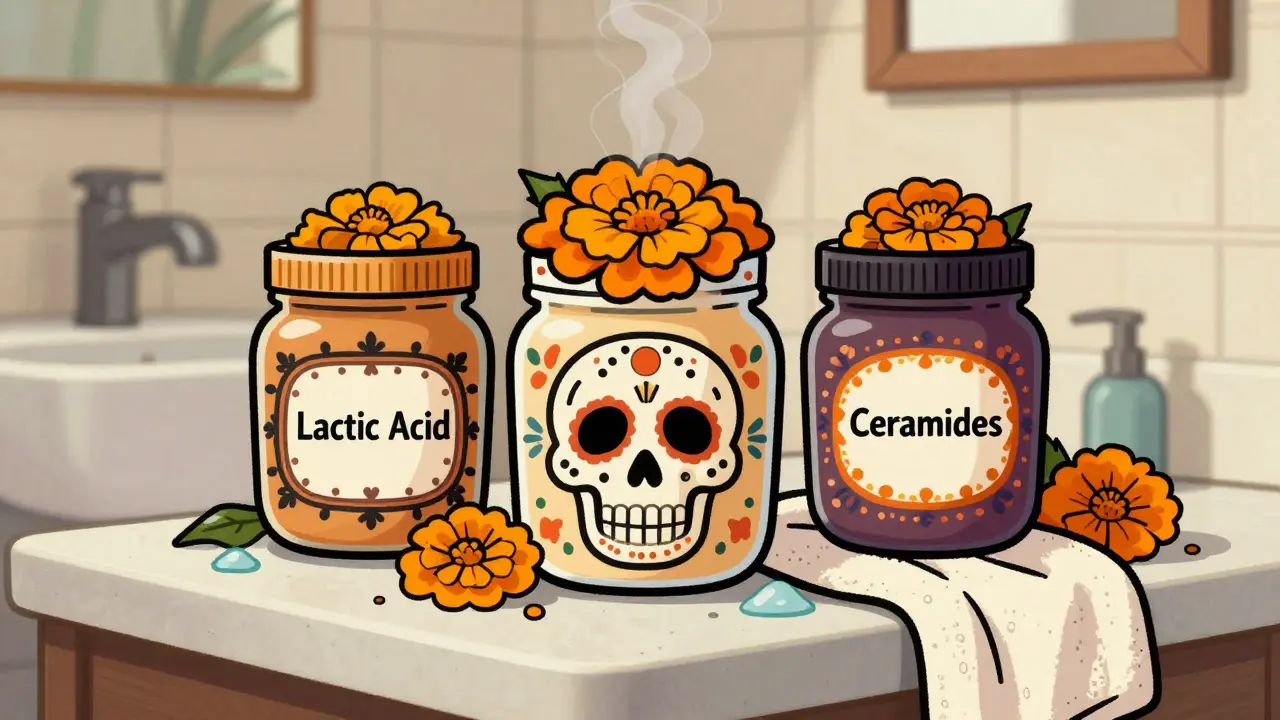
The Real Treatment: Hydration + Gentle Exfoliation
Doctors agree: the goal isn’t to remove KP. It’s to soften the bumps, smooth the texture, and keep the skin hydrated. That means two things: exfoliation and moisturizing. Not at the same time, though. You need to layer them.
Start with an exfoliant that contains one of these proven ingredients:
- Lactic acid (10-12%) - Breaks down the keratin plug. AmLactin (12% lactic acid) is the most studied. In one survey, 62% of users saw clear improvement after 8-12 weeks of daily use.
- Urea (10-20%) - Draws water into the skin and dissolves dead cells. CeraVe SA Lotion contains 10% urea and 3% salicylic acid. It’s one of the top-rated products, with 79% of reviewers saying it works best when applied right after showering.
- Glycolic acid (8-12%) - An alpha-hydroxy acid that gently removes surface cells. Paula’s Choice 8% AHA Lotion got 4.2/5 stars with 68% reporting visible smoothing in 4 weeks.
- Salicylic acid - A beta-hydroxy acid that works well on oily areas. It’s in CeraVe SA Lotion and some prescription formulas.
Apply your exfoliant once a day, preferably at night. That gives your skin time to repair without sun exposure. Then, within three minutes of applying it, slap on a thick moisturizer. Why? Because when your skin is damp, it absorbs products 50% better. Mayo Clinic says applying treatments to slightly wet skin right after a shower makes them work faster.
Look for moisturizers with ceramides. These are lipids your skin naturally makes-but KP patients don’t make enough. Ceramides rebuild your skin barrier. Brands like CeraVe, Eucerin, and Vanicream all have ceramide-rich lotions. They’re not fancy. They’re not expensive. But they work.
What About Retinoids and Lasers?
Prescription retinoids like tretinoin (0.025%-0.1%) can help. They speed up skin cell turnover and reduce keratin buildup. Studies show 70% of users see improvement-but it takes 3 to 6 months. And 40% of people can’t tolerate the initial burning, peeling, and redness. If you try it, start slow: once every other night, and only after moisturizing. Don’t rush it.
Laser therapy? Pulsed-dye lasers can reduce redness in inflammatory KP by 50-75% after 3-4 sessions. But it costs $300-$500 per session, and it’s not covered by insurance. The NHS and most public health systems won’t pay for it because long-term results aren’t proven. It’s a cosmetic option, not a medical one.
Real-Life Routine That Works
Here’s what a successful daily routine looks like:
- Shower with lukewarm water (not hot). Hot water strips your skin’s natural oils and makes KP worse. A 2023 study showed using cooler water reduces flare-ups by 45%.
- Pat skin dry-don’t rub. Leave it slightly damp.
- Apply exfoliant (lactic acid or urea) to affected areas. Use it every night.
- Within 3 minutes, apply a ceramide-rich moisturizer. Thick is better than thin.
- Wear loose cotton clothes. Tight fabrics rub and irritate. One study found 72% of people improved just by switching to looser clothing.
- Use a humidifier in your bedroom. Keeping indoor humidity between 40-50% cuts winter flare-ups by 60%.
Stick with it for 8-12 weeks. You won’t see results in 3 days. But if you do this every day, you’ll notice smoother skin. Not perfect. Not flawless. But noticeably better.

What to Expect Long-Term
Most people think KP will vanish. It won’t. But it can become barely noticeable. A 2023 study of over 2,000 patients found that only 28% cleared completely by age 30. 41% had major improvement. 31% still needed regular care. That’s normal. KP is like high blood pressure-you manage it, you don’t cure it.
And here’s the hard truth: 84% of people say they’re tired of the daily routine. It’s boring. It’s repetitive. But if you stop, the bumps come back in 2-4 weeks. That’s why consistency beats intensity. You don’t need to do everything. Just do the basics every day.
Market and Misleading Claims
The KP treatment market is worth over $1.2 billion. And a lot of it is hype. The FDA issued 17 warning letters in 2022-2023 to companies claiming their products could "cure" KP. There’s no cure. Not yet. Products like AmLactin and CeraVe SA Lotion dominate sales because they’re backed by science, not ads.
New developments are coming. Liposomal lactic acid (encapsulated to reduce irritation) is showing better results. LED light devices cleared by the FDA in 2023 are helping reduce follicular plugging. And genetic testing for filaggrin mutations might one day help personalize treatment. But for now, stick with the proven: exfoliate gently, moisturize deeply, and be patient.
Frequently Asked Questions
Is keratosis pilaris contagious?
No. Keratosis pilaris is not contagious. It’s a genetic skin condition caused by keratin buildup in hair follicles. You can’t catch it from touching someone’s skin or sharing towels.
Can keratosis pilaris go away on its own?
Yes, for many people. About 28% clear completely by age 30. Most see improvement during their late teens and 20s. But for about a third of adults, it persists. Even if it fades, it can come back if you stop skincare routines.
Why does KP get worse in winter?
Dry air lowers skin hydration, making keratin plugs harder and more visible. When humidity drops below 40%, your skin loses moisture faster. Using a humidifier and moisturizing more often during winter helps prevent flare-ups.
Should I use a body scrub on my KP?
No. Harsh scrubs irritate the skin and can cause inflammation or dark spots. KP is not dirt-it’s a plug of keratin. Gentle chemical exfoliants (like lactic acid or urea) work better without damaging the skin.
How long until I see results from treatment?
Most people notice smoother skin after 4-6 weeks of daily use. Full improvement usually takes 8-12 weeks. Retinoids may take 3-6 months. Consistency matters more than intensity.
Can I use KP treatments on my face?
Yes, but with caution. Facial skin is thinner and more sensitive. Use lower concentrations (5-8% lactic acid or 5% urea) and apply less frequently. Avoid retinoids on the face unless directed by a dermatologist.



man i thought i was the only one with this chicken skin thing on my arms
used a scrub for weeks and it just got worse
just started using amlactin last month and honestly? my arms feel like silk now
no more embarrassment in short sleeves
as someone from nigeria where humidity is always high, i never thought kp would be a problem for me until i moved to the u.s. for grad school
the dry winters here are brutal
but i learned something beautiful: skincare isn't just about looking good, it's about respecting your body's rhythm
consistency > perfection
and yes, i use ceramide cream every night like it's prayer
you're not broken, you're just adapting
the fundamental misunderstanding of keratosis pilaris lies in its conflation with dermatological pathology. it is not a disease state but a phenotypic expression of genetic variation in epidermal differentiation.
the keratin plug is not a defect, but a dysregulated homeostatic mechanism.
therefore, treatment should not aim for eradication but for modulation of the keratinization cascade.
the empirical success of lactic acid and urea lies not in chemical aggression, but in their ability to mimic natural desquamation processes.
this is not cosmetic. it is physiological reintegration.
lactic acid 12% + ceramides = game changer. no more exfoliating like you're sanding a deck.
apply to damp skin. 3-minute window. non-negotiable.
humidifier in bedroom. cotton tees. no hot showers.
if you're not seeing results in 6 weeks, you're not consistent. not the product.
so you're telling me i have to do skincare like it's a job?? 😭
but like... i just wanna wear a tank top without feeling like a lizard
fine. i'll try the amlactin. but if i have to do this for the rest of my life, i'm changing my name to 'keratin queen' 👑
i’ve been doing this for 12 years and i still get emotional when my arms feel smooth
it’s not vanity. it’s dignity.
you deserve to feel comfortable in your own skin
❤️ you’re not alone
stop wasting money on creams. just shave it off. problem solved. no more bumps. done.
why make it complicated? simple solution. you're overthinking it.
bro i tried everything
lactic acid
urea
retinoids
even that fancy german cream that cost 80 bucks
then one day i just stopped caring
and guess what? it got better
maybe it was the tea i started drinking
or the fact i stopped checking mirrors
or maybe the universe just said 'enough' 😂
point is: chill out. your skin has its own timeline
thank you for this incredibly thorough and compassionate breakdown. as a medical educator, i appreciate the evidence-based clarity and the emphasis on patient-centered management.
the inclusion of real-world data (62%, 79%, 45%) elevates this from anecdote to actionable protocol.
it's rare to see such a balanced synthesis of science and empathy.
well done.
why are we even talking about this? just wear long sleeves. problem solved. america is too soft.
my grandpa had it and he never complained. he worked in a steel mill. you think he cared about 'chicken skin'? nope.
get tough.
the thing no one says is that kp isn't really about the bumps
it's about the shame
the way you avoid mirrors
the way you pull your sleeves down in summer
the way you pretend you don't notice when someone stares
so yeah
lactic acid helps
but so does letting yourself be okay with being imperfect
^^^ this. i started saying it out loud: 'yeah, my arms look weird. so what?'
and somehow... it got better.
not because of the cream.
because i stopped hating them.