

Goldenseal and Metformin Interaction Risks for Blood Sugar Control

If you're taking metformin for type 2 diabetes and thinking about adding goldenseal for its "natural" benefits, you need to know this: goldenseal can mess with how well your medication works - and not in a good way.
What’s Actually Happening Between Goldenseal and Metformin?
Goldenseal isn’t just another herbal supplement. Its main active ingredient, berberine, is a powerful compound that affects how your body absorbs drugs. Metformin, the most common first-line treatment for type 2 diabetes, relies on specific transporters in your gut to get into your bloodstream. Goldenseal blocks those same transporters - specifically, organic cation transporter 1 (OCT1). That means less metformin gets absorbed.
A 2025 clinical trial published in Clinical and Translational Science showed that when people took goldenseal along with low to moderate doses of metformin (500-1500 mg per day), their metformin levels dropped by up to 25%. That’s not a small change. It’s enough to make your blood sugar harder to control. The effect was strongest at lower doses and disappeared at higher doses (2000 mg+), likely because the transporters became saturated and couldn’t be blocked as easily.
Here’s the catch: your body didn’t start clearing metformin faster. The drug wasn’t broken down or flushed out. It just didn’t get in the door in the first place. That’s why your blood sugar might suddenly spike - not because your diabetes is getting worse, but because your medication isn’t doing its job.
Why This Isn’t Just About Lowered Metformin Levels
Here’s where it gets confusing. The same 2025 study found that even though metformin levels dropped, participants’ HbA1c - a measure of long-term blood sugar control - actually improved slightly, from 6.8% to 6.5%. That doesn’t make sense if metformin was working less.
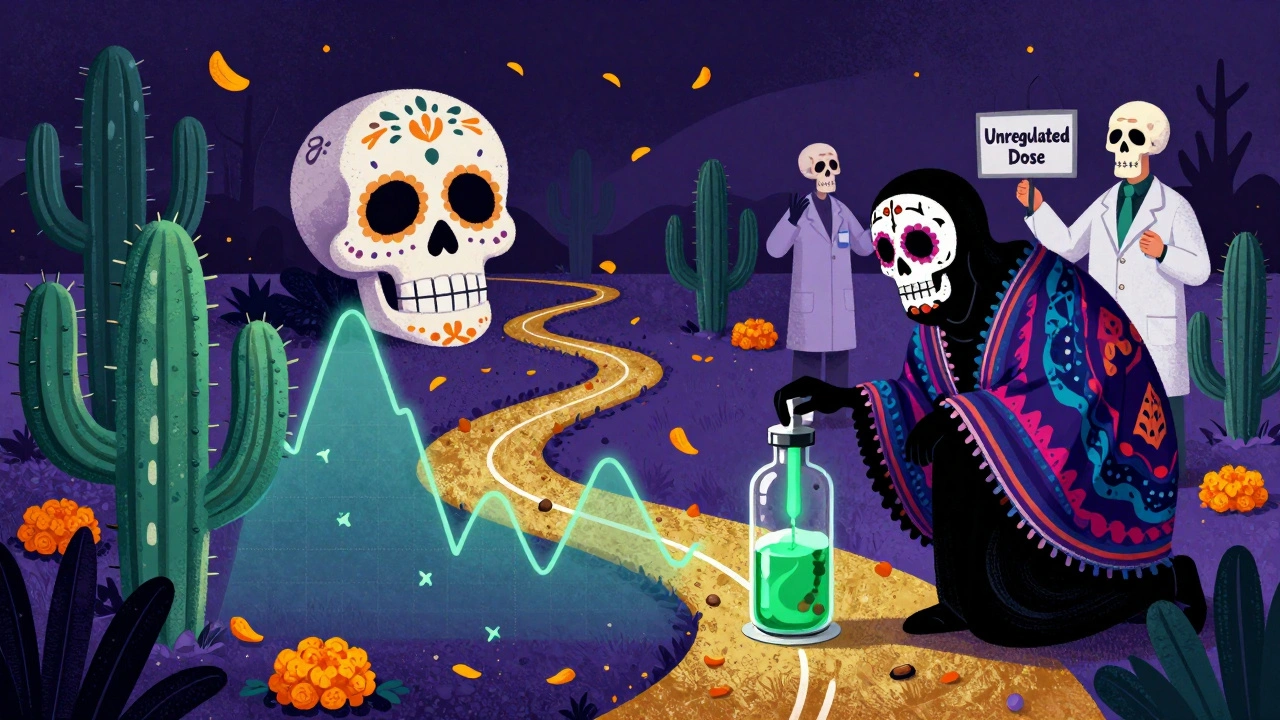
The reason? Berberine, the active part of goldenseal, also lowers blood sugar. In fact, studies show it can reduce fasting glucose and HbA1c almost as well as metformin in some cases. So while your metformin is being blocked, berberine is stepping in to help. That creates a dangerous illusion: your numbers look okay, so you think everything’s fine. But you’re not getting the full benefit of your prescribed treatment. You’re relying on a supplement with unpredictable dosing, inconsistent quality, and no regulatory oversight.
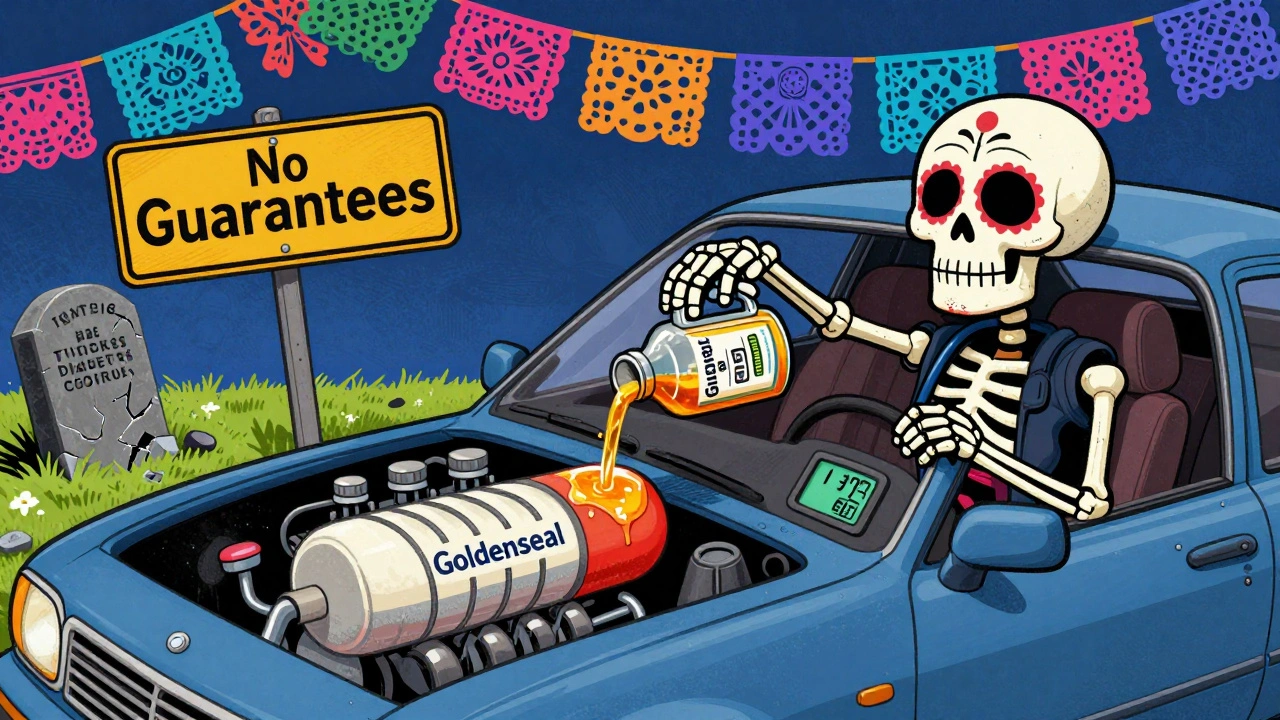
Imagine driving a car with half the fuel in the tank - but someone keeps adding sugar water to the gas tank to keep it running. It might seem like it’s working, but you’re not getting the performance or safety you paid for.
What the Experts Are Saying
The MSD Manual Professional Edition (2024) clearly warns: “Goldenseal may decrease the blood levels of metformin, potentially hindering glucose control.” At the same time, it adds that berberine “may also increase the hypoglycemic effects of antihyperglycemic drugs.” So you’re caught between two risks: your metformin might not work well enough, or you could end up with dangerously low blood sugar if berberine overpowers the system.
The Merck Manual Consumer Version (2024) backs this up, noting that berberine has real glucose-lowering power - but its effects fade after 90 days and are weaker in people over 60. That means if you’ve been taking goldenseal for months, you might think it’s helping, but it’s actually losing steam - while your metformin is still being blocked.
And you’re not alone. About 35-40% of people with diabetes use herbal supplements, according to a 2022 study in Diabetes Care. Goldenseal is one of the top 20 most popular herbs in the U.S., even though it’s endangered in the wild and often sold in unregulated, inconsistent doses. One capsule might have 100 mg of berberine. Another might have 500 mg. There’s no way to know.
Who’s at the Highest Risk?
If you’re taking metformin at a low dose - 500 to 1000 mg per day - you’re most vulnerable. That’s when the interaction is strongest. People who’ve just started metformin, or who’ve had their dose lowered after side effects, are especially at risk.
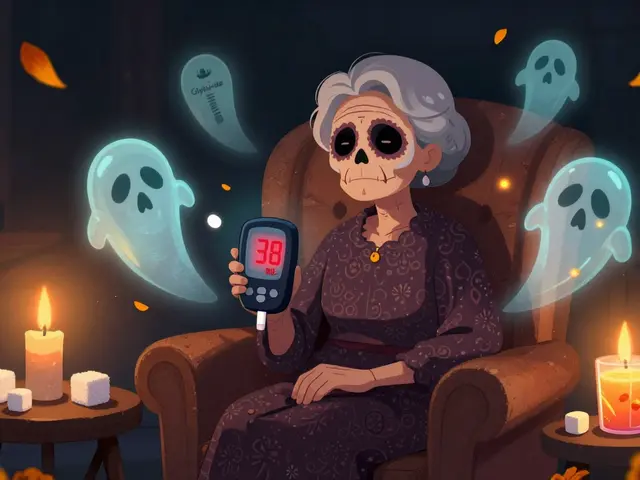
Older adults are another high-risk group. Berberine’s blood sugar-lowering effect weakens with age, so you’re more likely to lose metformin’s benefit without gaining enough from goldenseal. If you’re over 60 and taking both, your blood sugar could drift up without warning.
And if you’ve ever had an unexplained rise in fasting glucose or HbA1c - even if you’ve been “doing everything right” - goldenseal might be the hidden cause. Many doctors don’t ask about herbal supplements. They assume you’re only taking prescriptions. But if your numbers suddenly go off track, ask yourself: have you started a new supplement?
What Should You Do?
Stop taking goldenseal if you’re on metformin. That’s the safest choice. Not because berberine is dangerous - it’s not. But because mixing it with metformin turns your diabetes management into a guessing game.
If you’re using goldenseal for blood sugar control, talk to your doctor about switching to a standardized berberine supplement. These are available in consistent doses (usually 500 mg, two to three times daily), are better studied, and don’t come with the other unknown compounds in goldenseal root. But even then - don’t add it without medical supervision.
And if you’re not taking goldenseal but are considering it - don’t. There’s no benefit worth the risk. You’re already on a proven, effective medication. Adding an unregulated herb doesn’t make it better. It makes it unpredictable.
What About Other Herbal Supplements?
Goldenseal isn’t the only one. St. John’s wort, ginseng, bitter melon, and fenugreek can all interact with diabetes medications. Some raise blood sugar. Some lower it too much. Some interfere with how your body processes the drug.
The American Diabetes Association’s 2024 guidelines say you should tell your doctor about all supplements you take - not just the ones you think are harmless. The Endocrine Society says the same thing: herbal products and diabetes meds can interact in ways you can’t predict.
Don’t assume “natural” means safe. Natural doesn’t mean tested. Natural doesn’t mean regulated. Natural doesn’t mean it won’t mess with your prescription.
Bottom Line: Don’t Risk It
You’re managing type 2 diabetes with a medication that’s been studied for decades, used by over 150 million people, and proven to save lives. Goldenseal is a plant root with no standardization, no FDA oversight, and a documented history of interfering with your drug’s absorption.
Even if your blood sugar looks fine, you’re not getting the full benefit of your treatment. You’re relying on luck - and that’s not a strategy for long-term health.
If you’re using goldenseal, stop. Talk to your doctor. Get your blood sugar checked. And never add another supplement without checking for interactions first. Your pancreas, your kidneys, and your future self will thank you.
Can I take goldenseal with metformin if I lower my dose?
No. Lowering your metformin dose won’t fix the interaction - it makes it worse. At lower doses, goldenseal blocks up to 25% of metformin absorption. Reducing your dose further means even less medication gets into your system, increasing your risk of high blood sugar. The interaction is strongest at low doses, so adjusting your dose won’t help.
Does berberine alone cause the same interaction?
Yes. Berberine is the active compound in goldenseal that blocks metformin absorption. So whether you take goldenseal root or a purified berberine supplement, the interaction is the same. Standardized berberine supplements are more predictable in dosage, but they still interfere with metformin. Always talk to your doctor before combining them.
Why did HbA1c improve in the study if metformin levels dropped?
Berberine, the compound in goldenseal, also lowers blood sugar on its own. In the study, it likely compensated for the reduced metformin absorption, keeping HbA1c stable or even improving it. But that doesn’t mean it’s safe. You’re getting unpredictable results from an unregulated supplement, and your body’s response can change over time - especially as you age or if your diabetes progresses.
Is it safe to take goldenseal and metformin at different times of day?
No. The interaction happens in your intestines during absorption - not in your bloodstream. Taking them hours apart won’t help. Goldenseal affects the transporters in your gut that metformin needs to enter your body. Even if you take them 12 hours apart, those transporters are still blocked. The only safe option is to avoid goldenseal entirely while on metformin.
What should I do if I’ve been taking goldenseal and my blood sugar is rising?
Stop taking goldenseal immediately. Contact your doctor and ask for a blood test to check your metformin levels and HbA1c. Your doctor may need to adjust your metformin dose - especially if you were taking it at a lower dose (500-1500 mg). Don’t wait for symptoms like extreme thirst or fatigue. Rising blood sugar can damage your nerves, kidneys, and heart over time.
Are there safer herbal alternatives to goldenseal for blood sugar?
There’s no herbal supplement proven to be both safe and effective as a replacement for metformin. Some, like cinnamon or chromium, have weak effects and aren’t reliable. If you want to support your blood sugar naturally, focus on diet, movement, sleep, and stress management - all proven tools backed by decades of research. Supplements should never replace your prescribed medication.


omg i just started goldenseal last week 😅 hope i didnt mess up my metformin
This isn't even close to being the weirdest interaction I've seen. I once had a patient take turmeric with warfarin and wonder why their INR went through the roof. Natural doesn't mean safe. It just means no one's sued the manufacturer yet.
People treat herbs like they're vitamins - like a little sprinkle of chamomile won't hurt. But berberine? That's a pharmacologically active compound with a half-life, receptor binding, and transporter interference. It's not tea. It's a drug. And you wouldn't take two drugs without checking interactions. Why treat herbs differently?
So let me get this straight... you're telling me the same compound that makes goldenseal dangerous is also the reason people buy it? That's like saying 'this battery explodes but also powers your phone really well' and then shrugging.
Classic. We want the magic without the consequences. Until the consequences show up in the ER.
The real tragedy here isn't the interaction - it's the assumption that if something works, it must be safe. We've been here before with ephedra, with kava, with aristolochic acid. People see a drop in HbA1c and declare victory. But medicine isn't about short-term numbers. It's about long-term integrity. You're not just managing glucose - you're managing your liver, your kidneys, your cardiovascular system. And you can't out-supplement poor biology.
Herbs aren't the enemy. But treating them like they're exempt from pharmacology? That's the real danger.
I feel you. I took goldenseal for 'immune support' during flu season and my fasting sugars went from 98 to 142 in two weeks. My endo was like 'did you start anything new?' and I was like 'uhhh... maybe?'
Turns out I was the 37% of diabetics who think 'natural' means 'harmless'.
Now I just eat more veggies and walk after dinner. Who knew the simplest things were the most powerful?
The fact that berberine can mimic metformin’s effect is fascinating - and terrifying. It’s like your body’s trying to self-correct with a blunt instrument. But without standardization, you’re playing Russian roulette with your pancreas. One capsule might be 100mg. Another might be 500mg. And you won’t know until your glucose spikes or crashes.
There’s no such thing as 'natural medicine' - only medicine that hasn’t been regulated yet. And regulation isn’t the enemy. It’s the safety net.
LMAO why do americans think they can outsmart science with plant juice? 🤡
Take your metformin. Stop drinking dirt tea. We have real medicine for a reason. If you want to be a guinea pig, go to China - they’ve got clinical trials for this stuff. Not here. Not with my tax dollars funding your 'wellness' delusion.
I just deleted all my goldenseal capsules. Like, I literally threw them in the trash and cried. Not because I was sad - because I realized I’d been treating my diabetes like a Pinterest project. 'Add turmeric, drink apple cider vinegar, take goldenseal' - like it’s a smoothie recipe.
My HbA1c was 7.2. Now it’s 6.4. And I didn’t take a single herb. I just slept. And walked. And stopped pretending I could hack biology.
In India we use neem and bitter gourd for years - no problem. Why is goldenseal suddenly dangerous? You westerners overthink everything. Berberine is just another herb. If it works, use it. If it doesn’t, stop. Simple.
I mean... I get it. But honestly? If you’re taking metformin and still using 'natural remedies', you’re probably the kind of person who also buys essential oils for 'anxiety' and thinks yoga will cure your hypertension. It’s not that this interaction is dangerous - it’s that you’re the kind of person who needs to be told this in the first place.
I’m not saying this is wrong... but I’m also not saying it’s right. I’m just... sitting here. Thinking. Wondering if the fact that your HbA1c improved means you’re *actually* getting better - or just being lied to by a plant root that’s better at marketing than medicine. It’s not a black-and-white issue. It’s a gray, messy, emotionally charged, culturally loaded, pharmaco-botanical nightmare. And I don’t know what to believe anymore.
I’ve been on metformin for 12 years. I’ve never taken goldenseal. But I’ve seen friends do it. And every single one of them said, 'It helped my sugar!' - until they didn’t. Until their numbers started creeping up. Until they got a call from their doctor saying 'your kidneys are stressed' or 'your A1c jumped 0.8%' and they had no idea why.
It’s not about fear. It’s about awareness. You don’t need to demonize herbs. You just need to understand that your body doesn’t care if something is 'natural' or 'synthetic'. It only cares about dose, timing, and interaction. And if you don’t know those? You’re flying blind.
If you're taking goldenseal and metformin, stop. Not because I said so. Not because some study said so. But because your body deserves better than guesswork. You're not a lab rat. You're not a TikTok trend. You're a person managing a chronic condition - and that deserves science, not superstition.
And if you're thinking about starting it? Don't. There's no benefit that outweighs the risk. Not even a little bit.
And if you already did? Talk to your doctor. Get tested. And then go make yourself a cup of tea. The kind without berberine.
The medical community must prioritize patient education over commercial interests. Herbal supplements are marketed aggressively with misleading claims. Patients are not equipped to evaluate pharmacological interactions. This is not a personal choice issue. It is a systemic failure in public health communication. Standardized berberine supplements should be regulated as pharmaceuticals. Until then, the only ethical advice is avoidance. Your life is not a supplement experiment.