

Generic Drug Absorption Rates: What the 80-125% Rule Really Means
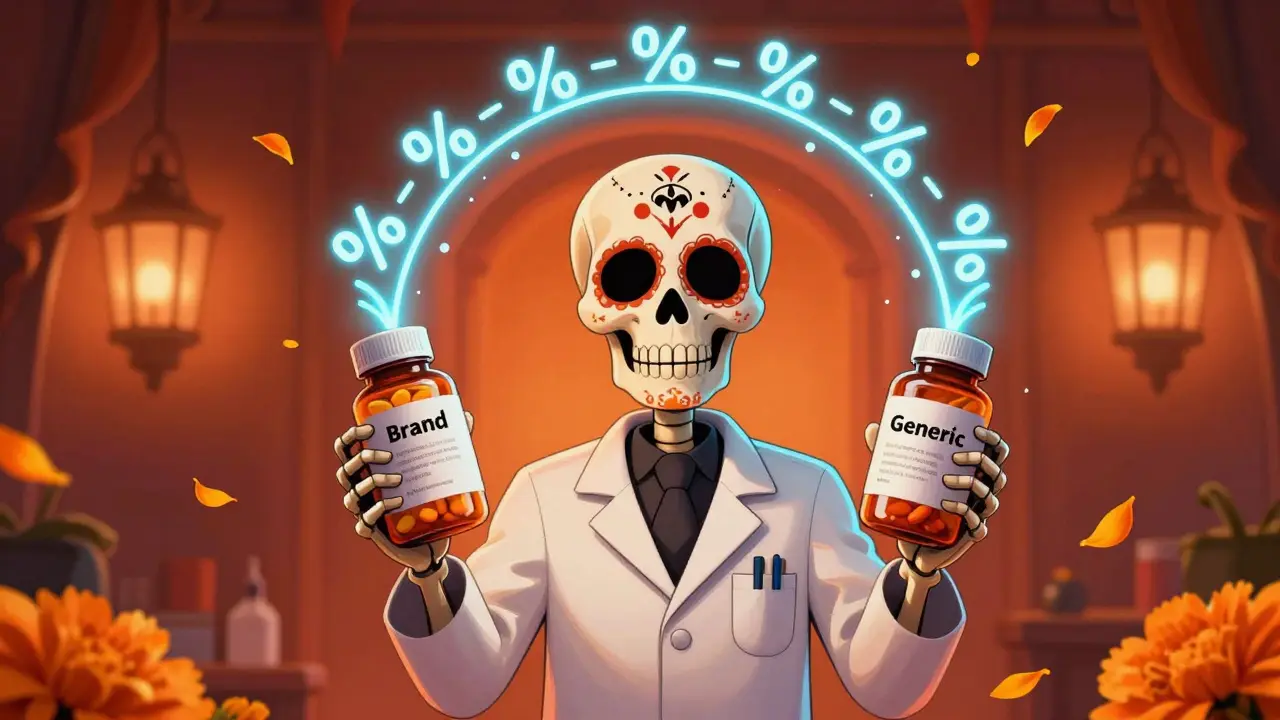
When you pick up a prescription and see a generic version instead of the brand-name drug, you might wonder: is it really the same? A lot of people think the 80-125% rule means generic drugs can have anywhere from 20% less to 25% more of the active ingredient than the brand. That’s not true. And this misunderstanding is why so many patients and even some healthcare providers still hesitate to use generics. The truth is simpler-and more reassuring-than the myth suggests.
What the 80-125% Rule Actually Measures
The 80-125% rule isn’t about how much drug is in the pill. It’s about how fast and how much of that drug gets into your bloodstream. This is called bioavailability. The FDA uses this range to decide if a generic drug performs the same way as the brand-name version. The goal? Make sure you get the same clinical effect-whether you take the brand or the generic.
Here’s how it works: in a bioequivalence study, healthy volunteers take both the brand and generic versions, and researchers measure two things: the total amount of drug absorbed over time (called AUC) and how quickly it peaks in the blood (called Cmax). These numbers are compared using a statistical method that logs the data. Why? Because drug absorption doesn’t follow a straight line-it’s more like a curve that’s naturally skewed. Taking the logarithm makes the math work properly.
The 80-125% range comes from this log scale. A difference of ±20% on the log scale equals 80% on the low end and 125% on the high end. That’s why it’s not 80-120%. It’s math, not magic.
It’s Not a Point Estimate-It’s a Confidence Interval
Here’s where most people get tripped up. The rule doesn’t say the average absorption just needs to fall between 80% and 125%. It requires that the 90% confidence interval of the ratio falls entirely within that range. That’s a much stricter test.
Let’s say the brand drug’s average AUC is 100 units. A generic might have an average of 90 units. That’s a 10% difference. But if the data shows the true average could be anywhere from 83 to 97 (the 90% CI), then it passes. Why? Because 83-97 is fully inside 80-125.
But if the average is 85 and the 90% CI is 78-92? It fails. Even though 85 looks close to 100, the lower end dips below 80. That means there’s a real chance the drug might not work the same for some people. The FDA won’t approve it.
Real data backs this up. Between 2008 and 2012, the FDA reviewed over 2,000 bioequivalence studies. In 98% of cases, the actual average absorption of generics was between 95% and 105% of the brand. That’s way tighter than 80-125%. The rule is designed to catch outliers, not to allow wide variation.
What About Safety and Effectiveness?
Some worry: if generics are allowed to vary, could they be less effective? Or cause more side effects?
A 2016 study in JAMA Internal Medicine looked at 2 million patient records for heart medications. Researchers compared outcomes between patients taking brand-name drugs and those taking generics. There was no meaningful difference in hospitalizations, heart attacks, or deaths. The same study found no increase in adverse events with generics.
The FDA’s Sentinel Initiative, which tracks 200 million patient records, confirmed this. Between 2015 and 2020, 94% of generic drugs showed no difference in safety compared to their brand-name counterparts.
Even more telling: a 2022 analysis of 828 approved generics found that the average difference in absorption was just 3.5%. That’s less than the natural variation your body has from day to day.

Where the Rule Doesn’t Apply
Not all drugs follow the 80-125% rule. For drugs with a narrow therapeutic index-where even small changes can be dangerous-the FDA uses tighter standards.
Examples: warfarin (a blood thinner), levothyroxine (for thyroid conditions), and some anti-seizure drugs. For these, the acceptable range is 90-111%. That’s a 21% window instead of 45%. The FDA introduced this stricter standard in 2019 after reviewing cases where switching generics led to unstable drug levels.
Even then, these drugs are still generics. They’re just held to a higher bar. The system works: patients on levothyroxine generics have the same thyroid levels as those on the brand, as long as they stay on the same generic formulation.
Why This Rule Exists
The 80-125% rule didn’t come from guesswork. It was built on decades of data, expert consensus, and statistical modeling. Before the 1984 Hatch-Waxman Act, generic drugs had no clear path to approval. The FDA needed a way to ensure safety without requiring expensive clinical trials for every single generic.
The 80-125% range was chosen because it represents a threshold where differences are unlikely to affect treatment outcomes. It’s not arbitrary-it’s based on how much variation the human body can naturally handle without losing therapeutic effect.
International regulators agree. The European Medicines Agency (EMA), Health Canada, and Australia all use the same 80-125% rule with a 90% CI. It’s the global standard.
What About Complex Drugs?
Not all drugs are pills you swallow. Some are inhalers, creams, eye drops, or injectables. For these, measuring blood levels doesn’t always tell the whole story.
For example, a generic inhaler might deliver the same dose of drug-but if the spray pattern or particle size is different, it might not reach the lungs the same way. The FDA is working on new methods for these complex products. In 2023, they released draft guidance for over 1,600 specific drugs with tailored testing rules.
But for the vast majority of pills and capsules-over 90% of all generics-the 80-125% rule with 90% CI is still the gold standard.

Why the Misconception Persists
Why do so many people think generics can be 25% weaker or stronger? Partly because the numbers sound like they’re about dosage. “80-125%” sounds like a range of drug content. But it’s not. It’s about absorption.
Pharmacists report explaining this to patients weekly. A 2020 survey found that 63% of patients changed their minds after a clear explanation. The FDA’s #GenericsWork campaign reached over 1.2 million people in 2021, helping clear up confusion.
Still, myths linger. On Reddit and pharmacy forums, you’ll still find posts claiming generics are “weaker.” Those posts often come from people who don’t know how the testing works.
The Bigger Picture: Cost and Access
Generics aren’t just safer than people think-they’re essential. In 2021, generics made up 90% of U.S. prescriptions but only 23% of drug spending. They saved the system $373 billion that year.
Without the 80-125% rule, generics wouldn’t be approved efficiently. Companies wouldn’t invest in making them. Patients would pay more. And access to life-saving drugs would shrink.
Pharmacists prescribe generics as the first choice in 97% of cases. Only 1.2% of prescribers choose brand over generic due to safety concerns. That’s a tiny fraction-and most of them are based on outdated beliefs.
Final Takeaway
The 80-125% rule isn’t a loophole. It’s a carefully designed safety net. It doesn’t allow generics to be weaker or stronger. It ensures they behave the same way in your body.
If you’ve been avoiding generics because of this myth, it’s time to reconsider. The science is solid. The data is clear. And the savings? Massive.
When your doctor prescribes a generic, you’re not getting a cheaper version. You’re getting the same medicine-backed by the same science, tested with the same rigor, and proven to work just as well.





The 80-125% rule is one of those things that sounds scary until you actually understand the math behind it. I work in pharmacy, and I’ve had patients refuse generics because they thought they were ‘weaker’-until I walked them through bioavailability curves and confidence intervals. Once they saw that the real-world data shows 95-105% average absorption, their anxiety just melted. It’s not magic-it’s statistics. And honestly? It’s one of the most rigorously tested systems in medicine.
Let’s be honest-this whole ‘bioequivalence’ framework is a carefully constructed illusion. The FDA doesn’t test for long-term effects, only acute plasma levels. What about metabolites? What about gut microbiome interactions? What about epigenetic impacts over years? We’re told ‘it’s the same,’ but the truth is, we’ve never done longitudinal studies comparing brand vs. generic outcomes across populations. Someone’s making money off this myth. And I’m not buying it.
Okay but like… what if your generic makes you feel weird? 😩 I switched from my brand-name blood pressure med to the generic and suddenly I was dizzy, nauseous, and crying in the shower for no reason. My doctor said ‘it’s all in your head’-but I KNOW my body. And now I’m stuck paying $400/month because I refuse to risk it again. This isn’t science-it’s corporate gaslighting. 💔
I appreciate the thorough breakdown. The 90% confidence interval detail is crucial-and often omitted in public discourse. I’ve seen too many patients panic over the ‘80-125%’ headline without understanding that it’s a statistical boundary, not a target range. The fact that 98% of generics fall within 95-105% should be shouted from the rooftops. Thank you for clarifying this with data-not opinion.
Let me enlighten you all with some context that this post conveniently omits: the 80-125% rule was designed during the Reagan era, when pharmaceutical deregulation was the gospel. The Hatch-Waxman Act wasn’t about patient safety-it was about corporate profit margins. The FDA’s ‘rigorous testing’ is a myth propagated by lobbyists. Have you ever read the actual bioequivalence protocols? They use healthy young males in controlled environments. Real patients? Diabetics? Elderly with renal impairment? Those populations are never tested. And yet, we prescribe generics to them en masse. This isn’t science. It’s capitalism masquerading as public health. The system is broken. And yes, I’ve published peer-reviewed papers on this.
Bro, you’re overthinking this. People have been taking generics for 40 years. My grandma took generic lisinopril for 12 years and lived to 94. The body adapts. The math is clean. If you’re worried about 3.5% variation, you’re probably the same person who refuses tap water because it’s not ‘pure enough.’ Chill. The system works. Stop overanalyzing and take your pill.
Oh wow. So the FDA uses logarithms… and *gasp*… statistics?! Who would’ve thought? 🤡 Let me get this straight: you’re telling me that a government agency, funded by taxpayers, with decades of peer-reviewed research and global consensus… actually did their job? And it’s not a conspiracy? I’m shocked. Truly. Next you’ll tell me vaccines work and the sky is blue. 😏
Okay, so I just read this whole thing, and I’m crying. Not because I’m sad-because I’m emotional. This is the most beautiful, nuanced, science-backed explanation I’ve ever seen. I used to be terrified of generics. I thought they were ‘fake medicine.’ Now I get it. The 90% CI thing? The 3.5% average difference? The fact that it’s the SAME STANDARD IN EUROPE AND CANADA? I feel like I’ve been given a gift. I’m going to tell my entire family. I’m going to post this on Facebook. I’m going to thank you. This isn’t just information-it’s liberation.
Wait-so you’re saying the FDA tests with healthy young men? That’s exactly what I’m talking about! I’m a 68-year-old woman with kidney issues. My body doesn’t process drugs like a 25-year-old lab rat. So when my generic made me dizzy, it wasn’t ‘all in my head’-it was the system failing people like me. I’m not anti-generic. I’m anti-one-size-fits-all.