

Dangerous Medical Abbreviations That Can Cause Deadly Prescribing Errors
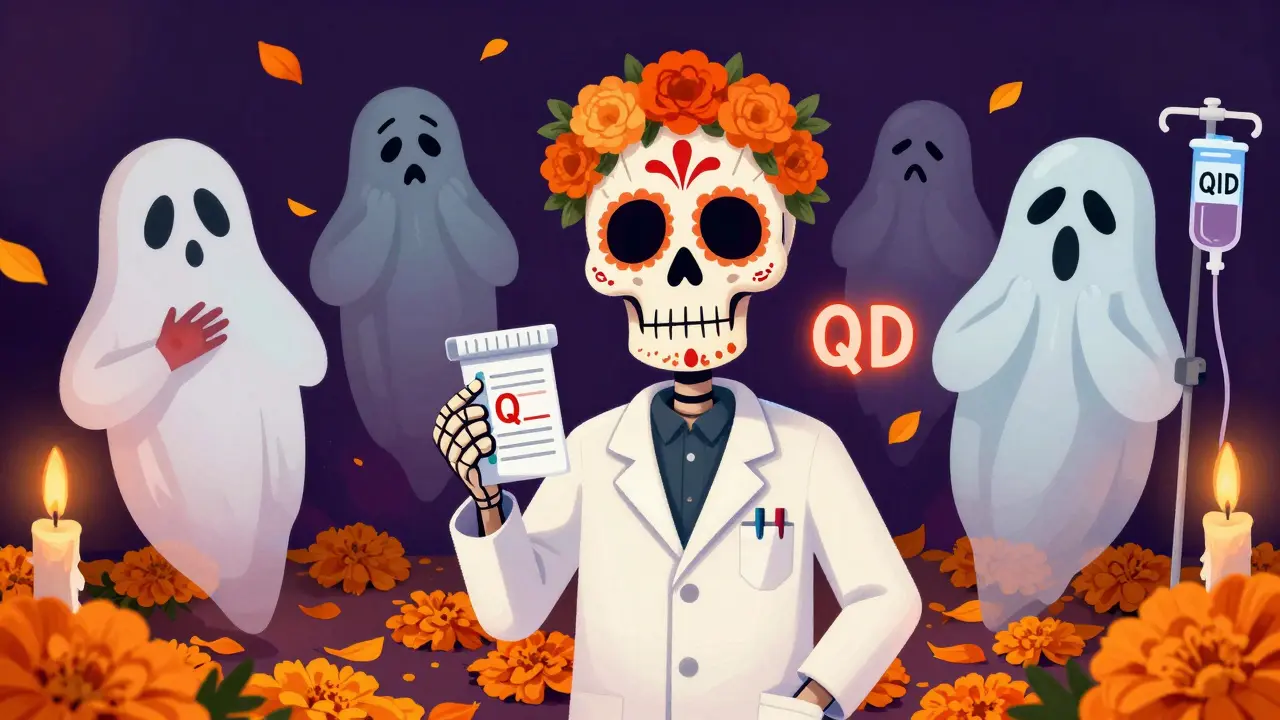
One wrong letter on a prescription can kill someone. It’s not science fiction. It’s happening right now in hospitals, clinics, and pharmacies across the country. A simple QD-meant to mean "once daily"-can be misread as "QID," leading to a patient getting four times the dose. A scribbled MS could be mistaken for MgSO4, causing someone to get magnesium instead of morphine. These aren’t hypotheticals. They’re real errors that have led to deaths, ICU stays, and lifelong harm.
Why These Abbreviations Are So Dangerous
Medical abbreviations weren’t created to confuse. They were meant to save time. But when handwriting is messy, or a screen displays a poorly formatted order, or a pharmacist is rushing between calls, those shortcuts become traps. The Joint Commission and the Institute for Safe Medication Practices (ISMP) have spent decades collecting data on this. Their findings are chilling: abbreviations like QD, U, and MS are behind nearly half of all preventable medication errors linked to prescribing.Take QD. It looks harmless. But in handwritten orders, the "D" can look like an "I," turning "once daily" into "four times daily." A 2018 ISMP analysis of over 4,700 error reports found that QD was involved in 43% of all abbreviation-related mistakes. That’s more than any other single abbreviation. Patients on blood thinners, diabetes meds, or chemotherapy got too much because someone read "QD" as "QID."
Then there’s U for "units." It’s tiny. Easy to scribble. But it looks just like a "0," a "4," or even a "cc." A diabetic patient was once given 100 units of insulin because the "U" was mistaken for "100." Another patient got 50 units instead of 5 because the "U" was read as "50." Both nearly died. Even worse, IU (international unit) gets confused with IV (intravenous). That’s not just a mix-up-it’s a route error. Giving a drug intravenously instead of orally can be fatal.
The Most Common Killer Abbreviations
Here are the top five dangerous abbreviations still showing up on prescriptions today-and what they should be replaced with:- QD → Write "daily"
- QOD → Write "every other day"
- U → Write "units"
- MS or MSO4 → Write "morphine sulfate"
- cc → Write "mL" (milliliters)
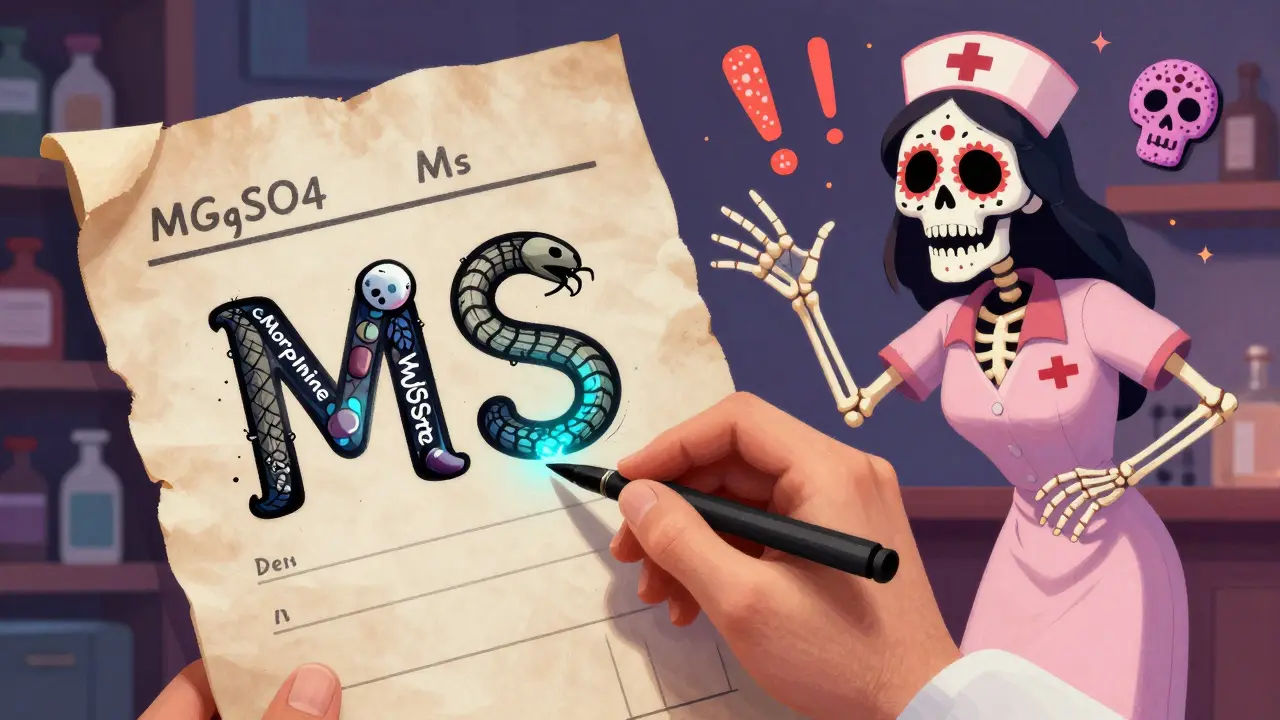
Let’s break down MS. It’s the most dangerous drug abbreviation on the list. Why? Because it’s identical in sound and appearance to MgSO4-magnesium sulfate. Morphine sulfate is a powerful opioid. Magnesium sulfate is used for seizures in preeclampsia or heart arrhythmias. Give the wrong one? You’re not just making a mistake-you’re risking respiratory arrest or cardiac arrest. A 2018 NCBI review found that MS was involved in over 1,200 reported errors in just five years. In one case, a nurse administered magnesium sulfate thinking it was morphine for pain. The patient stopped breathing and needed emergency intubation.
And then there’s TAC. Sounds like a brand name? It’s not. It’s supposed to mean triamcinolone, a steroid cream. But it looks just like Tazorac, a different acne medication. A patient got the wrong cream because the handwriting was unclear. Their skin condition got worse. Another example: DTO for diluted tincture of opium. Sounds obscure? It’s still used in some pain clinics. But it’s been confused with morphine sulfate-leading to double dosing. Patients overdosed. Some didn’t survive.
How Technology Makes It Worse (and Better)
You’d think electronic health records (EHRs) fixed this. They helped-big time. A 2021 study showed EHRs cut abbreviation errors by 68%. But here’s the catch: 12.7% of errors in EHR systems still came from abbreviations. Why? Because doctors still type free text. "Give MS 10 mg SC." The system doesn’t always flag it. Or worse, the dropdown menu has "MS" as a preset option because it’s been used for years.Some hospitals have fixed this. They’ve turned their EHRs into safety systems. When a prescriber types "QD," the system auto-corrects it to "daily" and pops up a warning: "Do not use QD. Use 'daily' instead." Some even block the order until it’s changed. At Mayo Clinic, this approach cut errors by 92% in under two years.
But not every clinic has that. Smaller practices, rural pharmacies, even some urgent care centers still rely on handwritten notes or outdated templates. And in those places, the old habits die hard.
Why Doctors Still Use Them
You’d think after 20+ years of warnings, everyone would stop. But they don’t. A 2022 survey by the American Medical Association found that 44% of physicians over 50 still use prohibited abbreviations. Why? Because that’s how they were trained. "QD" was taught in med school in the 90s. "U" was the shorthand everyone used. Changing feels like admitting you’re behind the times.And there’s pressure. Doctors are rushed. They’re juggling 30 patients a day. Typing out "every other day" takes three extra seconds. In a busy clinic, that’s three seconds they don’t have. So they reach for the old shortcut. It’s not laziness. It’s habit. And habit is hard to break without systems that make the right choice the only choice.
Younger doctors are better. Only 18% of those under 40 still use dangerous abbreviations. Why? Because they were trained in the EHR era. They learned from day one that "U" isn’t allowed. They’ve never had to write "QD" on a paper script. Their brains don’t have the same wiring.
What Pharmacies Are Doing to Catch These Errors
Pharmacists are the last line of defense. And they’re seeing it every day. The ASHP’s 2022 survey of 1,843 pharmacists found that 64% had intercepted a dangerous abbreviation error in the past year. The top three? QD, U, and MS.One pharmacist in Melbourne told me about a script that read "MS 5 mg IV." She called the doctor immediately. "This is morphine sulfate, right?" The doctor said yes. She replied, "Then why did you write IV? Morphine sulfate isn’t given intravenously unless it’s a hospital setting-and even then, it’s rare." The doctor realized he’d typed "MS" and meant "morphine sulfate," but accidentally clicked "IV" from a dropdown. He’d never noticed. The patient was supposed to get it orally. That mix-up could have killed them.
Many pharmacies now have "double-check" protocols for any order with an abbreviation. Some use automated alerts that flag anything with "U," "QD," or "MS" before the medication is even dispensed. Others require prescribers to sign off on a warning if they insist on using a banned term.
How to Protect Yourself
If you’re a patient, here’s what you can do:- Ask: "Is this written out fully?" If you see "QD," "U," or "MS," ask the pharmacist to confirm what it means.
- Check your prescription label. Does it say "daily" or "every other day"? If it says "QD," ask for clarification.
- If you’re on high-risk meds-like insulin, blood thinners, or opioids-double-check the dose and frequency with your pharmacist.
- Don’t assume the doctor wrote it right. Even the best doctors make mistakes.
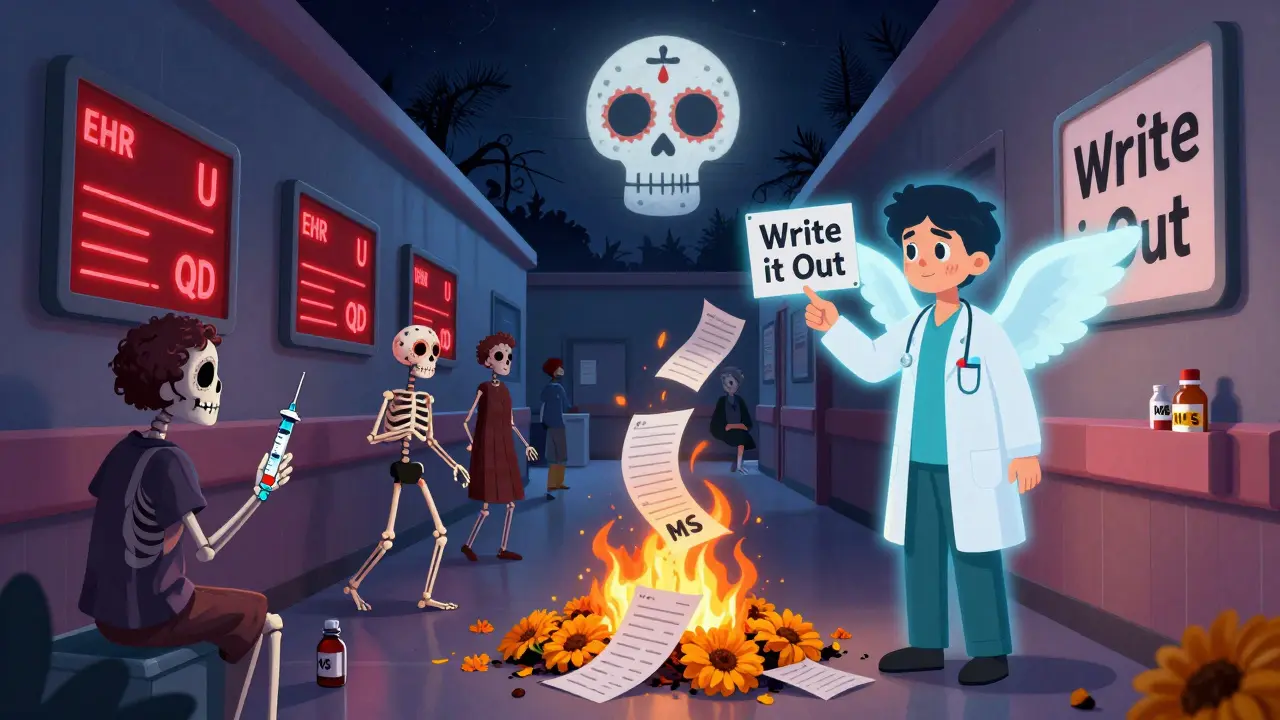
If you’re a prescriber or nurse: Stop using them. Period. Write out "daily," "every other day," "units," "morphine sulfate," "milliliters." It takes a second longer. But it saves lives.
And if you’re in charge of a clinic or hospital: Don’t just train staff. Build it into your system. Make the right thing the only thing. Block "QD" in your EHR. Force "daily" to appear. Turn off "U" and "cc" as options. Add pop-up warnings. Reward teams that catch errors. Make safety part of your culture-not just a policy on a shelf.
What’s Changing Now
The good news? Things are getting better. In January 2024, ISMP added 17 new abbreviations to its list-mostly from antiretroviral drugs like DOR, TAF, and TDF. Why? Because errors involving these drugs jumped 227% between 2019 and 2023. That’s the reality: as new drugs come out, new shortcuts appear. We have to keep updating the rules.AI is stepping in too. Epic Systems, one of the biggest EHR vendors, rolled out real-time abbreviation detection to 72% of its U.S. hospital clients by late 2023. The system now flags "MS" and suggests "morphine sulfate" before the order is finalized. By 2026, most voice-to-text systems will auto-correct "QD" to "daily" as you speak it.
But technology alone won’t fix this. The real fix is culture. It’s about choosing clarity over convenience. It’s about remembering that behind every abbreviation is a person who might not survive the mistake.
There’s no excuse anymore. We’ve known for over 20 years which abbreviations are deadly. We have the tools to stop them. What’s left is the will.
What’s the most dangerous medical abbreviation?
The most dangerous abbreviation is "QD" (once daily), which is frequently misread as "QID" (four times daily). It accounted for 43% of all abbreviation-related medication errors in a major ISMP analysis. Other top dangers include "U" for units (often mistaken for "0" or "4") and "MS" for morphine sulfate (confused with "MgSO4," magnesium sulfate).
Why can’t doctors just use "daily" instead of "QD"?
They can-and should. Many still use "QD" out of habit or because they were trained that way decades ago. Some think it saves time, but typing "daily" takes less than a second longer. The real barrier isn’t time-it’s culture. Hospitals that enforce full replacement with clear language see 90% fewer errors.
Is "U" for units really that risky?
Yes. "U" is one of the top three most dangerous abbreviations. It looks like "0," "4," or even "cc." A patient was once given 100 units of insulin because "U" was read as "100." Another got 50 units instead of 5 because the "U" was mistaken for "50." Both cases led to life-threatening low blood sugar. The fix? Always write "units."
What’s the difference between MS and MgSO4?
MS stands for morphine sulfate, a strong painkiller. MgSO4 is magnesium sulfate, used for seizures or heart rhythm problems. They sound similar and look almost identical in handwriting. Giving morphine instead of magnesium can cause respiratory failure. Giving magnesium instead of morphine can leave severe pain untreated. Confusing them has killed patients.
Are electronic prescriptions safer?
Yes-but not perfectly. EHRs cut abbreviation errors by 68%, but 12.7% of errors still happen because doctors type free text or use outdated templates. The safest systems block dangerous abbreviations entirely and force full words like "daily" or "units." If your clinic doesn’t do that, ask why.



Y’all need to stop treating doctors like they’re magic wizards who never make mistakes. I’ve seen my grandma nearly die because a nurse read "QD" as "QID" on her blood thinner. She ended up in the ER bleeding out. It wasn’t the doctor’s fault-it was the system. They let sloppy shortcuts live for decades. Now we’re acting like it’s shocking? No. It’s criminal. Write it out. Say "daily." Say "units." It’s not hard. It’s just human.
And if your EHR still lets you type "U"? Fire whoever programmed that. That’s not a bug-that’s a death sentence waiting to happen.
It is both tragic and profoundly irresponsible that, in the 21st century, we continue to tolerate the use of ambiguous, archaic, and dangerously imprecise medical shorthand in clinical practice. The Joint Commission has issued formal warnings since 2004, yet the persistence of "QD," "U," and "MS" reflects a systemic failure of professional accountability. This is not a matter of "habits"-it is a failure of ethics. Every physician who uses these abbreviations is complicit in potential harm. The fact that some still cling to them out of convenience reveals a disturbing prioritization of efficiency over patient safety. Such negligence cannot be excused by generational differences or time constraints. The standard of care is clear: clarity is non-negotiable. Anything less is malpractice by omission.
US hospitals are still letting doctors write QD like its 1998? Thats why we lose to Canada in health outcomes. No more excuses. Ban the letters. Force the words. Save lives. No debate.
Okay but what if this is all just a scare tactic by Big Pharma to sell you pricier EHR systems? Like… what if "MS" isn’t the problem? What if the problem is that doctors are overworked and underpaid? And now they’re blaming the letter M instead of the system that makes them rush? I’ve seen nurses cry because they have to chart 30 patients in 4 hours. This isn’t about abbreviations. This is about capitalism killing people with paperwork.
Oh look, another performative outrage piece from the medical-industrial complex. "QD" is dangerous? How quaint. The real danger is that we’ve turned healthcare into a compliance theater where doctors are forced to type out "daily" because some bureaucrat in a cubicle decided that "U" looks like a zero. Meanwhile, actual killers-antibiotic resistance, opioid overprescribing, insurance denials-go ignored because they don’t fit the neat little infographic. This is virtue signaling disguised as patient safety. Write out "units"? Cute. But you still won’t fix the fact that 60% of patients can’t afford their meds anyway. So why are we all pretending this is the hill to die on?
Also, "MS"? Please. If you can’t tell morphine from magnesium, maybe you shouldn’t be prescribing anything. That’s not an abbreviation problem. That’s a licensing problem.
qD is the worst but honestly i think its funny how people get mad about letters when the real issue is that doctors are burnt out and pharmacies are understaffed. i once got my insulin dose wrong because the script was smudged. not because of QD. because the ink ran. so yeah fix the system not the letters lol
The fixation on "QD" and "U" is a classic case of mistaking symptoms for causes. We’re not dealing with a linguistic problem-we’re dealing with an epistemological crisis in medical culture. The fact that these abbreviations persist reveals a deeper pathology: the normalization of ambiguity in life-or-death contexts. Language is not neutral. When we allow "MS" to stand in for "morphine sulfate," we are not saving time-we are outsourcing cognitive responsibility to the reader. This is not negligence. It is a form of symbolic violence. The solution isn’t just to replace letters with words-it’s to dismantle the entire infrastructure of haste that makes such shortcuts feel necessary in the first place. Until we address the temporal austerity of clinical practice, no amount of EHR pop-ups will matter. The system is the problem. The abbreviation is just its signature.
i get it safety matters but sometimes you just gotta trust the person behind the pen. i worked in a clinic where everyone knew each other. we used "U" for years. never had a problem. maybe its not about banning words but building trust and training. also i think we’re forgetting that most errors happen because of communication gaps, not letters. if your pharmacist calls you and says "this says MS" and you say "oh yeah morphine" then it’s fine. the tech helps but people still matter more
QD? U? MS? You think that’s the real danger? Nah. This is all a distraction. The real killer is AI-driven EHRs that auto-fill prescriptions based on patient history. They don’t care if you meant "daily"-they just grab the last dose you took and repeat it. I saw a guy get 1200mg of gabapentin because the system auto-populated "QD" from his old script. The doctor didn’t even look. The abbreviations are just the smoke. The fire is the algorithm that never sleeps and never asks questions.
Man I used to work ER. Saw a lady flatline because someone wrote "MS" and the nurse thought it was magnesium. She was 32. Had a 4-year-old. The doctor cried in the hallway. We all did. But here’s the kicker-two weeks later, same doc wrote "QD" again. No warning. No punishment. Just shrugged and said, "I’ve been doing it for 20 years." That’s the problem. Not the letters. The culture. The arrogance. The belief that you’re too experienced to mess up. That’s what kills people. Not QD. Not U. That mindset. And until we start firing people for this, not just "educating" them, it’s gonna keep happening. I’m not mad. I’m just done.
It is imperative that all healthcare institutions implement mandatory, standardized protocols that eliminate the use of ambiguous abbreviations in all forms of clinical documentation. The evidence is unequivocal: the use of "QD," "U," and "MS" constitutes a preventable and unacceptable risk to patient safety. Furthermore, it is the professional obligation of every prescriber to adhere to the guidelines established by the Institute for Safe Medication Practices and the Joint Commission. Compliance is not optional. It is foundational to the ethical practice of medicine. Institutions that fail to enforce these standards are not merely negligent-they are in violation of their fiduciary duty to protect human life.
You know what’s wild? The fact that we’re still talking about this in 2025. We’ve had the tools to fix this for 15 years. We know how to make systems that block "U" and auto-correct "QD." We’ve got the data. We’ve got the examples. We’ve got the stories. So why don’t we just… do it? It’s not about training doctors. It’s about designing the world so that the safe choice is the only choice. Like seatbelts. We didn’t convince people to wear them-we made it impossible not to. That’s what we need here. Not more lectures. Not more guilt. Just a system that says: "You can’t send this until you fix it." And then… it just works. No one has to think about it. No one has to be perfect. The machine does the right thing. And that’s how we save lives.
It’s not magic. It’s just engineering. And we’re really good at engineering. So why are we still letting people die because we’re too lazy to build the right button?