

Current Drug Shortages: Which Medications Are Scarce Today in 2026
Right now, getting the right medication isn’t just about having a prescription-it’s about whether that drug is even in stock. As of February 2026, more than 260 drugs are still in short supply across the United States, and for many patients, this isn’t a temporary inconvenience. It’s a life-threatening delay. The problem isn’t new, but it’s getting worse in some areas and showing no sign of slowing down. Hospitals, pharmacies, and doctors are scrambling to keep up, while patients are left wondering if their treatment will be interrupted. Here’s what’s actually running out, why it’s happening, and what’s being done about it.
What Drugs Are in Short Supply Right Now?
The most critical shortages aren’t random. They’re concentrated in drugs that are essential for survival, especially those used in emergency care, cancer treatment, and chronic disease management. According to the American Society of Health-System Pharmacists (ASHP), the top categories in shortage include:
- IV fluids - especially 5% Dextrose and 50% Dextrose injections. These are used for hydration, delivering medications, and managing blood sugar. The 5% Dextrose shortage started in February 2022 and isn’t expected to end until August 2025. The 50% Dextrose shortage began in December 2021 and won’t be resolved until September 2025.
- Chemotherapy drugs - cisplatin, carboplatin, and doxorubicin are among the hardest hit. Cisplatin, a key drug for testicular and ovarian cancers, has been in shortage since 2022 after an FDA inspection halted production at a major Indian manufacturing facility. Hospitals have had to ration it, prioritizing patients with the highest chance of survival.
- Antibiotics - including vancomycin, piperacillin-tazobactam, and meropenem. These are critical for treating severe infections in ICUs. Shortages have forced doctors to use older, less effective, or more toxic alternatives.
- ADHD medications - methylphenidate (Ritalin, Concerta) and amphetamine-based drugs (Adderall) are still in short supply due to a 35% annual spike in demand since 2020. Many patients report waiting weeks for fills or being switched to less effective generics.
- GLP-1 weight loss drugs - semaglutide (Wegovy, Ozempic) and tirzepatide (Zepbound, Mounjaro) are now in shortage due to overwhelming demand. Even patients using them for diabetes are being affected as manufacturers prioritize weight loss prescriptions.
- Hormonal agents - insulin, levothyroxine, and estrogen/progesterone formulations are seeing supply gaps. Insulin shortages, though less frequent than in past years, still occur in rural areas where distribution is weaker.
These aren’t obscure drugs. They’re the backbone of modern medical care. If you’re on any of these, you’re not alone-and you’re not imagining the difficulty in getting your meds.
Why Are These Shortages Happening?
It’s not one problem. It’s a chain of failures.
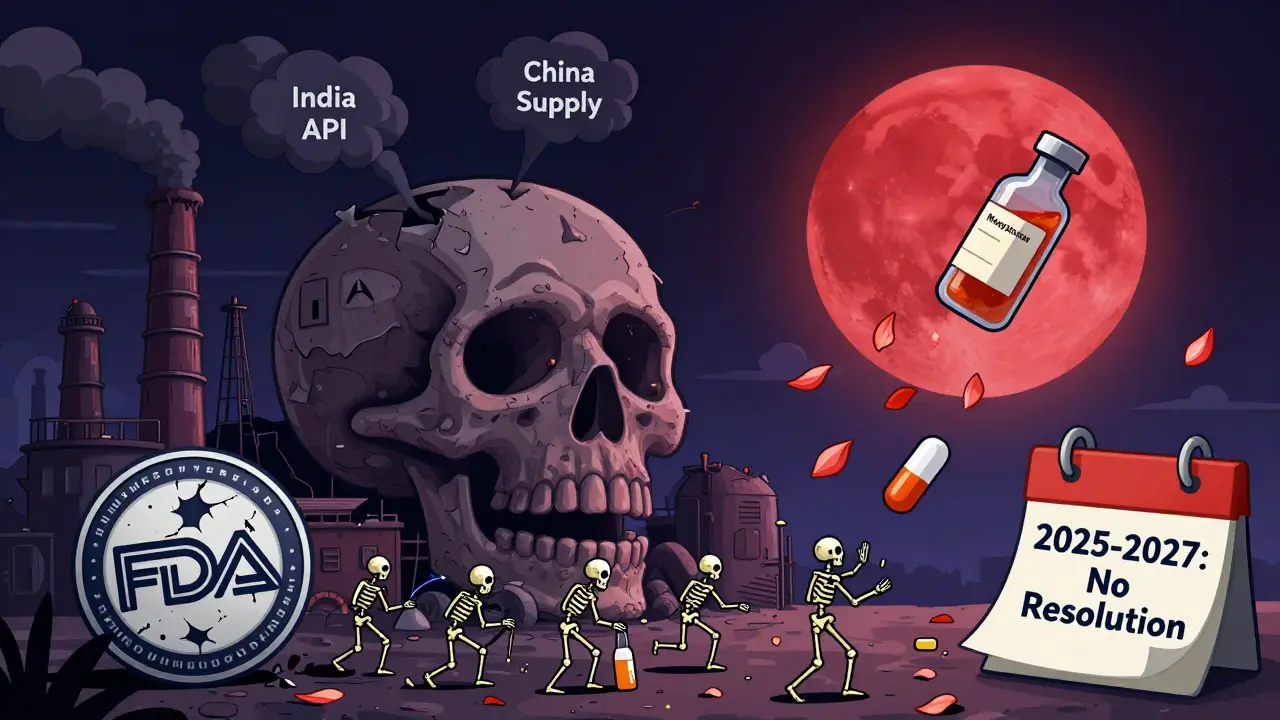
First, manufacturing is overseas. About 80% of the active ingredients in U.S. drugs come from just two countries: India and China. India supplies nearly half of all active pharmaceutical ingredients (APIs), while China handles about a quarter. When a single facility in India fails an FDA inspection-like the one that made 50% of the U.S. supply of cisplatin-it doesn’t just delay production. It creates a nationwide blackout.
Second, profit margins are razor-thin. Generic drugs make up 90% of prescriptions but only 20% of pharmaceutical revenue. Manufacturers make just 5-8% profit on these drugs, compared to 30-40% on brand-name drugs. Why would a company invest in building more capacity for a drug that pays so little? The answer: they won’t. So when demand spikes-like with GLP-1 drugs or ADHD meds-there’s no backup.
Third, regulatory delays. The FDA can’t force a company to make more of a drug. They can inspect, warn, and delay approval, but they can’t mandate production. In 2025, FDA Commissioner Robert Califf admitted the agency prevents about 200 potential shortages each year-but only because manufacturers voluntarily share early warnings. Many still don’t.
And fourth, supply chains are brittle. A shipping delay, a labor strike, or a geopolitical tension in the Red Sea can ripple through the entire system. A single container of API stuck in transit can mean a hospital runs out of saline for a week.
How Are Hospitals and Pharmacies Coping?
They’re making do-with creativity, risk, and exhaustion.
Hospital pharmacists now spend over 10 hours a week just tracking shortages. In 2024, 67% of pharmacists reported medication errors directly linked to substitutions during shortages. One pharmacist in Ohio told a Reddit thread how they had to ration cisplatin: patients with testicular cancer got it first. Those with ovarian or lung cancer? They waited-or got a less effective alternative.
Doctors are switching to alternatives. A 2024 AMA survey found 43% of physicians had to use a less effective drug because the preferred one wasn’t available. Some are using oral rehydration instead of IV fluids. Others are combining drugs or adjusting doses-sometimes without full clinical evidence.
Pharmacies are calling every supplier, every day. In 47 states, pharmacists can substitute a therapeutically equivalent drug-but only 19 states let them do it without calling the doctor first. That means delays. That means patients waiting hours or days.
And yet, only 28% of hospitals have a 30-day strategic stockpile of critical drugs. Why? Because building one costs tens of thousands of dollars-and insurance doesn’t cover it.
What’s Being Done to Fix This?
There are efforts-but they’re slow, scattered, and underfunded.
The FDA launched a new public portal in January 2025 where providers can report shortages not yet on the official list. In three months, it received 1,247 reports-87% led to FDA action. That’s progress. But it’s reactive, not preventive.
Some states are stepping up. New York is building an online database to show which pharmacies have which shortage drugs in stock. Hawaii now allows Medicaid to cover foreign-approved versions of drugs during shortages-a move that could save lives when U.S. supplies vanish.
Legislation is being pushed. The Drug Shortage Prevention Act requires manufacturers to report production issues earlier. The End Drug Shortages Act would define what counts as a “demand surge” so the FDA can act faster. But neither has passed Congress.
The most urgent fix? Financial incentives. The U.S. Pharmacopeia says we need to pay manufacturers to make critical drugs here, not overseas. Domestic production would cut supply chain risks. But right now, it’s cheaper to ship a vial from India than to build a factory in Ohio.
What This Means for You
If you’re taking a drug that’s in shortage, here’s what you can do:
- Check the ASHP Drug Shortages Database-it’s updated weekly and lists which drugs are out, why, and when they’re expected back.
- Call your pharmacy ahead. Don’t assume your prescription is ready. Ask if they have it-or if they can get it from another supplier.
- Ask your doctor about alternatives. Not all substitutes are equal, but some are safe and effective. Don’t refuse a substitution just because it’s not your usual brand.
- Don’t delay refills. Many shortages are temporary. Getting your refill early can help you avoid a gap.
- Report a shortage. If your pharmacy says they can’t get a drug, tell your doctor. They can report it to the FDA portal. Every report helps.
This isn’t a problem that will fix itself. It’s a systemic failure in how we make and distribute life-saving medicines. Until we invest in domestic manufacturing, require transparency from drugmakers, and build real stockpiles, shortages will keep happening. And every time they do, someone’s treatment gets delayed. Someone’s health gets worse. Someone risks dying because a vial never arrived.
Which medications are currently in the worst shortage?
The most critical shortages are in IV fluids (5% and 50% Dextrose), chemotherapy drugs like cisplatin and doxorubicin, antibiotics such as vancomycin and meropenem, ADHD medications (methylphenidate and amphetamines), and GLP-1 weight loss drugs like semaglutide and tirzepatide. These are essential for treating cancer, infections, diabetes, and severe dehydration.
Why are generic drugs more likely to be in shortage than brand-name drugs?
Generic drugs make up 90% of prescriptions but only 20% of pharmaceutical revenue. Manufacturers make just 5-8% profit on them, compared to 30-40% on brand-name drugs. With such thin margins, companies avoid investing in production capacity or quality upgrades. When demand spikes or a factory fails, there’s no financial incentive to ramp up supply.
How long do drug shortages usually last?
Some shortages last weeks, others years. The average duration in 2025 was 11 months. Many of the longest-running shortages started in 2022 or earlier and are tied to manufacturing facility shutdowns, regulatory delays, or global supply chain issues. IV fluids and chemotherapy drugs have been in shortage for over three years in some cases.
Can I get a substitute drug if my medication is out of stock?
In 47 states, pharmacists can substitute a therapeutically equivalent drug during a shortage. But only 19 states allow them to do it without calling your doctor first. Always ask your pharmacist if a substitution is available and safe. Never take a substitute without checking with your provider first.
Are drug shortages getting better or worse?
In early 2025, the number of active shortages dropped slightly from 277 to 270, but that’s misleading. Many of the resolved shortages were antibiotics, while new ones emerged in hormonal agents and CNS drugs. Without major policy changes, the Congressional Budget Office projects shortages will remain above 250 through 2027. Demand for GLP-1 drugs and ADHD meds is still rising, and geopolitical risks haven’t decreased.
Is there a way to know if my pharmacy has the drug I need?
Yes. The ASHP maintains a public Drug Shortages Database that lists current shortages and expected resolution dates. Some states, like New York, are launching online tools that show which local pharmacies have stock. Call your pharmacy directly-don’t wait for them to call you. If they don’t have it, ask if they can order it from another distributor.

Man, I’ve been seeing this in my pharmacy back home in Delhi-same drugs, same shortages. We get the leftovers after the US clears inventory. Cisplatin? We wait 3 months. No one talks about how this hits global supply chains. It’s not just an American problem-it’s a global asymmetry.
As a hospital pharmacist in Ohio, I can confirm: we’re rationing IV fluids like they’re gold. Last week, we had to use oral rehydration for a 78-year-old with sepsis because the IV bags were gone. It’s not just inconvenient-it’s dangerous. And no, we can’t just order more. The supply chain is broken at the source.
I’ve been tracking this since 2022, and honestly, the real tragedy isn’t the shortage-it’s that we keep treating it like a logistics issue instead of a moral one. We’re talking about people who need insulin to live, cisplatin to survive cancer, vancomycin to fight sepsis. And we let corporations decide who gets it based on profit margins? That’s not capitalism. That’s negligence dressed up as economics. We need to treat these as public health essentials, not commodities. The FDA can’t fix this alone. We need a national mandate: critical drugs must be produced domestically, with guaranteed margins. No more ‘let the market decide’ while kids with leukemia wait.
This hit home for me when my mom couldn’t get her levothyroxine last winter. She’s 72, has been on it for 20 years. We called 14 pharmacies. Three had it. One said it’d be here ‘in 2 weeks.’ Two weeks. She went without for 11 days. I cried. This isn’t a policy debate. This is someone’s mother, someone’s sibling, someone’s grandparent. We need to act like human beings, not accountants.
Hey, just wanted to say thanks for laying this out so clearly. I’m from Pune and work in pharma logistics. We see the same patterns-factories get shut down, orders get rerouted, and suddenly the US runs out. It’s not malice. It’s just how the system’s built. But yeah… someone’s gotta fix it.
Oh wow, so now we’re blaming India and China? Let me guess-next you’ll say the real problem is that people are too lazy to take their meds? Wake up. This is corporate greed wrapped in a ‘supply chain’ blanket. The same companies that charge $1000 for a vial of insulin are the ones who shut down US plants to save 2 cents per pill. This isn’t about manufacturing. It’s about profit.
YES!!! I’ve been screaming this into the void for years!!! 🙌 The GLP-1 shortage is literally affecting diabetics now?? I have a cousin on Ozempic for diabetes and she’s been rationing her doses because her pharmacy says ‘we only get 10 vials a month.’ This is a public health emergency!!! Why isn’t the government declaring a national shortage emergency?? We need emergency production quotas, NOW!!!
So we’re mad because the free market didn’t magically produce enough cheap drugs? Maybe if people stopped demanding 1000mg of Adderall to ‘focus’ on TikTok, we wouldn’t have shortages. Also, why is everyone surprised? Pharma’s been outsourcing since the 90s. It’s called capitalism. You want cheap drugs? You get cheap supply chains. No tears.
It's important to note that while the FDA reports on shortages, the root issue lies in the lack of financial incentives for generic manufacturers to maintain redundant capacity. The current reimbursement models under Medicare Part B and Medicaid disincentivize stockpiling. Until payment structures are revised to reward inventory resilience-not just lowest bid-the cycle will persist.
Shortages? Wow. Guess what? People die every day. That’s just life. You want medicine? Pay more. Or stop being a victim. Maybe if you didn’t take so many pills you’d be fine.
OMG I JUST FOUND OUT MY PHARMACY HAS NO INSULIN TODAY AND I’M CRYING 😭 I’VE BEEN ON IT FOR 15 YEARS AND I DON’T KNOW WHAT TO DO!!! CAN SOMEONE PLEASE TELL ME WHAT TO DO??? I’M SO SCARED!!!
Hey, I get it-it’s messed up. But let’s not lose hope. The New York pharmacy tracker? That’s a real win. The FDA portal? People are using it. And yeah, maybe we need to bring manufacturing home. But we’re starting to move. It’s slow, yeah. But we’re moving. And every time someone calls their pharmacist, reports a shortage, or asks their doc for an alternative? That’s a step forward. We’re not helpless. We just gotta keep pushing.
Let’s be real-this isn’t just about pills. It’s about who we are as a society. We let corporations offshore the very things that keep us alive because it’s cheaper. We cheer when CEOs get bonuses while patients wait. We call it ‘efficiency.’ But efficiency without humanity is just cruelty with a spreadsheet. We need to stop treating medicine like a product and start treating it like a right. Build factories in Ohio. Pay workers a living wage. Stop outsourcing our survival. We’ve got the tech. We’ve got the money. We just need the will.