

Arthritis Types Explained: Osteoarthritis vs. Rheumatoid Arthritis vs. Others

When your knees ache after walking, or your fingers feel stiff in the morning, it’s easy to assume it’s just "arthritis." But not all arthritis is the same. In fact, there are over 100 types - and two of them, osteoarthritis and rheumatoid arthritis, account for nearly all cases. They look similar on the surface: pain, swelling, trouble moving. But underneath? They’re completely different diseases. One is wear and tear. The other is your body attacking itself. Getting them mixed up can cost you years of mobility - or even your joints.
What is osteoarthritis?
Osteoarthritis (OA) is what happens when the cushion between your bones wears down. Think of it like the rubber on a tire. Over time, it thins out, and suddenly, bone starts grinding on bone. It’s not just "old age." It’s mechanical failure. You don’t get it because you’re old - you get it because your joints have been under stress for years.
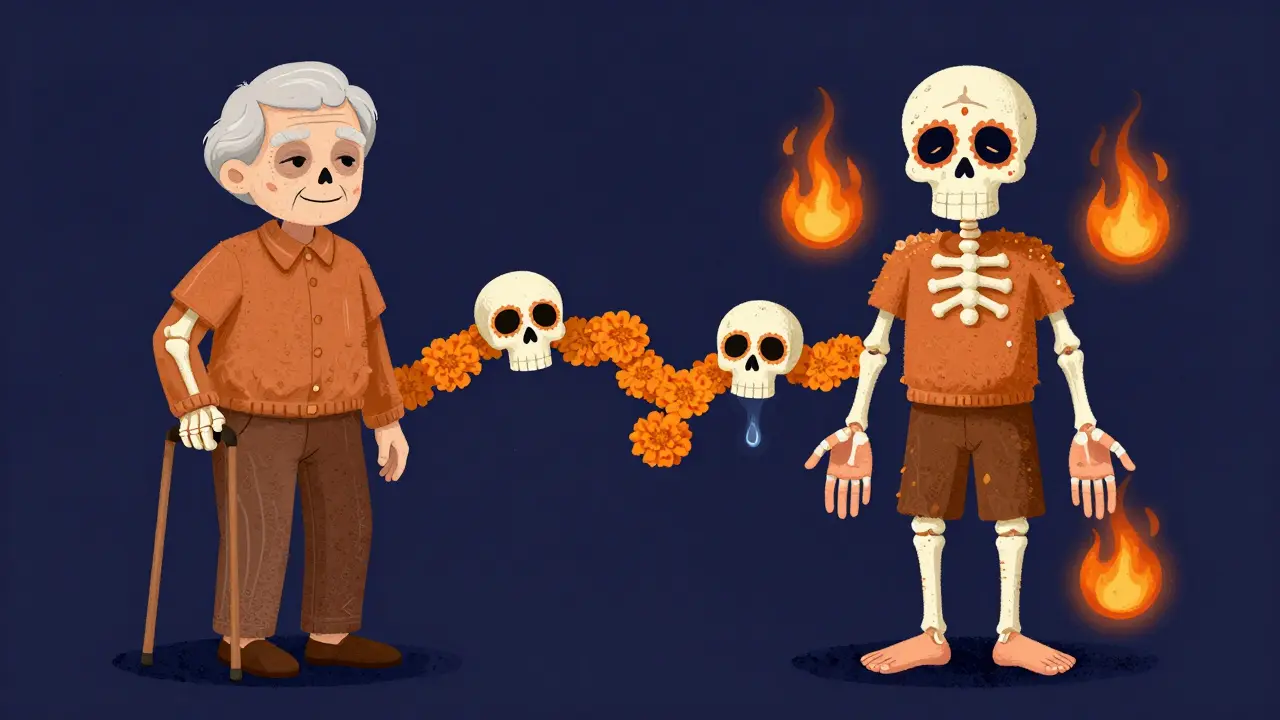
It most often hits the knees, hips, spine, and hands. In the hands, it’s easy to spot: bony knobs form on the joints closest to your fingertips (called DIP joints) and in the middle of your fingers (PIP joints). These are called Heberden’s and Bouchard’s nodes. They’re not dangerous - but they’re unmistakable.
Pain from OA shows up when you move. Walk too far? Your knee aches. Stand too long? Your hip complains. Rest helps. Morning stiffness? Usually under 30 minutes. That’s a key clue. If you’re stiff for over an hour, it’s probably not OA.
Weight is a huge factor. Carrying extra pounds doesn’t just make you tired - it crushes your knees. Every extra pound adds 4 pounds of pressure on your knee joint. Lose 10 pounds? You cut your knee OA pain by nearly half. That’s not a guess. That’s from the CDC’s data on 32.5 million American adults with OA.
There’s no cure. But you can slow it. Stay active - low-impact movement like swimming or cycling keeps joints lubricated. Strengthen the muscles around the joint. Protect it. And if it gets bad? Joint replacement works. Over 90% of all hip and knee replacements in the U.S. are for OA patients.
What is rheumatoid arthritis?
Rheumatoid arthritis (RA) isn’t about wear and tear. It’s about war inside your body.
Your immune system - the thing that fights off germs - turns on your own joints. It attacks the lining of the joint (the synovium), causing inflammation, swelling, and heat. That inflammation doesn’t just hurt. It destroys cartilage, bone, and even tendons. Left untreated, it can twist your fingers into claws or lock your knee in place.
RA doesn’t pick one joint. It goes for symmetry. If your left wrist hurts, your right wrist will too. Same with knuckles, ankles, elbows. It rarely touches the very tip of your fingers - that’s a telltale sign it’s not RA. It hits the knuckles (MCP joints) and wrists hard.
Stiffness? Lasts longer than an hour. Often two, three, even four hours. And it’s not just joints. RA is systemic. You’ll feel tired all the time. Might lose weight without trying. Get fevers. Have dry eyes or a cough. That’s because RA can attack your lungs, heart, even your blood vessels.
It can start at any age. Not just in seniors. Juvenile idiopathic arthritis affects kids. And while OA gets worse with age, RA can hit hard in your 30s or 40s. Women are three times more likely to get it than men.
Smoking? Big risk. If you smoke, your chance of developing RA doubles or triples. Genetics play a role too - especially the HLA-DRB1 gene. But even if you have the gene, you won’t get RA unless something triggers it - like infection, stress, or smoking.
Here’s the scary part: RA can destroy joints in months. Not years. That’s why early treatment isn’t optional - it’s life-changing. If you catch it within the first 3 to 6 months, you have a real shot at stopping it. Delay? You’re looking at permanent damage.
How they differ - side by side
Here’s the clearest way to tell them apart:
| Feature | Osteoarthritis (OA) | Rheumatoid Arthritis (RA) |
|---|---|---|
| Cause | Wear and tear on cartilage | Immune system attacks joint lining |
| Onset | Gradual, over years | Rapid, over weeks to months |
| Age of onset | Usually over 50 | Any age, including children |
| Joint pattern | Asymmetrical (one side) | Symmetrical (both sides) |
| Morning stiffness | Less than 30 minutes | Over 60 minutes |
| Systemic symptoms | None | Fatigue, fever, weight loss |
| Commonly affected joints | Knees, hips, DIP/PIP fingers | Wrists, MCP fingers, ankles |
| Diagnosis | X-ray: joint space loss, bone spurs | Blood tests: RF, anti-CCP antibodies |
| Primary treatment | Weight loss, physical therapy, NSAIDs | DMARDs, biologics, early aggressive therapy |
| Can be reversed? | No - but progression can be slowed | Yes - remission is possible with early treatment |
One more thing: RA can cause nodules - hard lumps under the skin, usually near elbows or pressure points. You won’t see those with OA.

Other types of arthritis you should know
OA and RA aren’t the whole story. There are others that sneak in:
- Gout: Caused by uric acid crystals building up in joints. Hits big toe hardest. Comes in sudden, fiery attacks. Pain is unbearable. Treated with diet changes and meds like allopurinol.
- Psoriatic arthritis: Comes with psoriasis (scaly skin patches). Affects fingers, toes, spine. Can cause swelling that makes fingers look like sausages.
- Ankylosing spondylitis: Targets the spine. Starts with lower back pain and stiffness. Can fuse vertebrae over time. Often runs in families.
- Lupus-related arthritis: Lupus is a full-body autoimmune disease. Joint pain is common, but it’s usually not as destructive as RA.
These are rarer - but they matter. If you have skin rashes, back pain, or sudden attacks of joint pain, don’t assume it’s OA or RA. See a rheumatologist.
Why diagnosis matters
Here’s the hard truth: treating OA like RA - or vice versa - can ruin your life.
OA gets NSAIDs (like ibuprofen) and physical therapy. That’s fine. But if you have RA and only take NSAIDs? You’re ignoring the real problem: your immune system is eating your joints. You need DMARDs - drugs like methotrexate or biologics like Humira - to shut down the attack. Delay those by six months? You might need joint replacement sooner. Or worse - lose function in your hands.
And if you have OA and get put on immune-suppressing drugs? You’re risking infections, liver damage, and side effects for no reason. You’re not getting better. You’re just getting sicker.
Doctors don’t guess. They test. X-rays show cartilage loss in OA. Blood tests find rheumatoid factor (RF) and anti-CCP antibodies in RA. Ultrasound is now used to spot early inflammation in RA before damage shows on X-rays. If your joints are swollen, warm, and symmetrical - and you’re under 60 - don’t wait. Get tested.
What you can do
If you’re worried about arthritis:
- Track your symptoms: Write down when pain starts, how long stiffness lasts, which joints hurt, and if you feel tired or feverish.
- Don’t ignore morning stiffness: If it lasts more than an hour, it’s not just "getting old."
- Manage your weight: Even 5-10 pounds lost can cut knee pain in half.
- Stay active: Movement keeps joints healthy. Walking, swimming, yoga - all help.
- Quit smoking: If you smoke, stopping cuts your RA risk by half.
- See a specialist: If you’re under 60 and have joint pain, see a rheumatologist. Not just your GP.
Arthritis isn’t one disease. It’s a group of diseases. And if you don’t know which one you have, you’re flying blind. The right diagnosis isn’t just about labels - it’s about saving your joints, your energy, and your future.
Can osteoarthritis turn into rheumatoid arthritis?
No. Osteoarthritis and rheumatoid arthritis are completely different diseases with different causes. OA is mechanical wear and tear. RA is autoimmune. One doesn’t become the other. But it’s possible to have both at the same time - especially as you get older. If your symptoms suddenly change - like new swelling, fatigue, or stiffness lasting hours - you might have developed RA on top of OA. That’s why ongoing monitoring matters.
Is there a blood test for osteoarthritis?
No. There’s no blood test for OA. Diagnosis is based on symptoms, physical exam, and X-rays showing joint space narrowing or bone spurs. Blood tests are used to rule out other types like RA or gout. If your blood work is normal but your X-ray shows joint damage, it’s likely OA.
Can you have rheumatoid arthritis without joint pain?
Yes - early on. Before joints hurt badly, RA often shows up as fatigue, low-grade fever, weight loss, or dry eyes. Some people feel generally unwell for weeks before joint pain starts. That’s why doctors look for systemic symptoms. If you have unexplained tiredness and swelling in multiple joints, don’t wait for pain to get worse - get tested.
Does arthritis always get worse over time?
Not necessarily. OA tends to progress slowly, but lifestyle changes - weight loss, exercise, avoiding joint stress - can slow it down significantly. RA, if caught early and treated aggressively with DMARDs or biologics, can go into remission. Studies show 30-50% of RA patients achieve remission with proper treatment. It’s not a death sentence - it’s a condition you can manage.
What’s the best way to prevent arthritis?
For OA: maintain a healthy weight, avoid repetitive joint stress, and stay active. For RA: don’t smoke, manage stress, and treat infections promptly. There’s no guaranteed prevention, but these steps reduce risk. Genetics play a role in RA, so you can’t control everything - but you can control what you eat, how you move, and whether you smoke.
Next steps if you’re concerned
If you’re over 50 and have joint pain that gets worse with activity - and improves with rest - start with your primary care doctor. Get an X-ray. Focus on weight and movement.
If you’re under 60 and have swelling in multiple joints, morning stiffness over an hour, fatigue, or unexplained weight loss - don’t wait. Ask for a referral to a rheumatologist. Bring your symptom log. Demand blood tests for RF and anti-CCP. Early action changes outcomes.
Arthritis isn’t one thing. It’s many. And knowing which one you’re dealing with isn’t just helpful - it’s essential.





So let me get this straight-you’re telling me my grandma’s knuckles aren’t just "old lady hands" but actual Heberden’s nodes? And I’ve been treating my knee pain like it’s just "aging" when it’s probably OA crushing my cartilage like a freight train? I’ve been doing squats. I’m an idiot. Also, losing 10 pounds cuts knee pain in half? That’s not a diet. That’s a life hack. I’m canceling my Netflix subscription and buying a yoga mat. Thanks for the gut-punch truth.
Thank you for this clear, compassionate breakdown. Many people suffer in silence thinking joint pain is just part of getting older. Your emphasis on early intervention for RA could literally change lives. I’ve seen friends lose mobility because they delayed testing. This post is a gift to anyone who’s ever been told "it’s all in your head." You’ve given them language. You’ve given them hope.
Wait, wait, wait. You’re telling me that RA is an autoimmune disease? That’s just a fancy word for "your immune system is broken." And OA? That’s just biology’s version of a tire wearing out? So we’re all just walking, grinding, rusting machines? And the real tragedy? We’re told to "stay active" while the pharmaceutical industry profits off our slow-motion collapse. This isn’t medicine. It’s capitalism with a stethoscope. And don’t even get me started on biologics-$50k a year to keep your joints from turning into scrap metal. Who’s really winning here? The patients? Or the shareholders?
Did you know the CDC’s OA stats are manipulated? They don’t include people who got diagnosed after 65 because they’re "too old to count." And RA? They only test for RF, but 30% of RA patients are seronegative. They miss half the cases. And don’t get me started on the HLA-DRB1 gene-Big Pharma suppresses genetic testing because if you know your risk, you might quit smoking or change your diet. And they don’t want that. They want you on Humira for life. I’ve seen the internal memos. This isn’t medicine. It’s a scam.
OA isn’t wear and tear. It’s neglect.
RA isn’t an attack. It’s a scream.
Diagnosis isn’t a label. It’s a lifeline.
Stop waiting for pain. Start listening to your body.
So let me get this straight-you’re telling me my 42-year-old cousin with "just arthritis" has been getting ibuprofen for years while her immune system devours her wrists? And her doctor never even mentioned anti-CCP? Oh honey. That’s not negligence. That’s a crime. I’m printing this out and mailing it to every GP in my county. Someone’s got to start holding people accountable. And no, I’m not sorry for being dramatic. This is life. Not a PowerPoint.
Stop overcomplicating this. OA = use it or lose it. RA = treat it or lose it. Weight loss fixes OA. DMARDs fix RA. If you’re not doing one or the other, you’re choosing pain. No excuses. No drama. Just action. Go. Now.
From a clinical standpoint, the distinction between OA and RA is foundational in rheumatology. OA manifests as mechanical degeneration with localized synovial hypertrophy, whereas RA is a systemic immune-mediated vasculitis with pannus formation. Early serological profiling for anti-CCP and RF, coupled with high-resolution ultrasound, enables pre-radiographic diagnosis. Delayed intervention correlates directly with joint space narrowing velocity. Lifestyle modification in OA remains underutilized-particularly weight management, which reduces biomechanical load by 4:1. In RA, the treat-to-target paradigm achieves remission in 40% of cases when initiated within 12 weeks of symptom onset. Evidence-based protocols exist. Implementation is the gap.
i just got diagnosed with RA last year and i didnt even know what it was i thought it was just my knees being old and then i started getting so tired and my eyes were dry and i lost 15 lbs and i thought i had cancer and then my doc said RA and now im on methotrexate and it feels like a miracle but also i dont know if i should tell my boss because i dont want them to think im weak or something idk
Wow. You really think people just need to "get tested"? Like it’s that simple? Have you ever tried getting a rheumatologist appointment in rural America? It’s a six-month wait. And don’t even mention the insurance denials. You talk about DMARDs like they’re candy. My sister’s on Humira. Her copay is $1,200 a month. She works two jobs. She’s 34. She has a 3-year-old. And you’re out here handing out pamphlets like this is a choice. This isn’t ignorance. This is systemic abandonment. And you? You’re part of the problem.