

Upset Stomach and Heartburn from Medications: Proven Ways to Relieve It
Medication Heartburn Risk Checker
Medication Safety Assessment
Enter your current medications to assess heartburn risk and get personalized prevention tips.
Your Risk Assessment
This tool is for informational purposes only. Always consult your doctor before making changes to your medication regimen.
Many people take pills every day without thinking twice-until their stomach starts burning, or they feel that familiar acid rising in their throat. It’s not just spicy food or stress. More often than you’d guess, it’s the medicine itself. Heartburn and upset stomach from medications are common, but they’re not normal. And you don’t have to live with them.
Why Your Pills Are Causing Heartburn
It’s not magic. It’s chemistry. Some medications directly irritate the lining of your esophagus or stomach. Others relax the muscle that normally keeps stomach acid where it belongs-the lower esophageal sphincter. When that muscle loosens, acid flows backward. That’s heartburn. The biggest offenders? NSAIDs like ibuprofen and aspirin. About 1 in 3 people who take them regularly get heartburn. Why? They block protective chemicals in your stomach lining. Without those, acid eats away at your tissue. Aspirin isn’t much better-15 to 25% of users report burning. Then there are antibiotics. Doxycycline, a common tetracycline, is notorious. If you swallow it without enough water or lie down right after, it can stick to your esophagus and cause ulcers. About 12% of people who don’t follow the rules end up with pill-induced esophagitis. Symptoms show up fast-within hours. Heart medications like nifedipine and amlodipine (calcium channel blockers) are another surprise. They’re great for blood pressure, but they relax the LES muscle, letting acid escape. Up to 1 in 5 people on these drugs get reflux. Even asthma meds like theophylline can weaken that same muscle by 30-50%. And if you’re on metformin for diabetes, you’re not alone. Around 1 in 3 new users get nausea, bloating, or heartburn. The good news? For most, it fades after a few weeks.Medications That Can Hurt Your Esophagus
Some pills don’t just cause discomfort-they can cause real damage. Bisphosphonates like alendronate (used for osteoporosis) are especially risky. If you take them lying down, or with too little water, they can burn holes in your esophagus. Studies show 5-10% of users develop serious injury if they don’t follow the protocol. Potassium chloride and quinidine also carry risks. These aren’t everyday drugs for most, but if you’re on them, you need to know the rules. One sip of water won’t cut it. You need a full glass-8 ounces-and you need to stay upright. The worst part? Many people don’t realize their heartburn is drug-related. They assume it’s just aging, or they’ve eaten too much. But if your symptoms started after you began a new pill, that’s a red flag.What Works: Simple Fixes That Actually Help
You don’t have to stop your meds. There are proven ways to reduce or eliminate the burning. Take NSAIDs with food. It’s that simple. Eating reduces heartburn by 40-50%. A sandwich, a bowl of oatmeal-anything to buffer the acid. Don’t take them on an empty stomach. Ever. Drink a full glass of water with every pill. Not a sip. Not half a glass. Eight ounces. This is critical for antibiotics, bisphosphonates, and potassium pills. Water flushes the pill down before it can sit and irritate. Studies show this cuts esophagitis risk by 60-70%. Stay upright for at least 30 minutes after taking meds. No lying down. No slumping on the couch. No napping. Stay standing or sitting. For doxycycline and bisphosphonates, aim for 60 minutes. This simple step prevents 80-90% of pill-induced injuries. Try an antacid before your NSAID. If you take ibuprofen daily, take an over-the-counter antacid like Tums or Rolaids 30 minutes before. It reduces heartburn by 30-40%. Not perfect, but better than nothing. Ask about PPIs if you’re on long-term NSAIDs. Proton pump inhibitors like omeprazole cut the risk of stomach ulcers by 70-80% in people who take NSAIDs regularly. Your doctor can prescribe this as a protective combo. It’s not a cure-all, but for high-risk users, it’s a game-changer.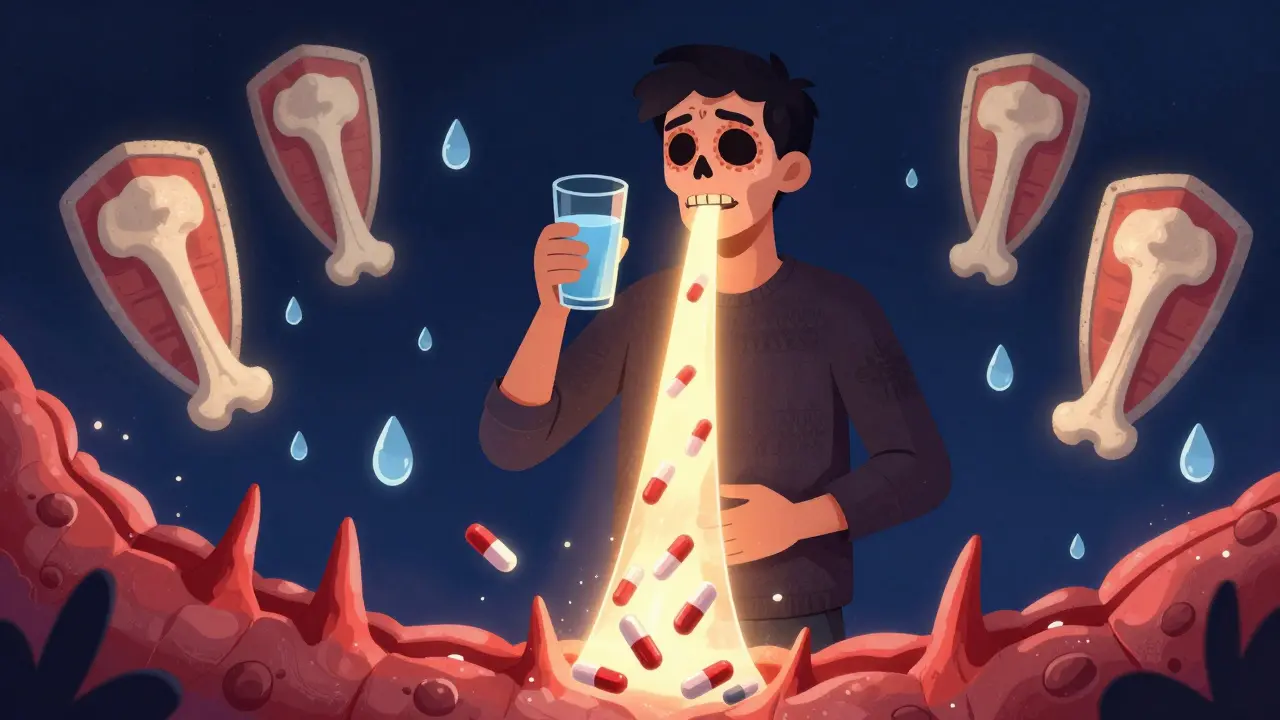
When to Worry: Red Flags You Can’t Ignore
Most of the time, these symptoms are annoying but harmless. But some signs mean something serious is happening. If you have:- Chest pain that feels tight, heavy, or spreads to your arm or jaw
- Difficulty swallowing food or liquids
- Blood in your vomit or stool (black, tarry stools or bright red blood)
- Unexplained weight loss
Don’t wait. Call your doctor. These aren’t typical side effects. They could mean an ulcer, esophageal narrowing, or even Barrett’s esophagus-a condition that increases cancer risk.
What to Ask Your Doctor
If you’re on one of these meds and getting heartburn, talk to your doctor. Don’t stop cold turkey. Some drugs, like beta blockers, can cause dangerous rebound effects if stopped suddenly. Ask:- “Is there a different pill I can take that’s less likely to cause heartburn?”
- “Can I switch to a delayed-release version?”
- “Would a protective medication like omeprazole help?”
- “Are there newer formulations that are gentler on the stomach?”
For example, in 2022, the FDA approved a new delayed-release doxycycline that’s less likely to stick in your throat. It’s not available everywhere yet, but it’s an option now.
Also, ask if your meds interact. Taking NSAIDs with corticosteroids? That combo increases ulcer risk by 4-5 times. Your doctor should be checking for that.
What’s New in 2026
Medicine is catching up. In 2023, new NSAID formulations with protective coatings showed 30-35% less stomach irritation in clinical trials. They’re starting to appear on pharmacy shelves. Electronic health records now flag patients at risk. If you’re over 50, on NSAIDs long-term, and have a history of reflux, your doctor’s system might automatically suggest a PPI. And in the future? Genetic testing might tell you if you’re more likely to react badly to NSAIDs. About 1 in 5 Caucasians have a gene variant that makes them more sensitive. That’s not routine yet-but it’s coming.Bottom Line: You Don’t Have to Suffer
Heartburn from meds isn’t something you just have to live with. It’s preventable. It’s manageable. And in most cases, you don’t need to quit your treatment. Start with the basics: water, food, upright posture. If that doesn’t help, talk to your doctor. There are safer options, protective strategies, and newer drugs that weren’t available a few years ago. Your stomach shouldn’t pay the price for your health. With the right steps, you can take your meds-and keep your peace of mind.Can I take ibuprofen if I have heartburn?
You can, but you shouldn’t take it on an empty stomach. Always take ibuprofen with food or a full glass of water. If you get heartburn often, ask your doctor about switching to a different pain reliever like acetaminophen, or adding a proton pump inhibitor like omeprazole to protect your stomach.
Does doxycycline always cause heartburn?
No. Doxycycline only causes heartburn or esophagitis if taken incorrectly-like with little water, right before lying down, or with a full stomach. When taken with 8 oz of water and kept upright for 60 minutes, the risk drops by over 80%. New delayed-release versions also reduce this risk significantly.
How long does metformin-induced heartburn last?
For most people, stomach issues from metformin improve within 2 to 4 weeks as the body adjusts. Taking it with meals helps. If symptoms persist beyond a month, talk to your doctor about switching to extended-release metformin, which is gentler on the stomach.
Can I use antacids every day for medication-induced heartburn?
Short-term use is fine-like taking Tums before your NSAID. But long-term daily use of antacids can interfere with nutrient absorption and mask more serious problems. If you need daily relief, ask your doctor about proton pump inhibitors (PPIs), which are more effective for chronic reflux and safer for long-term use under medical supervision.
Should I stop my medication if it gives me heartburn?
Never stop a prescribed medication without talking to your doctor. Stopping blood pressure meds, antibiotics, or diabetes drugs suddenly can be dangerous. Instead, work with your doctor to find solutions-like changing the time you take it, adding a protective drug, or switching to a gentler alternative.
Are there natural remedies for drug-induced heartburn?
There’s no proven natural fix that replaces medical advice. Ginger or aloe vera may soothe mild irritation, but they won’t stop NSAIDs from damaging your stomach lining or prevent doxycycline from sticking to your esophagus. The real solutions are practical: water, food, staying upright, and talking to your doctor about safer options.

Finally someone wrote the truth about meds and heartburn. I was on ibuprofen for years and thought I was just 'getting old' until I started taking it with food. Game changer. No more midnight acid baths.
Also, never lie down after doxycycline. I learned that the hard way - ER visit, $2k bill, and a new respect for water.
Thanks for the reminder. We need more posts like this.
Water. Food. Upright. That’s it. No magic. No supplements. Just basic human behavior.
Stop blaming your stomach. Start blaming your habits.
Okay but let’s be real - this whole post is just a pharmaceutical ad disguised as advice.
Why not just say ‘switch to acetaminophen’? Because Big Pharma doesn’t make money off Tylenol.
And don’t get me started on PPIs - they’re basically legal acid reflux crutches. Long-term use causes bone loss, kidney damage, and vitamin B12 deficiency. But sure, keep popping omeprazole like candy.
Also, ‘delayed-release doxycycline’? That’s just a fancy way of saying ‘we made it more expensive’.
It’s fascinating how laypeople conflate symptom management with causation. The real issue isn’t pill irritation - it’s the lack of pharmacokinetic literacy in the general population.
NSAIDs inhibit COX-1, period. Water doesn’t fix biochemistry.
And antacids? Temporary palliative measures with zero therapeutic value. You’re treating the symptom, not the mechanism.
Someone should write a white paper on this.
I feel you. My stomach has been crying since I started metformin. It’s like my body is screaming, ‘Why are you doing this to me?’
But I keep taking it because I know I need it… even though part of me wonders if the universe is punishing me for being too tired to cook healthy meals.
Maybe the real medicine is rest. Or love. Or both.
From a clinical pharmacology standpoint, the primary pathophysiological mechanism underlying drug-induced GERD is the pharmacodynamic modulation of the lower esophageal sphincter tone via calcium channel blockade or prostaglandin inhibition.
Non-pharmacological interventions like upright posture and hydration are adjunctive at best. The gold standard remains PPIs for high-risk cohorts, particularly those with concomitant corticosteroid use - which elevates ulcer risk by 4.7x per meta-analysis (JAMA 2021).
Also, genetic polymorphisms in CYP2C9 affect NSAID metabolism - if you’re a poor metabolizer, you’re at higher risk. Consider genotyping.
For anyone on bisphosphonates: you must take them at least 30 minutes before breakfast, with 8 oz of plain water, and remain upright for a full hour. No exceptions. No coffee. No tea. No juice. Only water.
And yes - if you skip this, you’re statistically likely to develop esophagitis. The FDA warning isn’t a suggestion. It’s a lifeline.
Also, don’t confuse ‘delayed-release’ with ‘safe.’ It just means the drug dissolves slower - not that it’s harmless.
lol i just took my ibuprofen with a soda and laid back down… guess i’m gonna be crying into my pillow again tonight
but seriously though, this post saved me. i had no idea water mattered that much. i thought it was just ‘drink something’
thanks for not being a doctor who just says ‘take an antacid’ and leaves it at that. you actually gave us tools.
also i’m gonna start sitting up for 30 mins after my pills… even if i have to pretend i’m waiting for my microwave popcorn to finish. worth it.