

How to Make a Medication Action Plan with Your Care Team
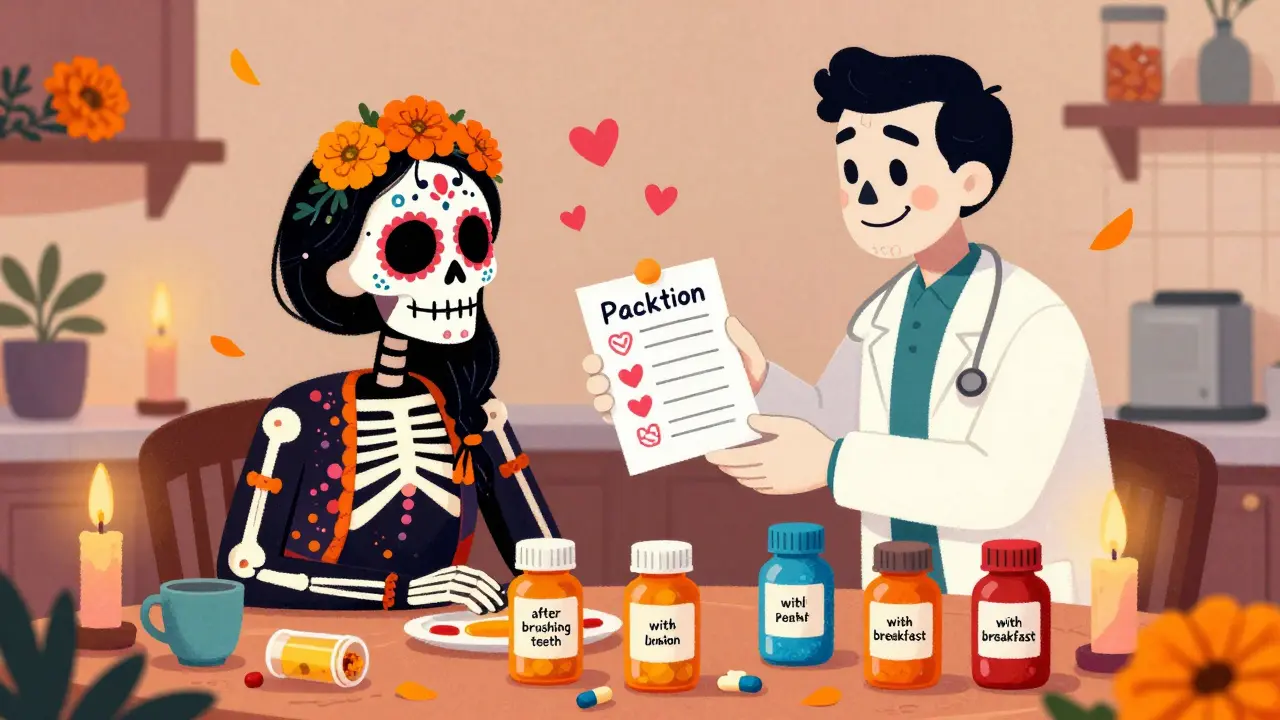
Imagine this: you’re juggling five different pills a day-some in the morning, some at night, others only on weekdays. You forget one. Then another. You start skipping doses because the schedule feels impossible. You’re not lazy. You’re overwhelmed. That’s where a medication action plan comes in-not as another piece of paper, but as your personal roadmap to take back control.
What Exactly Is a Medication Action Plan?
A medication action plan (MAP) isn’t just a list of your drugs. It’s a living, personalized guide created with your care team that tells you what to take, when, why, and what to do if something goes wrong. It’s built around your life, not the other way around.Unlike a simple prescription list, a true MAP includes specific actions. For example:
- “Take your blood pressure pill after brushing your teeth every morning.”
- “If you feel dizzy after taking your diabetes medicine, sit down and check your blood sugar.”
- “Call your pharmacist if you run out of insulin before your next refill.”
These aren’t vague suggestions. They’re measurable steps tied to your daily routine. In Germany, since 2016, everyone on three or more prescription meds gets a standardized medication plan issued by their doctor and updated by their pharmacist. In the U.S., Medicare Part D has required Medication Therapy Management (MTM) programs-including MAPs-for eligible patients since 2006. And it works: studies show patients who use personalized action plans improve adherence by 25-40% and cut medication-related hospital visits by 32%.
Who’s on Your Care Team?
You’re not alone in this. Your care team includes:- Your doctor-who prescribes your meds and adjusts them based on your health changes.
- Your pharmacist-who knows how all your drugs interact, spots duplicates, and can simplify your regimen.
- Your nurse or care coordinator-who helps you navigate appointments and follow-ups.
- Family members or caregivers-who can help remind you, spot side effects, or call in refills.
Too often, these people work in silos. A MAP breaks those walls down. In fact, the most effective plans are co-created. Dr. John Fanikos from Brigham and Women’s Hospital says, “The best plans reflect the patient’s daily routine, health literacy, and real concerns.” That means you need to speak up.
How to Start Building Your Plan
You don’t need to wait for an invitation. Here’s how to begin:- Collect everything. Grab every pill bottle, supplement, OTC medicine, and herbal remedy you take-even the ones you only use sometimes. Include creams, inhalers, patches. Bring them all to your appointment.
- Ask for a Comprehensive Medication Review (CMR). This is a 30-60 minute session with your pharmacist or doctor. It’s not a quick refill chat. It’s a full audit. Medicare Part D patients on 8+ chronic meds qualify automatically. But even if you’re not on Medicare, ask: “Can we do a full meds review?” Many private insurers now cover it.
- Speak your truth. Tell them: “I forget my pills at night.” “I skip them when I travel.” “I don’t know why I’m taking this one.” Don’t sugarcoat it. The plan only works if it’s honest.
- Ask for a written copy. Don’t leave without a printed or digital version. If they say, “We don’t do that,” ask: “Can you help me make one?”
What Should Be in Your Plan?
A good MAP has five key parts:- A complete list of all medications-prescription, OTC, vitamins, supplements. Include the dose and how often you take it.
- The reason for each drug-not just “for blood pressure,” but “to lower your risk of stroke.”
- Clear action steps tied to your habits. Example: “Take your cholesterol pill with your evening meal.”
- Red flags-what symptoms mean you should call someone. “If your legs swell or you feel faint after taking this, call me immediately.”
- Measurable goals-“I will take all my morning meds correctly for 21 days straight.”
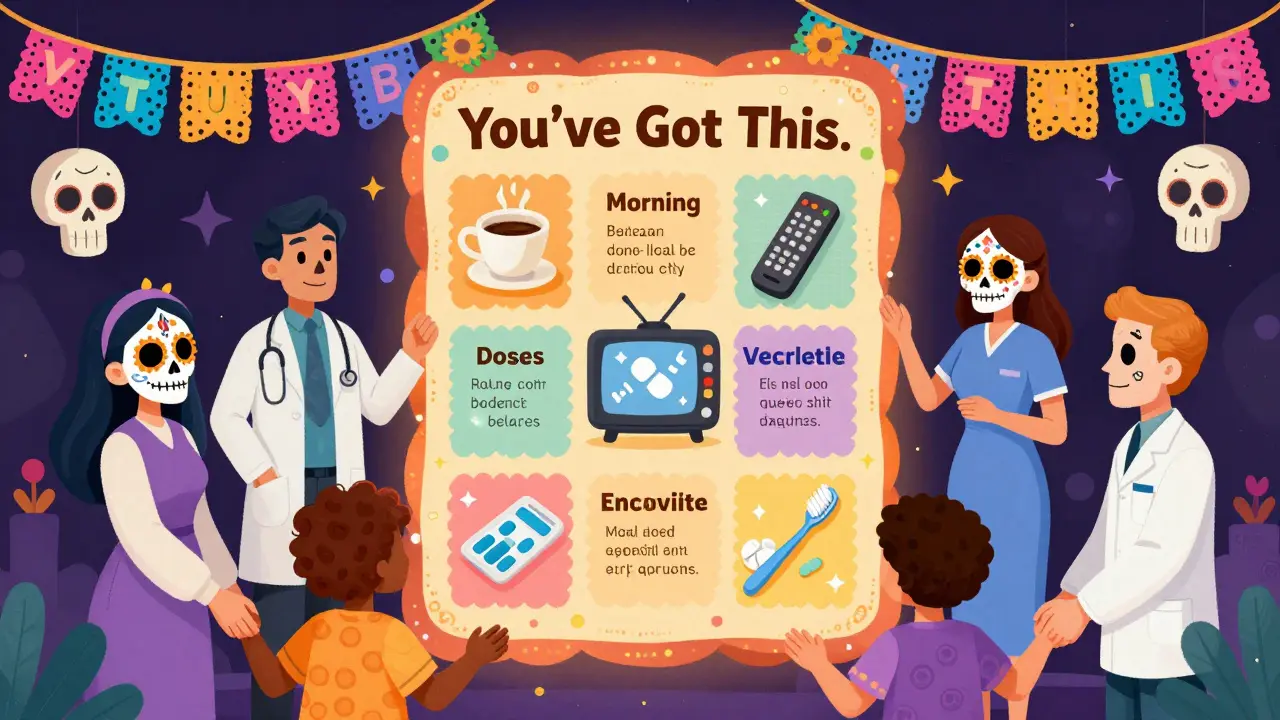
Some people use color coding: red for heart meds, green for diabetes, blue for pain. Others use pictures-like a coffee cup next to their morning pill. One woman with diabetes turned her plan into a visual chart with photos of her meds placed beside her breakfast plate, toothbrush, and evening TV spot. Her adherence jumped from 65% to 95%.
What to Avoid
Not all plans work. Here’s what fails:- Generic templates-pre-printed forms with no personalization. Johns Hopkins found these changed nothing.
- Medical jargon-phrases like “antihypertensive” or “HbA1c” confuse more than help.
- Unrealistic goals-“Take all meds perfectly every day” is impossible for most. Start small.
- One-time only-plans that sit in a drawer. Your meds change. Your life changes. Your plan should too.
Ask yourself: “Does this plan fit my actual day?” If you’re up at 6 a.m. and go to bed at 11 p.m., your plan shouldn’t say “take at 8 a.m. and 8 p.m.” if you’re asleep by 10:30.
Keep It Alive
Your plan isn’t done once you sign it. It needs updates:- Every time you get a new prescription.
- After any hospital stay or ER visit.
- When you start or stop a supplement.
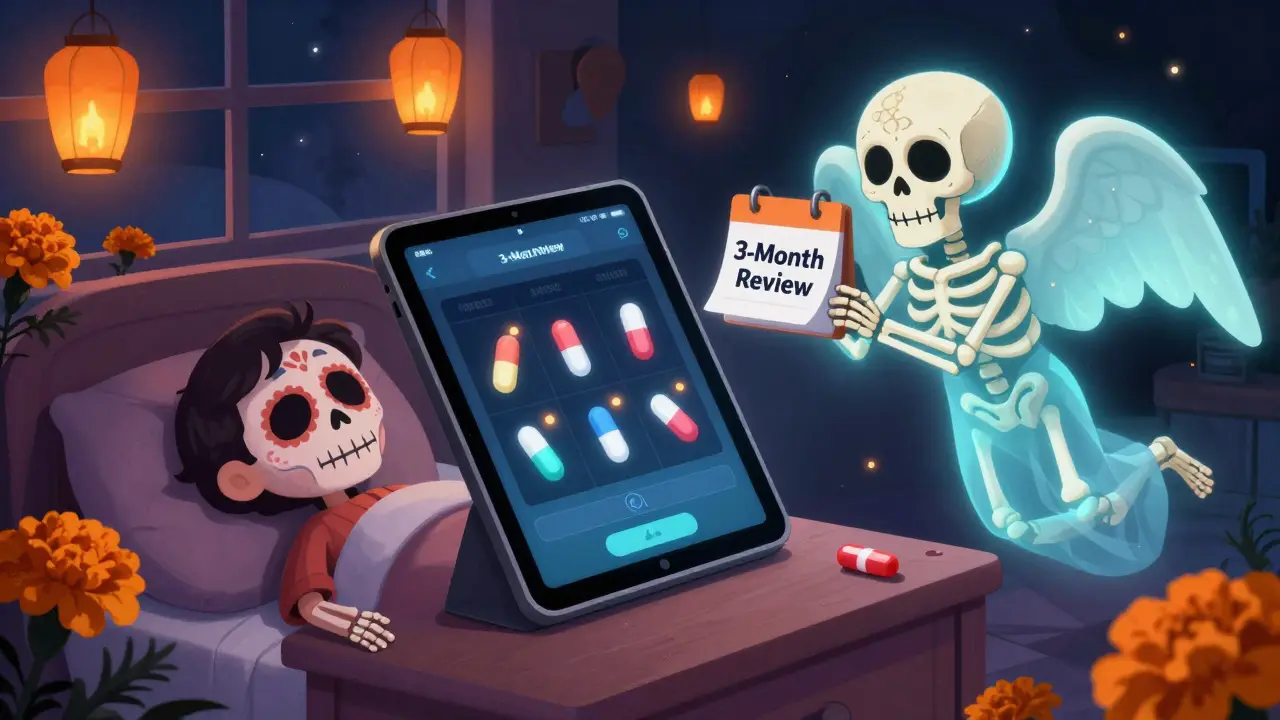
- Every 3-6 months, even if nothing changed.
Pharmacists in Germany are legally required to update the plan every time they dispense meds-especially if you buy something over the counter. You can do the same. When you refill your insulin or pick up a new painkiller, ask your pharmacist: “Can we update my action plan?”
Many pharmacies now offer apps that sync with your MAP. They send reminders, track doses, and alert your care team if you miss a dose. CVS, Walgreens, and others have these tools. Ask if yours does.
What If You’re Not Eligible?
You don’t need Medicare to get a good plan. Many private insurers now cover Medication Therapy Management. Check your plan’s benefits. If they don’t offer it, ask your doctor to write a note: “Patient would benefit from a personalized medication action plan to improve adherence and reduce risk of adverse events.”Even without formal MTM, you can still build one yourself. Use free tools from the American Pharmacists Association or the CDC. Print a blank template, fill it out with your care team, and keep it on your fridge or phone.
Why This Matters
Every year in the U.S., about 280,000 people are hospitalized because of medication errors. That’s preventable. The cost? $42 billion. But here’s the good news: every $1 spent on proper medication management saves $12.30 in avoided hospital visits and ER trips.This isn’t about being perfect. It’s about being clear. About knowing why you’re taking each pill. About having a plan that works with your life, not against it. When you take charge of your meds, you’re not just following orders-you’re managing your health.
Do I need to be on Medicare to get a medication action plan?
No. Medicare Part D patients on 8+ chronic medications automatically qualify for a free Medication Therapy Management program that includes a MAP. But many private insurers, employer plans, and even some community health centers now offer similar services. If you take three or more medications regularly, ask your pharmacist or doctor if they can help you create one-even if you’re not on Medicare.
Can my pharmacist really help me make a plan?
Yes-and they’re often the best person to do it. Pharmacists are trained to spot drug interactions, duplicates, and side effects. They know how your meds work together and can simplify your regimen. In fact, in Germany, pharmacists are legally required to update patients’ medication plans every time they dispense a new drug. In the U.S., pharmacists can now provide Medication Therapy Management services under state laws and insurance contracts. Bring all your meds to your pharmacy and ask: “Can we review everything and make a plan that fits my day?”
What if I don’t understand the medical terms on my plan?
Demand simpler language. If your plan says “take lisinopril 10 mg daily for hypertension,” ask your pharmacist to rewrite it as “take this blood pressure pill every morning to keep your heart healthy.” Your plan should be written in words you use every day-not medical jargon. If they won’t change it, ask for a new version. You have the right to understand your own care.
How often should I update my medication action plan?
Update it every time your meds change-new prescription, stopped drug, new OTC supplement. Even if nothing changes, review it every 3-6 months. Your body changes. Your routine changes. Your plan should too. Some people set a reminder on their phone for the first day of every third month. Others tie it to a regular appointment, like their annual checkup.
Can a medication action plan help with side effects?
Absolutely. A good plan doesn’t just list what to take-it tells you what to watch for. For example: “If you feel dizzy after taking your blood pressure pill, sit down and wait 10 minutes. If it doesn’t go away, call your doctor.” Or: “If your muscles ache after starting this statin, stop taking it and call us right away.” These clear instructions help you act fast, avoid ER visits, and feel safer managing your meds.
Is there a digital version of a medication action plan?
Yes. Many pharmacies now offer apps that sync with your MAP. You can scan your pill bottles, set reminders, track doses, and even share updates with your care team. CVS, Walgreens, and Kaiser Permanente have these tools. Some apps also alert your pharmacist if you miss a dose. Ask your pharmacist if they offer a digital version. If not, you can still use free apps like Medisafe or MyTherapy to build your own tracker based on your written plan.
Next Steps
If you’re taking three or more medications, don’t wait for someone to offer you a plan. Take action:- Collect all your meds-today.
- Call your pharmacy or doctor’s office and ask: “Can I schedule a Comprehensive Medication Review?”
- Bring your list to the appointment.
- Ask for a written or digital copy of your plan.
- Put it where you’ll see it-on the fridge, your phone, or your wallet.
- Review it every three months.
Medication adherence isn’t about willpower. It’s about design. A good plan removes the guesswork. It turns confusion into clarity. And for many, it’s the difference between staying healthy and ending up in the hospital. You’ve got the power to make yours work. Start today.



I used to skip my meds like it was a game-until I ended up in the ER. Then I made a MAP with my pharmacist and my mom. Now I have sticky notes on my toothbrush, my coffee mug, and my TV remote. It’s dumb, but it works. I haven’t missed a dose in 8 months.
Also, color-coding my pills saved my life. Red = heart, green = diabetes, blue = pain. I can’t read well at 6 a.m., but I can remember colors.
Stop overthinking it. Just start.
Most people think this is about memory. It’s not. It’s about design. Your brain isn’t broken-you’re just asking it to do too much. A good MAP doesn’t ask you to remember. It removes the need to.
My dad had 7 meds. He used to take them all at breakfast because it was ‘easier.’ Turns out two of them were supposed to be taken with food, and three were supposed to be taken on an empty stomach. He was poisoning himself. A pharmacist caught it. Now he has a little plastic box with labels that say ‘Morning (after coffee)’ and ‘Night (before bed).’ No confusion. No stress.
This isn’t healthcare. It’s common sense.
Let me be clear: if your doctor gives you a printed list with no context, you’ve been failed. A medication action plan isn’t a document-it’s a conversation. It’s the moment you say, ‘I don’t understand why I’m taking this,’ and someone actually listens.
My sister’s cardiologist gave her a 3-page PDF with 12 drugs, each with a Latin name and a dosage. She cried. I took her to her pharmacist. We sat for 45 minutes. He rewrote it in plain English. He drew pictures. He asked her what time she woke up. He tied each pill to her routine-‘after brushing teeth,’ ‘with your lunch sandwich.’
She started taking them. She’s alive today because someone treated her like a person, not a chart.
Don’t settle for less. Demand better.
And yes, it’s okay to say, ‘I don’t know what this is for.’
I love how this post doesn’t just say ‘take your meds.’ It says ‘take them when you’re brushing your teeth’ or ‘if you feel dizzy, sit down.’ That’s the difference between a prescription and a partnership.
I’m a nurse, and I’ve seen people die because they didn’t know what their meds were for. One guy was taking a beta-blocker for his heart but thought it was for anxiety. He stopped it because he ‘didn’t feel anxious.’ He had a heart attack two weeks later.
It’s not about being perfect. It’s about being clear.
And honestly? If your pharmacist doesn’t offer to make a plan with you, find a new one.
They’re the unsung heroes here.
I just started my MAP last week. Took me 3 hours to gather all my bottles. Found three things I hadn’t taken in 6 months. One was a pill I was told to take ‘as needed’-but I’d been taking it daily for years. My pharmacist facepalmed.
Now I have a note on my phone: ‘Check meds every Sunday.’
It’s not fancy. But it’s mine.
And I feel less scared.
Wow. Another ‘just talk to your pharmacist’ post. 😒
Yeah, sure. Let me just walk into Walgreens and say, ‘Hey, can we make a life plan based on my 12 pills?’
They’ll hand me a coupon for 20% off protein powder and tell me to ‘have a nice day.’
Real talk: most pharmacies are corporate hellholes. The ‘pharmacist’ is 22 and has never met a patient with more than 3 meds.
This plan sounds nice. But in practice? It’s a luxury for people who have time, money, and a doctor who actually cares.
For the rest of us? We’re just lucky if we get our refill on time.
...and yes, I’m still taking my blood pressure meds. Somehow.
😭
Stop making this complicated. You don’t need a fancy plan. You need a pill organizer and a phone alarm.
My grandma had 9 meds. She used a $7 plastic box from CVS. She set alarms for 7 a.m., 1 p.m., and 8 p.m. That’s it. No color codes. No charts. No meetings.
She lived to 92.
Simple systems beat complex ones every time.
Also, if you’re taking supplements, stop. Most of them are useless. And if you’re not sure? Ask your pharmacist. Not Google. Not your cousin who ‘read an article.’
Keep it dumb. Keep it simple. Keep it consistent.
That’s the whole game.
Let’s be honest-this whole ‘medication action plan’ is just another corporate healthcare buzzword dressed up as empowerment. You’re being sold a narrative that says ‘you can fix this if you just try harder.’ But the real issue is systemic: pharmaceutical companies profit from complexity. Insurance companies profit from hospitalizations. Doctors profit from prescriptions. And patients? We’re just the meat in the machine.
Yes, a MAP might help you take your pills. But it won’t fix the fact that you’re paying $800 for a pill that costs $2 to make. It won’t fix the fact that your doctor spends 7 minutes with you and prescribes 5 new drugs because that’s what the algorithm tells them to do.
And let’s not pretend this is about ‘personalization.’ It’s about shifting responsibility onto the patient so the system doesn’t have to change.
Don’t be fooled. This isn’t liberation. It’s distraction.
And if you’re still taking statins after reading this? You’re part of the problem.
My dad’s plan had a photo of his dog next to his heart med. He’d take it after petting her. It was stupid. It was perfect.
He didn’t need a chart. He needed a trigger.
Find yours. It doesn’t have to be smart. It just has to be yours.
And if you’re afraid to ask your pharmacist for help? They’ve seen worse. Trust me.
Just go.
Today.
OMG YES!! 😍 I made my MAP with my niece and we turned it into a little book with stickers and doodles. I put it in my purse. I show it to people when they ask why I’m so organized. They think I’m weird. I think I’m alive.
My mom’s plan had a drawing of a sun for morning meds and a moon for night. She said it made her feel like she was ‘talking to the sky.’
Don’t laugh. It worked.
And if you’re nervous to ask your doctor? Just say ‘I want to be less confused.’ They’ll get it.
You’re not broken. You’re just trying to survive a system that doesn’t care.
But you? You can still win.
💖
As someone from India where healthcare access is fragmented and pharmacy systems are under-resourced, I can confirm: the principles here are universal. In rural India, patients often rely on family members to remember dosing schedules. One study in Bihar showed that when caregivers were given simple visual aids-like colored beads for each medication-adherence improved by 47%.
Language doesn’t matter. Jargon does. Clarity does.
This model isn’t American. It’s human.
And yes, even in places without Medicare, community health workers can replicate this with printed cards and community meetings.
It’s not about technology. It’s about dignity.
My cousin in Toronto got her MAP through a community clinic. No insurance. No fancy app. Just a volunteer pharmacist who sat with her for an hour and wrote it on a napkin.
She laminated it.
Now it’s on her fridge.
She’s been stable for two years.
It’s not about the system.
It’s about someone taking the time.
Be that person.
For yourself.
For someone else.