

Clinical Trial Data vs Real-World Outcomes: Key Differences That Matter
Clinical Trial vs Real-World Effect Calculator
Compare Trial Results to Real-World Outcomes
Based on the article's findings, clinical trials often show higher effectiveness than real-world results. Enter a clinical trial percentage to see what it might look like in everyday practice.
Real-world effectiveness: 0%
Based on the article: Clinical trials show 30% effect, but real-world data shows 12% due to factors like non-adherence and comorbidities
Why this gap exists:
- ● Patients often take medications differently
- ● Real-world patients have more complex health conditions
- ● Non-adherence to treatment protocols
When a new drug hits the market, you might assume its success is proven beyond doubt-after all, it passed clinical trials. But here’s the catch: the people in those trials aren’t most patients. Clinical trial data and real-world outcomes tell two different stories. One shows what a drug can do under perfect conditions. The other shows what it actually does in the messy, complicated world of everyday medicine.
Why Clinical Trials Don’t Reflect Real Life
Clinical trials are designed to answer one question: Does this treatment work under ideal conditions? To get a clear answer, researchers control everything. Participants are carefully selected. They’re usually younger, healthier, and have fewer other medical problems. People with kidney disease, heart issues, or diabetes are often excluded-even if those conditions are common in real life. A 2023 study in the New England Journal of Medicine found that only about 20% of cancer patients seen in major hospitals would qualify for a typical clinical trial. And Black patients were 30% more likely to be turned away-not because of their disease, but because of factors like transportation, work schedules, or lack of access to specialized centers. That’s not a flaw in the system-it’s built in. Trials need clean data, so they exclude the noise. But in the real world, patients don’t fit into neat boxes. A 68-year-old with diabetes, high blood pressure, and arthritis might be taking five different medications. They might miss doses. They might not show up for follow-ups. They might live far from a clinic. Clinical trials can’t capture that. And that’s where the gap opens up.What Real-World Outcomes Reveal
Real-world outcomes come from everyday practice. They’re pulled from electronic health records, insurance claims, wearable devices, and patient registries. These sources track millions of people-not just the ones who signed up for a trial. The data isn’t perfect. It’s messy. Missing entries, inconsistent timing, and uncontrolled variables are the norm. But that messiness tells you something clinical trials can’t: Does this treatment work for people like me? A 2024 study in Scientific Reports compared 5,734 patients from clinical trials with 23,523 from real-world records. The real-world group had lower rates of complete data (68% vs. 92%), longer gaps between check-ins (5.2 months vs. 3 months), and far more complex health profiles. Yet, when researchers looked at outcomes like hospitalizations and survival, the differences were significant. For example, a diabetes drug might show a 30% reduction in kidney decline in a trial. But in real-world data, that number drops to 12%-not because the drug doesn’t work, but because patients aren’t taking it exactly as directed, or they’re on other meds that interfere. That’s not failure. That’s reality.The Hidden Cost of Clean Data
Clinical trials cost a lot. The average Phase III trial runs about $19 million and takes 2 to 3 years. They require dozens of sites, trained staff, strict monitoring, and months of planning. Real-world studies? They can be done in 6 to 12 months at 60-75% lower cost. Why? Because the data already exists. Insurance companies, hospitals, and pharmacies collect patient data every day. The FDA’s Sentinel Initiative now monitors over 300 million patient records from 18 partners. Companies like Flatiron Health spent $175 million and five years building a database of 2.5 million cancer patients. It was worth it: Roche bought them for $1.9 billion. But here’s the problem: that data is scattered. There are over 900 different electronic health record systems in the U.S., and most can’t talk to each other. Privacy laws like HIPAA and GDPR make sharing harder. Only 35% of healthcare organizations have teams trained to analyze real-world data properly.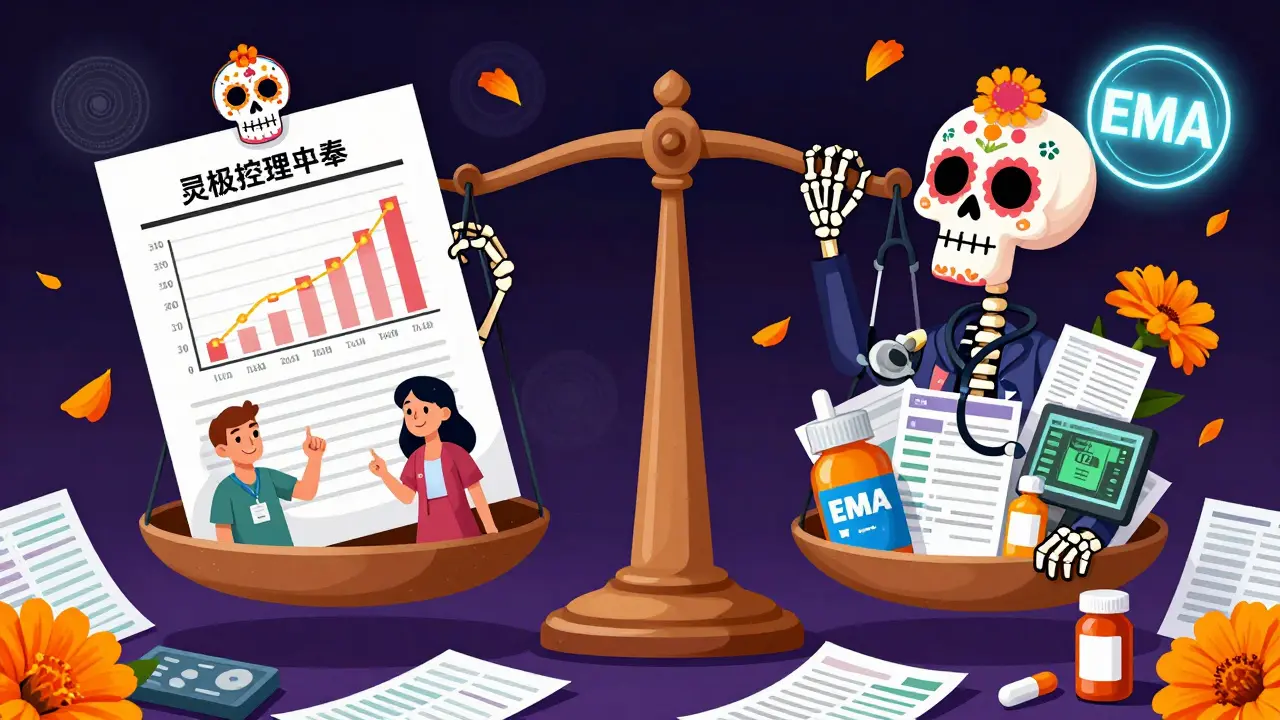
Regulators Are Catching Up
The FDA didn’t always accept real-world evidence. But since the 2016 21st Century Cures Act, they’ve changed course. Between 2019 and 2022, they approved 17 drugs using real-world data as part of the review-up from just one in 2015. The European Medicines Agency is even further ahead: 42% of their post-approval safety studies now use real-world data, compared to 28% at the FDA. Why the difference? It comes down to risk tolerance. The FDA wants ironclad proof before approving a drug. The EMA is more willing to use real-world evidence to speed up access, especially for rare diseases where clinical trials are nearly impossible. Payers are pushing too. UnitedHealthcare, Cigna, and other insurers now require real-world data showing cost-effectiveness before covering expensive new drugs. In 2022, 78% of U.S. payers said they used real-world outcomes in formulary decisions.When Real-World Data Gets It Wrong
Real-world evidence isn’t magic. It’s powerful-but risky if misused. A 2021 study in JAMA by Dr. John Ioannidis of Stanford warned that enthusiasm for real-world data has outpaced the science. Some studies have produced results that directly contradict clinical trials, not because the trial was wrong, but because the real-world analysis missed hidden factors. Imagine a study finds that a heart drug increases stroke risk in real-world use. But what if the patients who got the drug were sicker to begin with? Or had worse access to follow-up care? Without controlling for those differences, you’re comparing apples to oranges. That’s why experts use statistical tricks like propensity score matching-to make the groups more alike before comparing outcomes. And here’s the kicker: a 2019 Nature study found that only 39% of real-world studies could be replicated. That’s not because the data is fake. It’s because too many studies don’t share their methods clearly. Without knowing how the data was cleaned, filtered, or analyzed, no one can check the results.



Let me just say this: clinical trials are a joke. They’re not science-they’re marketing. They pick the healthiest people, exclude anyone who’s actually sick, and then act like the drug works for everyone. It’s not just flawed-it’s dishonest. And don’t even get me started on how they ignore race, income, and access. This isn’t medicine. It’s a luxury product for the lucky few.
Man, I’ve been in the hospital system here in India for over a decade, and I can tell you-real-world data is the only truth. My uncle took that diabetes drug everyone was hyping, and yeah, his numbers looked good on paper-but he missed half his doses because the pharmacy was two towns over and he couldn’t afford the bus fare. He’s got arthritis too, so he forgot half his pills. The trial? It didn’t account for any of that. Real life doesn’t care about your controlled variables. It just wants you to survive.
This is exactly why we need to stop treating clinical trials as the gold standard. They’re a starting point-not the finish line. Real-world data isn’t messy because it’s bad. It’s messy because it’s real. And if we’re going to make healthcare equitable, we have to stop pretending everyone fits into a neat little box. The FDA’s moving in the right direction, but payers and providers need to catch up faster.
Oh, please. Real-world data? That’s just anecdotal noise dressed up as science. You can’t trust electronic records-half of them have typos, missing fields, or were entered by overworked interns who don’t know what they’re doing. And propensity score matching? That’s statistical voodoo. If you can’t randomize, you’re not doing science-you’re doing guesswork with graphs. The clinical trial is the only thing keeping us from drowning in pseudoscience.
It’s fascinating how we’ve built an entire medical infrastructure around the illusion of control. We design trials to eliminate confounding variables, then wonder why the results don’t translate. The irony is that the very rigor we celebrate is what makes them irrelevant to the majority. Real-world data isn’t inferior-it’s complementary. But we treat it like the stepchild because it doesn’t fit our tidy narrative of scientific purity.
Real-world data is the future. Period. We’ve got wearables tracking heart rates, pharmacy logs showing adherence, EHRs with comorbidities-this isn’t noise, it’s a live feed of what’s actually happening. The problem isn’t the data. It’s that 90% of clinicians can’t interpret it. We need training, tools, and incentives. Not more trials. More translation.
Big pharma loves trials because they’re expensive and slow. Real-world data threatens their monopoly. But here’s the thing-it’s cheaper, faster, and more honest. The FDA’s finally getting it. The EMA’s ahead. We’re dragging our feet because we’re scared of change. Let’s stop pretending perfection is possible and start chasing what works for real people.
They’re hiding something. You think the exclusion criteria are about data quality? Nah. It’s about profit. If they let in the elderly, the poor, the diabetic, the overweight-they’d find out the drug doesn’t work for 80% of people. So they filter them out. Then they sell it to everyone anyway. The FDA? Complicit. The media? Obsequious. This isn’t science. It’s a Ponzi scheme with stethoscopes.
I’m so tired of people acting like real-world data is inferior. It’s not. It’s just different. And honestly? It’s more humane. When you see that a drug only reduces kidney decline by 12% in real life, that’s not a failure-it’s a warning. It tells us we need better support systems, better education, better access. We don’t need perfect trials. We need better care.
My cousin in Delhi took a new blood pressure med. She’s 72, diabetic, can’t afford the refill every month, and forgets to take it when she’s stressed. The trial said 90% adherence. Her reality? 40%. But when we tracked her with a simple app, we saw patterns-she missed doses on payday week because she was buying groceries. That’s insight you can’t get from a trial. Real-world data isn’t noise. It’s context.
My mom’s on five meds. She can’t tell you what half of them do. The trials? They had people with binders and alarms and nurses checking in. Real life? She takes what she remembers. That’s not negligence. That’s systemic failure. We need to design drugs and systems for people like her-not the idealized version in the brochure.
Let’s be real-clinical trials are colonial. They exclude people who can’t afford to fly to Boston for a 3am blood draw. They exclude those who don’t speak English. They exclude those who work two jobs. And then they act surprised when the drug doesn’t work for brown people, poor people, old people. This isn’t science. It’s elitism with a lab coat.
AI predicting outcomes? Real-world data being used for approvals? This is how they control us. They’re building a surveillance system under the guise of progress. Every pill you take, every heartbeat tracked-it’s feeding a corporate AI that decides who gets treatment and who doesn’t. The FDA isn’t helping patients. They’re helping insurers and tech giants. Don’t be fooled.