

Absolute Risk vs Relative Risk in Drug Side Effects: How to Interpret Numbers
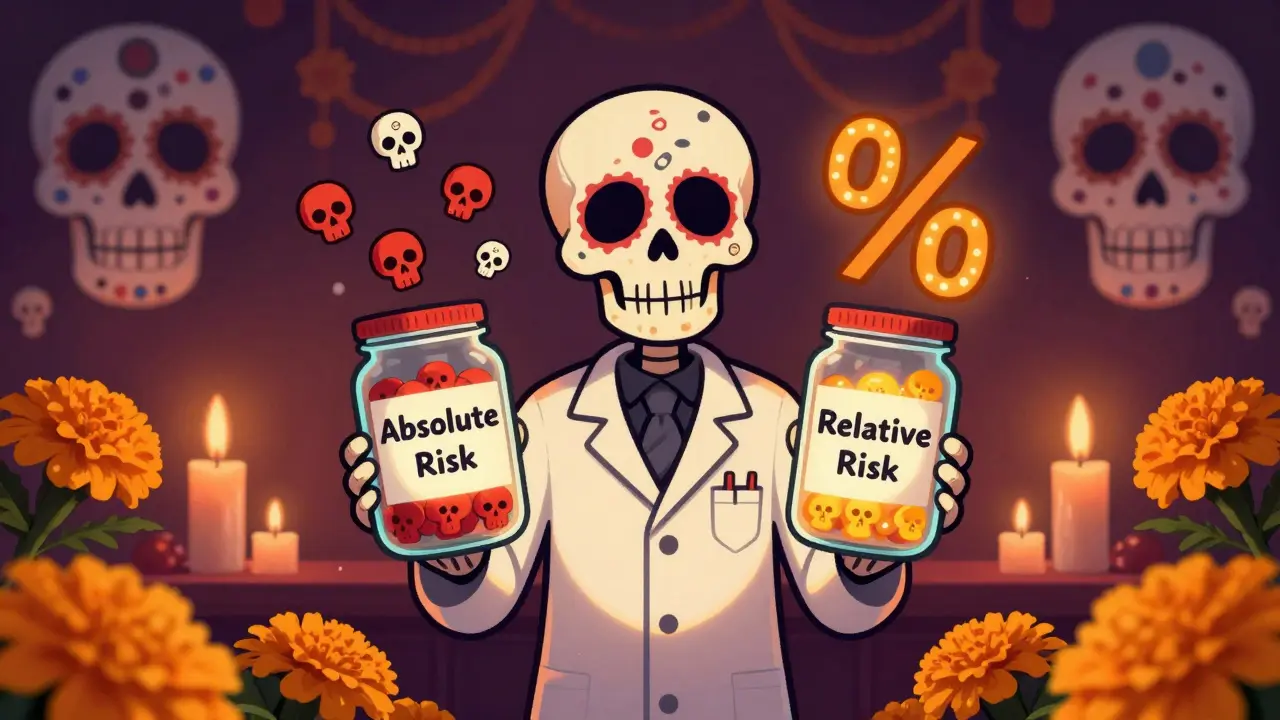
Absolute vs Relative Risk Calculator
Absolute Risk Reduction
-
Relative Risk Reduction
-
Number Needed to Treat (NNT)
-
What NNT means:
NNT = - means that for every - people who take the treatment, 1 person will benefit from the treatment.
Why this matters:
When a drug ad says "Reduces risk by 50%" it's using relative risk. But without knowing the absolute risk, you can't understand the real impact.
Before Treatment
2% risk of heart attack
(2 out of 100 people)
After Treatment
1% risk of heart attack
(1 out of 100 people)
Absolute Risk Reduction: 1 percentage point (2% - 1% = 1%)
Relative Risk Reduction: 50% (reduced by half)
Have you ever seen a drug ad that says, "This medication cuts your risk of heart attack in half"? It sounds powerful - like you’re doing something huge for your health. But what if I told you that your actual risk only went from 2% to 1%? That’s still a 50% reduction - but it’s not the life-saving leap it sounds like. This is the gap between absolute risk and relative risk, and understanding the difference can change how you think about every pill you take.
What Absolute Risk Really Means
Absolute risk is the real, honest number: how likely something is to happen to you, right now, in your life. It doesn’t compare you to anyone else. It just says: out of 100 people like you, how many will have this side effect?For example, if a drug causes severe nausea in 3 out of 100 people, the absolute risk is 3%. That’s it. No tricks. No math games. Just facts. If you’re one of those 100, you have a 3% chance of feeling sick. If you’re not, you’re fine. Simple.
This is what matters most when you’re deciding whether to take a drug. If the side effect is rare - say, 1 in 10,000 - then even if it’s serious, the odds are low. But if it’s 1 in 10? That’s a different conversation.
Doctors use absolute risk to make real decisions. When prescribing statins for high cholesterol, they don’t just say, "This lowers your risk." They say, "For someone your age with your numbers, this drug reduces your chance of a heart attack from 10% to 8% over 10 years." That’s absolute risk. It’s grounded. It’s personal.
What Relative Risk Is (and Why It’s Misleading)
Relative risk is a ratio. It compares your risk on the drug to your risk without it. It doesn’t tell you the starting point. That’s the problem.Take a drug that reduces heart attack risk from 2% to 1%. The absolute risk reduction? Just 1 percentage point. But the relative risk reduction? 50%. That’s half. And that’s what ads love to shout.
Here’s another example: a drug reduces the chance of a rare side effect from 1 in 100,000 to 1 in 1,000,000. That’s a 90% relative risk reduction. Sounds amazing. But in real terms? You went from a 0.001% chance to a 0.00001% chance. You’re talking about one extra person out of every 111,000 who avoids the side effect. That’s not nothing - but it’s not a miracle either.
Pharmaceutical companies use relative risk because it makes their drugs look better. A 50% reduction sounds way more impressive than a 1% reduction. And let’s be honest - if you don’t know the difference, you’ll believe the bigger number.
Studies show that 78% of direct-to-consumer drug ads in the U.S. use relative risk without ever showing the absolute numbers. That’s not an accident. It’s strategy.
Why Both Numbers Matter - Together
You can’t understand a drug’s effect with just one number. You need both.Let’s say a new antidepressant increases the risk of sexual side effects from 8% on placebo to 20% on the drug. The absolute increase? 12 percentage points. That’s 1 in 8 people. Pretty significant.
The relative risk? 2.5 times higher. That sounds scary - and it should. But if you only heard "2.5 times higher," you might think it affects half the people. It doesn’t. It affects 12% more. Still a lot - but not half.
On the flip side, if a drug reduces stroke risk from 0.5% to 0.4%, the relative reduction is 20%. Sounds small. But if you’re at high risk for stroke, that 0.1% drop might mean avoiding a life-changing event. Context changes everything.
That’s why experts say: always ask for both. If a doctor says, "This drug reduces your risk by 30%," ask: "From what? To what?" That’s the key.
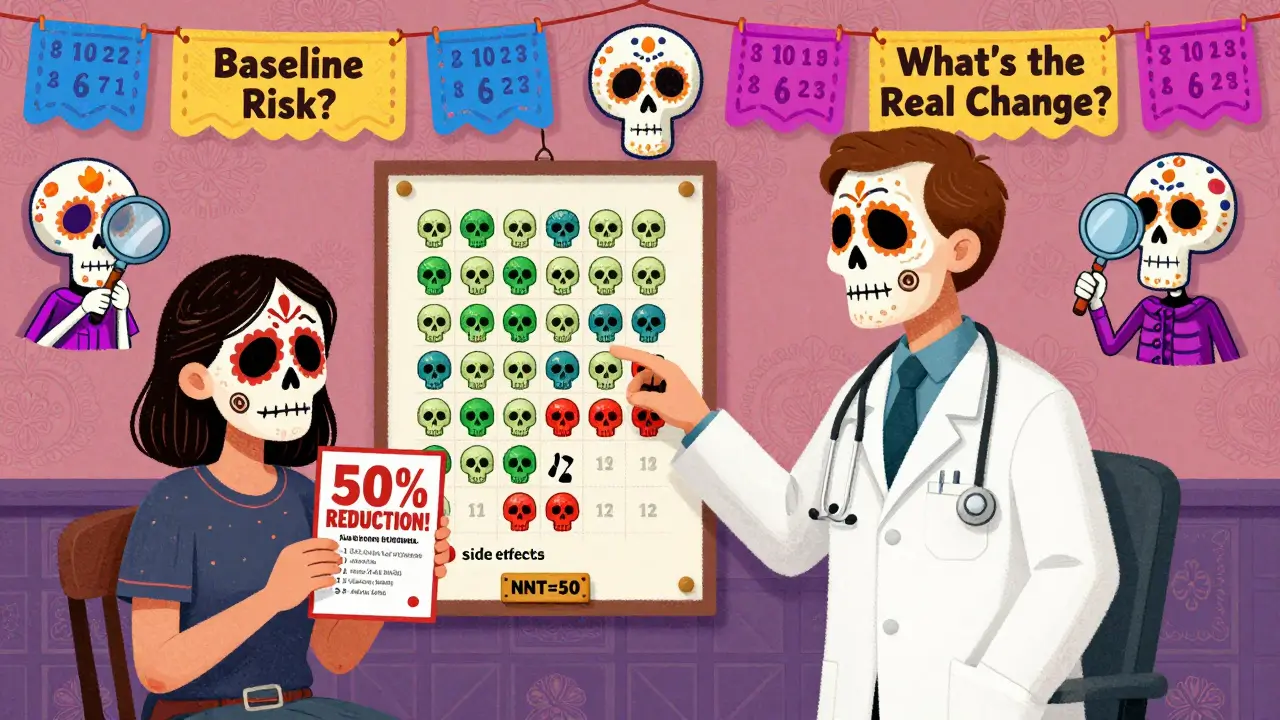
The Number Needed to Treat (NNT) - A Real-World Measure
There’s another number that cuts through the noise: Number Needed to Treat, or NNT.NNT tells you how many people need to take a drug for one person to benefit. It’s calculated from absolute risk reduction. If a drug reduces heart attack risk by 2% (0.02), then NNT = 1 / 0.02 = 50. That means 50 people need to take it for one person to avoid a heart attack.
That’s not a bad thing. But it does show you the scale. If the drug has side effects that affect 1 in 10 people, you’re giving a side effect to 5 people for every one who benefits. That’s a trade-off.
NNT is used in clinical guidelines for a reason. It forces you to think in real numbers, not percentages. If NNT is 100, and side effects affect 1 in 5, you might decide it’s not worth it. If NNT is 5 and side effects are rare? That’s a different call.
How Ads and Media Twist the Numbers
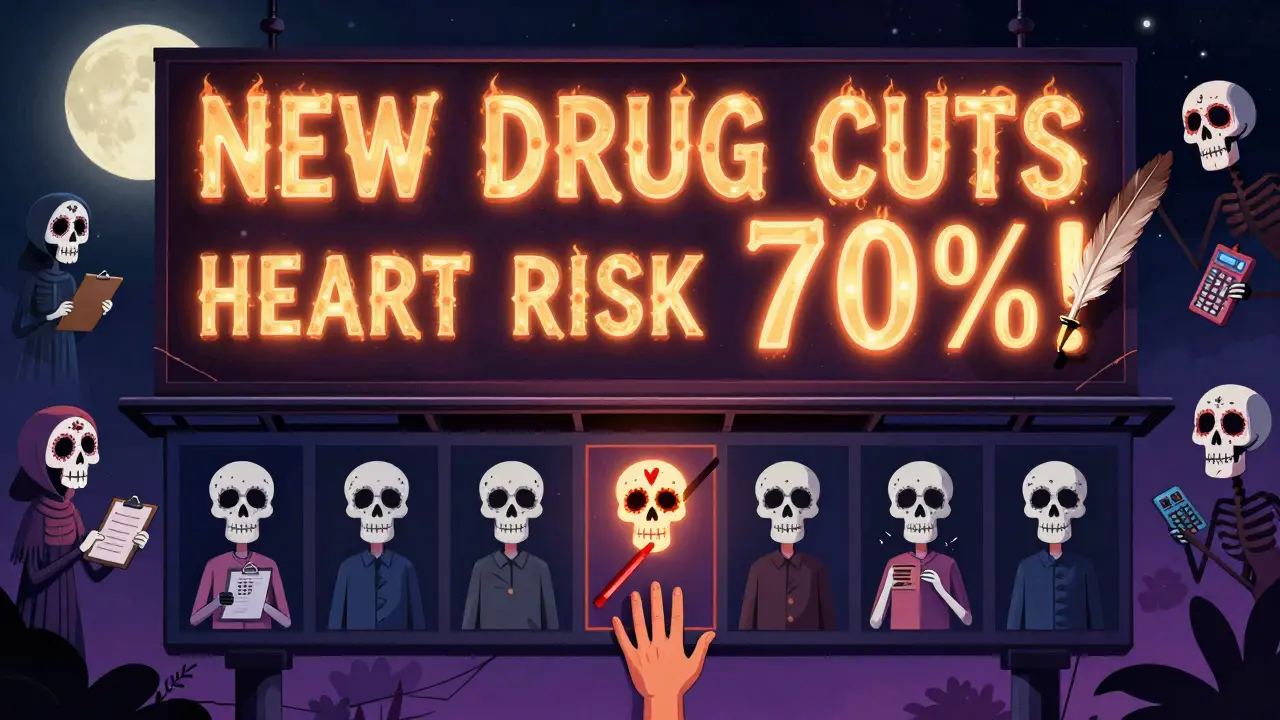
You’ve probably seen headlines like: "New Drug Cuts Cancer Risk by 70%!"That’s almost always relative risk. The absolute risk? Maybe it went from 0.75% to 1.25% - a 0.5 percentage point increase. That’s a 70% relative increase, but the real-world change? Tiny. This happened during the Fukushima nuclear disaster. News outlets said cancer risk "increased 70%" - terrifying. But the actual increase? From 0.75% to 1.25%. Still less than 1.5% total risk.
Same with drugs. A statin ad says, "Reduces heart attack risk by 50%." But if your baseline risk is 1%, it’s now 0.5%. You’re still at risk. You just have half the chance. That’s not a cure. It’s a modest improvement.
And here’s the kicker: patients who only hear relative risk are more likely to start a drug - and more likely to stop it later when they realize the benefit was smaller than they thought. One study found that 60% of doctors couldn’t even convert relative risk into absolute terms. If they’re confused, how can patients understand?
What You Should Do
If you’re considering a new medication, here’s what to ask:- What’s my baseline risk without this drug?
- What’s my risk with it?
- What’s the absolute difference?
- How many people need to take this for one to benefit? (NNT)
- What are the real odds of side effects? Not "more likely," but "how many out of 100?"
Don’t be afraid to ask for numbers. If your doctor says, "It’s 50% better," say: "Can you show me the numbers?"
Visual tools help. Some clinics use charts with 100 little icons - 100 people. Color the ones who get better, the ones who get side effects. Suddenly, it’s clear. A 10% improvement isn’t a miracle. It’s 10 out of 100.
And if you’re reading an ad? Look for the fine print. If it doesn’t mention the starting risk, it’s hiding something.
What’s Changing Now
Regulators are waking up. In 2023, the FDA started pushing for clearer risk communication in drug ads. The European Medicines Agency already requires both absolute and relative numbers on patient leaflets. Harvard Medical School now teaches risk interpretation in its curriculum. Cochrane, a global health research group, has created standardized templates so journals report data the same way.But change is slow. Most patients still don’t know the difference. And the industry still has every reason to keep using relative risk - because it works. It sells.
So you have to be the one who asks. Who digs deeper. Who doesn’t let a 50% number scare or excite you without knowing the full story.
What’s the difference between absolute risk and relative risk?
Absolute risk tells you the actual chance of something happening - like "3 out of 100 people get this side effect." Relative risk compares two groups - like "your risk is cut in half." The problem? A "50% reduction" sounds big, but if your risk went from 2% to 1%, it’s only a 1 percentage point change. Absolute risk gives you the real picture.
Why do drug ads use relative risk instead of absolute risk?
Because relative risk numbers look bigger. Saying a drug "reduces heart attack risk by 50%" sounds more impressive than saying it "lowers risk from 2% to 1%." Pharmaceutical companies know this - and studies show 78% of U.S. drug ads use relative risk without showing the absolute numbers. It’s not a mistake. It’s marketing.
What is Number Needed to Treat (NNT)?
NNT tells you how many people need to take a drug for one person to benefit. It’s calculated from absolute risk reduction. For example, if a drug reduces heart attack risk by 2%, the NNT is 50 - meaning 50 people need to take it for one heart attack to be prevented. It helps you weigh benefits against side effects.
Can relative risk be misleading?
Yes - especially when the baseline risk is very low. A drug that cuts a 0.001% risk to 0.0001% sounds like a 90% reduction - which is technically true - but in real life, you’re talking about one fewer person out of 100,000. That’s not a major benefit. Relative risk alone hides how small the actual change is.
How can I better understand my own risk?
Ask your doctor: "What’s my risk without the drug? What’s it with the drug?" Request the absolute numbers. If they mention a percentage reduction, ask what it started from. Use visuals - like pictograms showing 100 people - to make it concrete. And never trust an ad that doesn’t show the baseline risk.

Let me get this straight - you’re telling me people actually believe pharmaceutical ads without questioning the numbers? This isn’t just ignorance, it’s willful stupidity. A 50% reduction sounds heroic until you realize it’s going from 2% to 1% - meaning 98 out of 100 people were never at risk to begin with. And yet, doctors prescribe these things like they’re handing out candy. No wonder we have a healthcare system that’s broke and broken. You don’t need a PhD to understand absolute risk. You need common sense. And apparently, that’s in short supply.
Pharma doesn’t care if you live or die - they care if you take the pill. They’re not selling health. They’re selling hope wrapped in statistics. And we’re all too dumb to see through it. If you’re not asking for the baseline risk before signing off on a drug, you’re not a patient - you’re a data point.
And don’t even get me started on NNT. If 50 people have to take a drug for one person to benefit, and 1 in 10 get side effects? That’s not medicine. That’s a pyramid scheme with a stethoscope. We’ve turned healthcare into a numbers game, and the losers are the ones who trusted the system.
Stop being passive. Demand the numbers. Refuse to be manipulated. If your doctor can’t explain it in plain terms, find someone who can. Or better yet - don’t take the damn pill. Let your body handle it. Evolution didn’t design us to be chemical lab rats.
This isn’t about science. It’s about power. And the people who control the numbers control you.
absolute risk is the only number that matters when you're deciding whether to take a drug. relative risk is marketing. period. if your doctor says 'this reduces your risk by 40%' ask 'from what to what' and if they look confused you know why.
the 78% stat about ads using relative risk without absolute is insane. it's not just misleading it's predatory. people with low baseline risk get scared into taking statins or antihypertensives they don't need. meanwhile the side effects - muscle pain, diabetes risk, liver stress - get buried in footnotes.
the real solution is forcing full disclosure. no ad should be allowed to say 'reduces risk by X%' without showing the starting point. simple. effective. long overdue.
Ohhhhh… I just… I can’t… I mean… I’ve been on statins for five years… and I just realized… I had a 3% chance of a heart attack… and now it’s 2%… so I’ve been taking this pill… for… for… a 1% reduction?… and I’ve been having night sweats… and I can’t sleep… and my legs ache… and I didn’t even know… I didn’t know… I just… I trusted…
And now I’m sitting here… reading this… and I feel… so… betrayed…
It’s not just the numbers… it’s the silence… the way no one ever told me… the way the doctor just handed me the script… like it was a gift… like it was a miracle… and it was… a 1%… difference…
I think I need to cry…
…but I’m too tired…
…and my legs are still hurting…
Y’all are acting like this is some groundbreaking revelation. Newsflash: we’ve known this since the 90s. Pharma has been doing this since before most of you were born. The real question is why we let them.
I’ve been in healthcare for 18 years. I’ve seen patients cry because they thought a drug was going to ‘save them’… only to find out it shaved 0.3% off their stroke risk. Meanwhile, they’re now on a drug that makes them dizzy and gives them a weird metallic taste every morning.
And guess what? The doctor didn’t even know the absolute numbers. They just read the brochure.
So yeah - ask for the numbers. Ask for the NNT. Ask for the pictograms. If your provider rolls their eyes? Walk out. You deserve better. And honestly? You’re not being paranoid - you’re being smart.
This whole thing feels like being handed a glitter-covered calculator and told, ‘Trust the numbers.’ But the glitter? That’s the relative risk. The actual math? Buried under three layers of corporate jargon and a sales pitch that sounds like a TED Talk from a used car salesman.
Imagine if your car’s fuel efficiency went from 25 mpg to 25.5 mpg. The manufacturer would scream, ‘We’ve improved mileage by 2%! New technology!’ But you? You’d just stare at the pump and say, ‘I still have to fill up every 300 miles.’
That’s what this is. We’ve turned medical decision-making into a game of ‘Which percentage sounds bigger?’ instead of ‘What actually changes in my life?’
And yet… we keep falling for it. Why? Because we want to believe. We want to think there’s a pill for everything. But sometimes… the best medicine is asking the right questions.
Maybe the real breakthrough isn’t in the drug - it’s in the patient who refuses to be dazzled.
i never knew about nnt until i read this and wow. i took a blood pressure med for 3 years because my doc said it cut my risk by 30% and now i have weird muscle cramps and i think its from the drug. i wish someone had told me the absolute risk was 0.8% to 0.6% and that 50 people had to take it for one person to benefit. i feel so stupid. i just trusted. i didnt know to ask. i wish i had. now im scared to take anything. i dont even know what to do anymore.
Oh great. Another woke medical lecture. You know what’s more dangerous than a 50% relative risk? People who don’t take their meds because they read some blog about ‘absolute risk.’
Statins save lives. Period. I’ve seen patients with LDL over 200 go from having a 12% chance of a heart attack to 5% - that’s not ‘1% reduction’ nonsense. That’s life-saving.
And yes, some ads are shady. But you don’t throw out the baby with the bathwater. You educate people. You don’t let them become victims of their own ignorance. If you’re too lazy to understand numbers, don’t blame the system - go to medical school.
Also, ‘NNT’? Sounds like a crypto token. Use real terms. Real science. Not this emotional, feel-good pseudoscience.
Let me get this straight - you’re telling me the government lets drug companies lie to people by hiding the baseline risk? That’s not marketing. That’s fraud. That’s treason against the American people.
78% of ads use relative risk? That’s not an accident. That’s a coordinated attack on public intelligence. Who’s behind this? Big Pharma? The FDA? The AMA? Who’s getting paid? Who’s silencing the truth?
And why is no one in Congress doing anything? Why are we letting them sell fear disguised as science? This isn’t about health. This is about control. They want you dependent. They want you afraid. They want you to believe you need a pill for every little thing.
Wake up. This is how empires fall. Not with bombs. With misleading statistics. And we’re letting it happen. Every time we take a pill without asking - we’re complicit.
…what if… the whole thing… is a simulation?
What if the numbers… aren’t real?
What if the ‘3% risk’… was never meant to be calculated?
What if the ‘1% reduction’… was designed to make you feel safe… while the real danger… is something else?
I’ve been thinking… maybe the drugs don’t work… because they’re not supposed to.
Maybe the side effects… are the point.
Maybe the whole system… is built to keep us docile.
…and maybe… the only way out… is to stop taking the pills.
…but then again… what if the pills… are the only thing keeping us alive?
…I don’t know anymore.
…I think I’m being watched.
…they know I read this.
…they always do.