

Weight Loss Plateaus: Why Your Metabolism Slows Down and How to Break Through
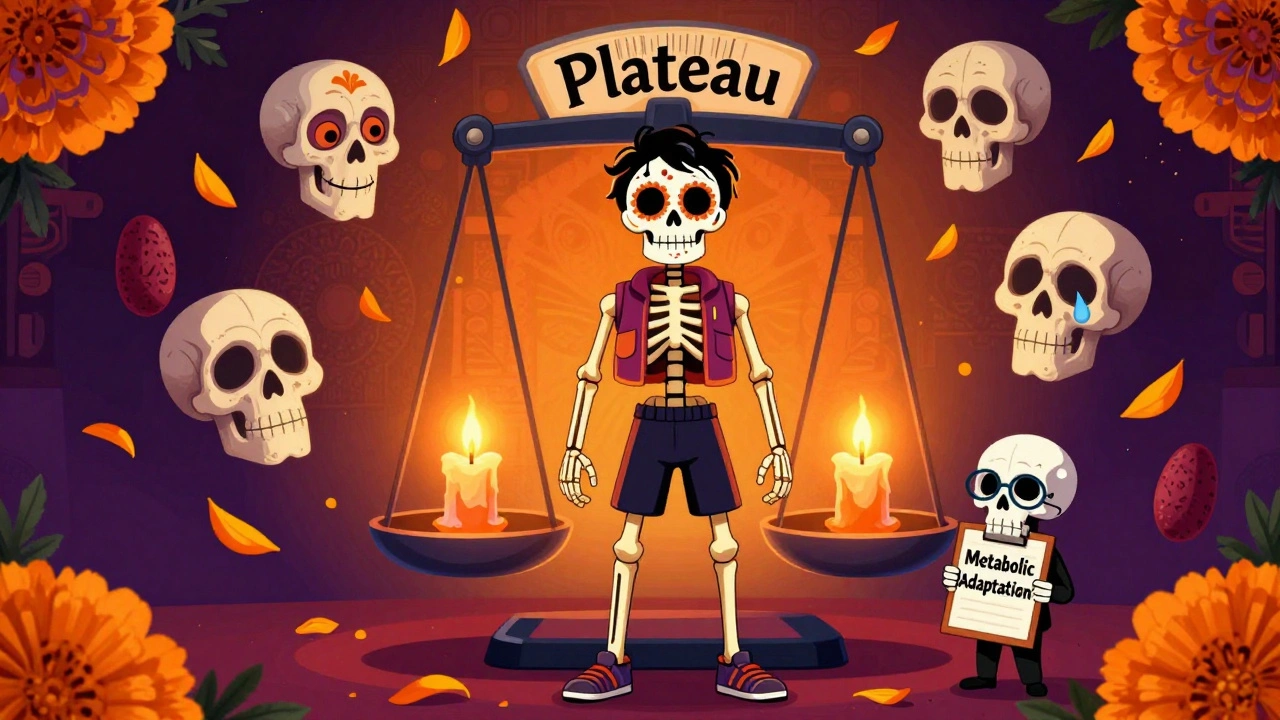
You’ve been eating clean, hitting the gym, tracking every calorie-and yet the scale won’t budge. You’re not lazy. You’re not failing. Your body is doing exactly what it’s designed to do: defend your old weight.
Why Your Weight Loss Stalls (It’s Not Your Fault)
When you lose weight, your body doesn’t just shrug and say, "Okay, new normal." It fights back. This isn’t about willpower. It’s biology. After you drop 5, 10, or even 20 pounds, your metabolism slows down more than it should. That’s called metabolic adaptation-or adaptive thermogenesis. Studies show your body burns up to 40% fewer calories than expected just from losing weight alone. This isn’t a myth. It’s been proven since the 1940s Minnesota Starvation Experiment, where participants’ metabolisms crashed even after they stopped dieting.Here’s the math: If you lose 10 pounds, your body should burn fewer calories because you’re lighter. But it doesn’t stop there. It burns even more calories than that. Why? Because your brain thinks you’re starving. It drops thyroid hormones, slashes leptin (the "I’m full" signal), and pumps up cortisol (the stress hormone). Your fat cells shrink, but your body starts hoarding energy like it’s preparing for winter. And that’s why your weight loss stalls.
The Real Reason Calorie Counting Fails After a While
Most people think if they just eat less, they’ll keep losing. But when your metabolism adapts, your original calorie target becomes too high. You’re no longer in a deficit-you’re just maintaining. And if you cut calories even lower, your body responds by slowing down even more. That’s why someone eating 1,200 calories a day for months might not lose an ounce. Their body has adjusted. Research from the University of Alabama at Birmingham found that each 10 kcal/day drop in metabolic rate adds about one extra day to your weight loss timeline. That means if your metabolism drops by 100 kcal/day, you’re looking at 10 extra weeks of no progress-even if you’re doing everything "right."And here’s the kicker: initial weight loss is mostly water. That first 5-10 pounds? That’s glycogen and fluid. Once that’s gone, your body shifts into defense mode. Many people think they’re doing something wrong when the scale stops moving. They’re not. They’re just hitting a natural biological wall.
How Your Body Physically Changes During a Plateau
Metabolic adaptation isn’t just a number on a chart. It shows up in your body in real ways:- Your resting metabolic rate (RMR) drops more than predicted by weight loss alone
- Leptin levels can fall by up to 70%, making you hungrier than ever
- Thyroid hormone production slows, reducing your body’s internal furnace
- Brown fat-your body’s natural calorie-burning tissue-becomes less active
- Cortisol rises, which can increase belly fat storage and cravings
Women are especially vulnerable. Studies show women have more brown fat than men, but when they diet, their brown fat shrinks faster and harder. That’s one reason women often hit plateaus sooner and harder than men, even with identical diets.
Diet Breaks: The Secret Weapon Most People Ignore
The most effective way to reset your metabolism isn’t to eat less-it’s to eat more for a short time. This is called a diet break. Instead of staying in a deficit for months, take 1-2 weeks every 8-12 weeks and eat at your maintenance calories. No tracking. No guilt. Just food.Why does this work? Because your body gets a signal: "We’re not starving anymore." Leptin rebounds. Thyroid function improves. Cortisol drops. Metabolic adaptation reverses by up to 50%, according to research from Byrne et al. (2018). People who use diet breaks don’t just break plateaus-they lose more fat long-term. One study found that people using diet breaks lost 23% more fat over six months than those who kept cutting.
Think of it like resetting a computer. You don’t keep pressing the power button harder when it freezes. You reboot. Same with your metabolism.

Strength Training Isn’t Optional-It’s Essential
Losing muscle during weight loss makes your metabolism worse. Muscle burns more calories at rest than fat. So if you’re only doing cardio, you’re losing both fat and muscle-and your body burns even fewer calories.Resistance training three to four times a week preserves muscle. Studies show people who lift weights lose 8-10% less of their resting metabolic rate compared to those who don’t. You don’t need to be a bodybuilder. Bodyweight squats, push-ups, dumbbell rows, and lunges are enough. Do them consistently. That’s how you protect your metabolism while you lose fat.
Protein Is Your Metabolism’s Best Friend
Eating enough protein isn’t just about building muscle. It’s about keeping your metabolism from crashing. Research shows that when people consume 1.6-2.2 grams of protein per kilogram of body weight during weight loss, they lose more fat and less muscle. One study found people on high-protein diets lost 3.2 kg more fat and 1.3 kg less muscle than those on low-protein diets.That means if you weigh 70 kg (about 154 lbs), aim for 112-154 grams of protein a day. Eggs, chicken, fish, Greek yogurt, tofu, lentils, and whey protein are easy sources. Spread it across meals. Don’t save it all for dinner.
Why Weight Loss Apps and Programs Still Fail
Most apps still use static calorie targets. They say, "Eat 1,500 calories a day." But your body changes. Your needs change. So that number becomes outdated within weeks. That’s why so many people hit plateaus and blame themselves.Some newer programs are catching on. WW updated their Points system in 2021 to adjust targets based on weight loss progress. Noom added "metabolic reset" features based on NIH research. These aren’t gimmicks-they’re science-backed. But even these tools only work if you understand the underlying biology. You can’t just rely on an app. You need to understand why your body is doing what it’s doing.

Pharmaceuticals and Surgery: When the Body Won’t Cooperate
For some people, metabolic adaptation is so strong that diet and exercise alone aren’t enough. That’s where medications like semaglutide (Wegovy) come in. These drugs mimic gut hormones that reduce hunger and slow digestion. In clinical trials, users lost nearly 15% of their body weight over a year-not because they ate less, but because their brain stopped screaming for food.Bariatric surgery works even better. It physically changes gut hormones and resets metabolism. Studies show people who have surgery experience 60% less metabolic adaptation than those who lose weight through diet alone. But surgery isn’t for everyone. It’s invasive, expensive, and comes with lifelong dietary changes.
These aren’t "easy outs." They’re tools for people whose bodies have fought back too hard. And they’re becoming more common. Pharmaceutical companies spent $1.2 billion in 2023 developing drugs that target metabolic adaptation directly.
What to Do Right Now (Simple, Actionable Steps)
If you’re stuck on a plateau, here’s your 7-day plan:- Stop cutting calories. Eat at maintenance for 3-5 days. Use an online calculator to estimate your current needs (weight × 13-15 for women, ×14-16 for men).
- Hit the weights. Do three full-body strength sessions this week. No cardio needed.
- Up your protein. Add one extra serving of protein at each meal. Aim for 20-30g per meal.
- Track your hunger. Write down when you feel ravenous. That’s your body signaling low leptin.
- Get enough sleep. Poor sleep raises cortisol and lowers leptin. Aim for 7+ hours.
- Don’t weigh yourself daily. Wait 2-3 weeks before stepping on the scale again.
- Plan your diet break. Schedule 1-2 weeks at maintenance calories in the next 6-8 weeks.
What’s Next for Weight Loss Science
The future of weight loss isn’t about eating less. It’s about working with your biology. Researchers are now testing cold exposure to activate brown fat. Early studies show people who sit in 60°F rooms for an hour a day burn 5-7% more calories. Others are developing pills that turn white fat into calorie-burning brown fat.By 2025, experts predict 85% of evidence-based programs will include metabolic adaptation strategies. The old model-"eat less, move more"-is outdated. The new model is: "eat smart, move strong, rest well, and reset often."
Dr. David Ludwig from Harvard put it best: "Understanding and working with-rather than against-metabolic adaptation represents the next frontier in sustainable weight management."
You’re not broken. You’re not lazy. You’re just human. And your body is doing exactly what evolution designed it to do: survive. Now you know how to work with it-not against it.
Why does my weight loss stall even when I eat very little?
Your metabolism slows down more than expected after weight loss-a process called adaptive thermogenesis. Your body reduces calorie burning to defend its previous weight, even if you cut calories drastically. This isn’t about willpower; it’s biology. Studies show metabolic adaptation can drop your energy expenditure by 15-40% beyond what your new weight predicts.
Can I reverse metabolic adaptation?
Yes. The most effective way is through a diet break: eating at maintenance calories for 1-2 weeks every 8-12 weeks. This helps reset hormones like leptin and thyroid, reducing metabolic adaptation by up to 50%. Strength training and higher protein intake also help preserve muscle and support metabolic recovery.
Do diet breaks cause weight gain?
Short-term diet breaks (1-2 weeks) typically cause little to no fat gain. Any weight gain is mostly water and glycogen, which drops quickly when you return to a deficit. In fact, people who use diet breaks lose more fat over time than those who stay in a constant deficit because their metabolism doesn’t crash.
Is cardio or weight lifting better for breaking plateaus?
Weight lifting is more effective. Cardio burns calories during the workout, but strength training preserves muscle, which keeps your resting metabolism higher. Studies show people who lift weights lose 8-10% less of their metabolic rate during weight loss than those who only do cardio. You still need movement-but muscle is your metabolic armor.
How much protein do I need to prevent muscle loss during weight loss?
Aim for 1.6 to 2.2 grams of protein per kilogram of body weight daily. For a 70 kg (154 lb) person, that’s 112-154 grams per day. Higher protein intake helps preserve muscle, reduces hunger, and supports metabolism. Research shows people on high-protein diets lose more fat and less muscle during calorie restriction.
Do weight loss medications like Wegovy help with plateaus?
Yes. GLP-1 agonists like semaglutide (Wegovy) reduce hunger and slow digestion, helping overcome the increased appetite caused by metabolic adaptation. In trials, users lost nearly 15% of body weight. These aren’t magic pills-they work best with diet and exercise-but they can help when biology is working against you.
Will my metabolism stay slow forever after weight loss?
No, but it may stay lower than before you lost weight. Studies show metabolic adaptation persists for over a year after weight loss. However, with consistent strength training, adequate protein, and occasional diet breaks, you can bring your metabolism closer to normal. Long-term maintenance is possible-it just requires smarter habits, not more willpower.





Been there. Done that. The scale just stared at me like I owed it money. Turns out my body wasn’t lazy-it was terrified I was gonna starve. Who knew evolution had a panic button?
Now I eat like a normal human for a week every couple months. Magic.
STOP blaming yourself. This isn’t about discipline. Your body is a survival machine. It doesn’t care about your Instagram goals. It cares about keeping you alive. And right now? It thinks you’re in a famine.
Stop fighting it. Start working with it. You’re not broken. You’re biologically brilliant.
Y’all are overcomplicating this. Just eat less and move more. If your metabolism’s slow, you’re probably just lazy. I lost 40 lbs in 3 months on 800 calories a day and no gym. You’re just making excuses.
Also, protein? Pfft. I eat bacon for breakfast. Done.
Tommy, your approach is dangerous and scientifically inaccurate. A 800-calorie diet can cause muscle loss, hormonal disruption, and long-term metabolic damage. The research in this post isn’t opinion-it’s replicated, peer-reviewed biology.
Metabolic adaptation isn’t laziness. It’s your thyroid, leptin, and cortisol playing defense. Ignoring it leads to rebound weight gain, not success.
Trust the science. Not the internet bros.
This is one of the most coherent and evidence-based explanations of metabolic adaptation I’ve read in years. The analogy of rebooting a computer is particularly apt.
It’s refreshing to see a post that doesn’t villainize the body but instead invites understanding. The diet break strategy alone is worth the read.
Thank you for sharing this.
YES. Diet breaks changed my life. I was stuck for 6 months. A 10-day break at maintenance? I gained 2 lbs. Then went back to deficit and lost 7 lbs in 2 weeks.
Also, protein. I started hitting 140g/day. My hunger vanished. My energy soared.
👍 You’re not failing. You’re adapting. And that’s okay.
THIS is why I hate the wellness industry. They make you feel guilty for having a body that evolved over 10,000 years to survive famine. Now they want you to buy $80 protein powder and a $200 app to "reset your metabolism"?
My grandma lost weight on corn tortillas and beans. No tracking. No apps. Just food.
Stop overthinking. Just eat real food. Move. Sleep. Done.
Actually, the Minnesota Starvation Experiment didn’t prove metabolic adaptation-it proved starvation. People were eating 1,500 calories while doing manual labor. That’s not dieting. That’s torture.
Also, who says we should even be trying to lose weight? Maybe your body’s at its set point.
Just saying.
Man, I love this. It’s like the universe finally whispered the truth in my ear after years of yelling at the scale.
My mom’s from Jamaica. She used to say, "You don’t fight the tide, you ride it."
Turns out, she was a metabolic genius.
Now I lift, I eat chicken, and I let my body breathe. Best decision ever.
Wait. So you’re telling me the government and Big Pharma are hiding the truth? That weight loss isn’t about willpower but about hormones and corporate greed?
And now they’re selling us GLP-1 drugs for $1,000 a month? I’m not surprised. They made us fat, then sold us the cure.
Wake up people. This is a scam. They want you addicted to pills so you keep paying.
They’re watching. They always are.
As a registered dietitian with 14 years in clinical practice, I can confirm the data presented here is not only accurate but critically underrepresented in mainstream nutrition discourse.
The notion that "calories in, calories out" is sufficient for long-term weight management is not only outdated-it is clinically harmful.
Metabolic adaptation is a well-documented, reproducible phenomenon in endocrinology literature, and the interventions outlined-diet breaks, protein intake, resistance training-are gold-standard recommendations.
Thank you for sharing this with such clarity.
Oh, so now I’m supposed to eat MORE to lose weight? 😏
And I thought I was being "disciplined" by eating salad for dinner… turns out I was just starving my metabolism into a coma.
Thanks for the reality check. I’m scheduling my diet break… and eating a whole pizza.
…and I’m not even sorry.
Most of this is pseudoscience dressed up as biology. You can’t "reset" your metabolism. Your BMR is determined by genetics, age, and muscle mass. No amount of protein or diet breaks will change that.
And those drugs? They’re just appetite suppressants. You’re not fixing anything-you’re masking it.
Real weight loss is discipline. Not gimmicks.
Love this. Been doing diet breaks for 18 months now. Lost 30kg. Kept it off. No drugs. No shakes. Just food, weights, and patience.
People think weight loss is a sprint. It’s a marathon with nap times.
And yeah-women do hit plateaus harder. Biology’s a rough ride, but knowing the map? That’s power.
Keep going. You’ve got this.