

Molluscum Contagiosum: What It Is, How It Spreads, and Real Treatment Options
If you’ve seen small, round, pearly bumps on your child’s skin-or maybe even on your own-and wondered what they are, you’re not alone. These aren’t acne, not allergies, and not just a rash. They’re molluscum contagiosum, a common viral skin infection that shows up as tiny, painless bumps with a dimple in the center. It’s harmless in most cases, but it’s contagious, it can stick around for months, and it causes real stress for parents and adults alike.
What Molluscum Contagiosum Actually Looks Like
The bumps are usually 2 to 6 millimeters across-about the size of a pencil eraser. They’re smooth, firm, and often look like they’ve been polished. Their most telling feature? A tiny dent or dot right in the middle. That’s called an umbilication, and it’s the key thing doctors look for to tell molluscum apart from warts or other skin issues. The color can vary: skin-toned, pink, or slightly white. In kids, they show up mostly on the face, neck, armpits, arms, or hands. In adults, they’re more likely to appear on the genitals, inner thighs, or lower abdomen-usually from sexual contact. People with eczema are more prone to getting them, and the bumps can spread faster and get bigger if their skin is already irritated. They don’t hurt. They don’t itch much-at least not at first. But if your child starts scratching, that’s when things get messy. Scratching spreads the virus to other parts of the body, and it can lead to bacterial infections. One study found scratching triples the number of bumps in just a few weeks.How It Spreads-and How Not to Spread It
The virus that causes molluscum, called MCV, is easy to pass around. It doesn’t need blood or bodily fluids. Just skin-to-skin contact is enough. That’s why it’s so common in daycare centers and schools. One kid with molluscum can infect others by sharing towels, toys, or even pool noodles. It can also spread in water. Swimming pools, hot tubs, and even bathwater can carry the virus if someone with molluscum has been in it. That’s why some pools require kids with visible bumps to stay out-but the CDC updated its stance in 2023 to say that’s unnecessary. You don’t need to keep your child out of school or swimming just because they have these bumps. The incubation period is 2 to 6 weeks. So if your child got exposed at a birthday party, you might not see anything for over a month. That makes it hard to trace. And once it’s there, it can keep spreading for months. In healthy kids, the bumps usually go away on their own in 6 to 18 months. But sometimes they hang around for up to 4 years.How It’s Different from Other Skin Problems
It’s easy to mistake molluscum for something else. Here’s how to tell:- Warts (from HPV) are rough, raised, and don’t have that central dimple. They’re usually thicker and more stubborn.
- Herpes blisters are painful, fluid-filled, and come in clusters. Molluscum is painless and solid.
- Chickenpox causes lots of itchy, fluid-filled blisters all over the body-not just a few discrete bumps.
- Impetigo is bacterial, oozes, and crusts over. Molluscum stays dry and firm.
Do You Need to Treat It?
This is the big question. And the answer, according to the American Academy of Dermatology, is usually: no. For healthy children and adults, the best treatment is often no treatment. The bumps will go away on their own. Trying to remove them can cause pain, scarring, or even make the infection spread. One 2021 study found that 92% of cases cleared up within 18 months without any intervention. But there are exceptions. If the bumps are on the face, genitals, or are causing emotional distress-like teasing at school or anxiety about dating-then treatment makes sense. The Cochrane Review looked at 27 studies and found that cantharidin (a blistering agent applied by a doctor) had the highest success rate: 73% of patients cleared up after 12 weeks. That’s way better than placebo, which only worked 25% of the time. Other options include:- Cryotherapy (freezing with liquid nitrogen): Fast, but painful. Can leave scars, especially on kids’ delicate skin.
- Topical creams: Potassium hydroxide (5-10%) is popular. One product called MolluDab got 63% positive reviews on Amazon for clearing bumps in under 8 weeks. But it’s not FDA-approved, so results vary.
- Laser therapy: Used for stubborn cases. Expensive and usually not needed.
What Works Best for Kids with Eczema
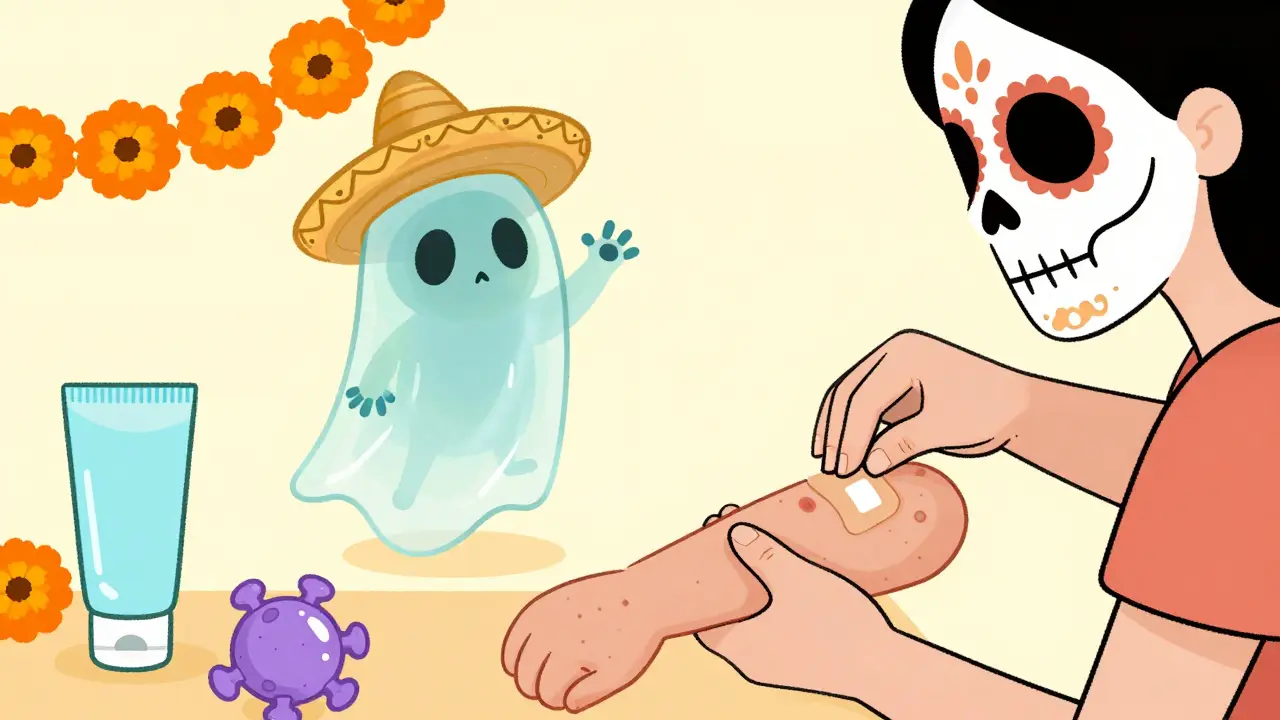
If your child has eczema and gets molluscum, things get trickier. Studies show they’re 30% more likely to get the infection, and the bumps spread faster. The eczema makes the skin barrier weak, so the virus slips in easier. Managing both at once means:- Keeping eczema under control with moisturizers and gentle steroids (as prescribed)
- Avoiding harsh scrubs or treatments that irritate the skin
- Using topical treatments that are soothing, not abrasive
What to Avoid
There’s a lot of bad advice out there. Don’t:- Try to pop or squeeze the bumps. That spreads the virus and can cause scarring.
- Use apple cider vinegar, tea tree oil, or duct tape. There’s no solid evidence they work, and they can irritate the skin.
- Let your child share towels, bath toys, or clothing with others.
- Delay treatment if you’re immunocompromised. In people with HIV or other immune disorders, molluscum can become widespread, large, and persistent. It’s not just a cosmetic issue-it can be a sign your immune system needs attention.
Real Stories, Real Stress
Online forums are full of people sharing their experiences. On Reddit, one man described how genital molluscum made him avoid dating for 14 months. He felt ashamed, even though it was harmless. Another parent said her daughter was bullied at school because of bumps on her neck. She finally got treatment after months of anxiety. But there are also stories of relief. One mom said she just covered the bumps with band-aids, kept the skin moisturized, and waited. The bumps disappeared in 10 months. No pain, no scars, no stress.
What’s New in 2026
A new topical cream is in phase 2 trials. It works by boosting the skin’s immune response instead of killing the virus. Early results show 82% clearance in 12 weeks-much better than older options. It’s not available yet, but it could be a game-changer for kids and adults who don’t want to wait. Also, the CDC now clearly says: Don’t exclude kids from school or swimming because of molluscum. That’s a big shift from a few years ago. The virus spreads too easily to control that way, and the emotional toll isn’t worth it.When to See a Doctor
You don’t need to rush to the clinic for every bump. But see a dermatologist if:- The bumps are growing quickly or spreading all over
- They’re on the genitals and you’re sexually active
- Your child has eczema and the bumps aren’t improving
- You have a weakened immune system
- The bumps become red, swollen, or ooze pus (sign of infection)
Bottom Line: Patience, Not Panic
Molluscum contagiosum isn’t dangerous. It’s not a sign of poor hygiene. It’s just a common virus that likes warm, humid skin. In most cases, it fades on its own. The key is to avoid scratching, avoid sharing towels, and give it time. If you’re tempted to treat it aggressively-think again. The cure can be worse than the disease. For most people, the best treatment is calm, consistent care. And patience.Are molluscum bumps contagious?
Yes. Molluscum contagiosum spreads through direct skin contact, sharing towels or toys, or even swimming in the same water. It’s highly contagious among children and can spread quickly in households. Adults usually get it through sexual contact.
Do molluscum bumps leave scars?
Usually not. In healthy people, the bumps go away without scarring. But if you scratch them, pick at them, or get aggressive treatments like freezing or scraping, you can end up with permanent marks-especially on the face or sensitive skin.
How long do molluscum bumps last?
In healthy children and adults, most bumps disappear within 6 to 18 months. Some last up to 4 years, especially if the immune system is slow to respond. In people with weakened immune systems, they can persist for years and grow larger.
Can adults get molluscum contagiosum?
Yes. While it’s most common in kids, adults get it too-usually through sexual contact. In adults, the bumps often appear on the genitals, inner thighs, or lower abdomen. If you’re sexually active and notice new bumps in those areas, see a doctor to rule out other conditions.
Should I keep my child out of swimming lessons?
No. The CDC updated its guidelines in 2023 to say children with molluscum should not be excluded from swimming or school. The virus spreads too easily in water to prevent transmission this way, and the emotional impact of missing activities isn’t worth it. Covering bumps with waterproof bandages is fine, but not required.
Is there a cure for molluscum contagiosum?
There’s no single approved cure, but the body clears the virus naturally in most cases. Treatments like cantharidin, potassium hydroxide, or cryotherapy can speed things up, but they’re not always necessary. A new immune-boosting cream is in clinical trials and shows promise for faster clearance without side effects.
Can molluscum come back after it’s gone?
Once the bumps are gone, your body usually builds immunity to that strain of the virus. But you can get infected again if exposed to a different strain. It’s rare to have multiple outbreaks, but possible-especially if your immune system is compromised.
Does molluscum mean my child has a weak immune system?
No. Most kids with molluscum are perfectly healthy. It’s a common virus that affects nearly everyone at some point. Only if the bumps are unusually large, widespread, or last longer than 3 years should you consider checking for an underlying immune issue.



I just let mine be. Ten months, gone. No drama.
I'm a pediatric nurse and see this all the time. Parents panic, but 90% of cases resolve without intervention. The real risk is over-treatment. Cryotherapy on a toddler’s face? Please. Moisturize, avoid scratching, and wait. Your kid’s skin will thank you.
My daughter got it after swimming camp. The school sent a letter. Like it was leprosy.
The CDC’s 2023 guidance is a masterclass in bureaucratic surrender. We used to protect children from contagion. Now we normalize it. This is not progress-it’s cultural capitulation disguised as compassion. The virus thrives on our collective indifference.
So you’re saying we should just accept a virus spreading through playgrounds? That’s not patience. That’s negligence. If it’s contagious, it’s a public health issue. Stop pretending it’s harmless.
The medical establishment is complicit. They suppress natural immunity by promoting interventions. Molluscum is nature’s filter. Those who survive it are stronger. The pharmaceutical-industrial complex profits from fear.
So we’re telling parents to just… wait? Like it’s a bad Netflix show? Meanwhile, my cousin’s kid got bullied into tears because his neck looked like a marble collection. Patience is a luxury when your child’s self-esteem is rotting.
The immunological kinetics of MCV infection are profoundly influenced by epidermal barrier dysfunction, particularly in atopic dermatitis comorbidity. The viral load correlates directly with transepidermal water loss metrics. Intervention protocols must prioritize barrier restoration prior to virostatic modalities.
New cream in trials? 🤯 This could be the future. Imagine not having to freeze a 4-year-old’s face. 🙌 Hope it gets approved soon. My niece had 40 bumps. It was heartbreaking.
my kid got it and we just ignored it. no big deal. skin cleared. life went on
The data on cantharidin is compelling, but the real issue is accessibility. In rural clinics, you’re lucky to get a dermatoscope, let alone a prescription for off-label potassium hydroxide. We need scalable, low-cost solutions-not just clinical trials in urban centers.
The notion that molluscum contagiosum is benign ignores the psychosocial burden it imposes. Shame, social isolation, and parental anxiety are not trivial sequelae. Medical neutrality is not neutrality-it is abdication.
In India, we call this 'chhota pimple'. Grandmas say: 'Let it be, it will go with time.' No creams. No doctors. Just coconut oil and patience. And guess what? It worked. No scars. No trauma.
I know it’s hard to sit back and watch your kid suffer, but trust me-this is one of those moments where doing nothing is the most powerful thing you can do. I watched my son’s bumps go from 15 to zero over 11 months. We used fragrance-free lotion, kept his nails short, and didn’t let him share towels. No screaming. No tears. Just quiet, steady care. And now? He’s a healthy, happy 7-year-old who doesn’t even remember it happened. You’ve got this.
I think the real question isn’t whether to treat-it’s why we feel the need to treat at all. We’ve been trained to fear imperfection. A bump isn’t a failure. A virus isn’t a flaw. Maybe the deeper issue is that we’ve lost the ability to sit with discomfort-our own and our children’s. The body knows how to heal. We just need to stop interfering with our anxiety.