

How to Store Inhalers and Nebulizer Medications Safely

It’s March 2026, and the temperature in Melbourne has already hit 32°C. Your child’s inhaler sits in the car glovebox. Your partner’s nebulizer ampules are in the bathroom cabinet. You think they’re fine. But they’re not.
Improper storage doesn’t just reduce effectiveness-it can turn a life-saving device into a useless piece of plastic. A 2023 study from the University of North Carolina found that inhalers left in a car at 35°C for just 24 hours delivered 40% less medication. That’s not a small drop. That’s the difference between breathing and not breathing during an asthma attack.
What Happens When Inhalers Get Too Hot or Too Cold?
Most metered-dose inhalers (MDIs) like ProAir HFA or Ventolin are pressurized cans. They contain medication suspended in a propellant. If the temperature climbs above 30°C, the pressure inside increases. The canister can leak, or worse, rupture. If it gets too cold-below 15°C-the propellant doesn’t vaporize properly. The dose you get might be half of what’s printed on the label.
Dry powder inhalers (DPIs) like Spiriva or Advair are even more sensitive. They don’t use propellant. Instead, they rely on your breath to pull fine powder from a capsule. But if humidity rises above 60%, that powder clumps. The capsules become brittle and crack. You’ll hear a crunch when you load it. Then, nothing comes out. GlaxoSmithKline’s 2020 report confirmed that at 65% humidity, DPIs lose up to 35% of their delivered dose within a week.
Nebulizer solutions are liquid. Albuterol, Pulmicort, Xopenex-they’re not meant to sit in the sun. A 2022 study in the Journal of Aerosol Medicine showed that exposing albuterol ampules to 40°C for just 30 minutes permanently destroyed the active ingredient. No amount of shaking or refrigeration fixes it. It’s gone.
Where NOT to Store Your Medications
Let’s clear up the biggest myths.
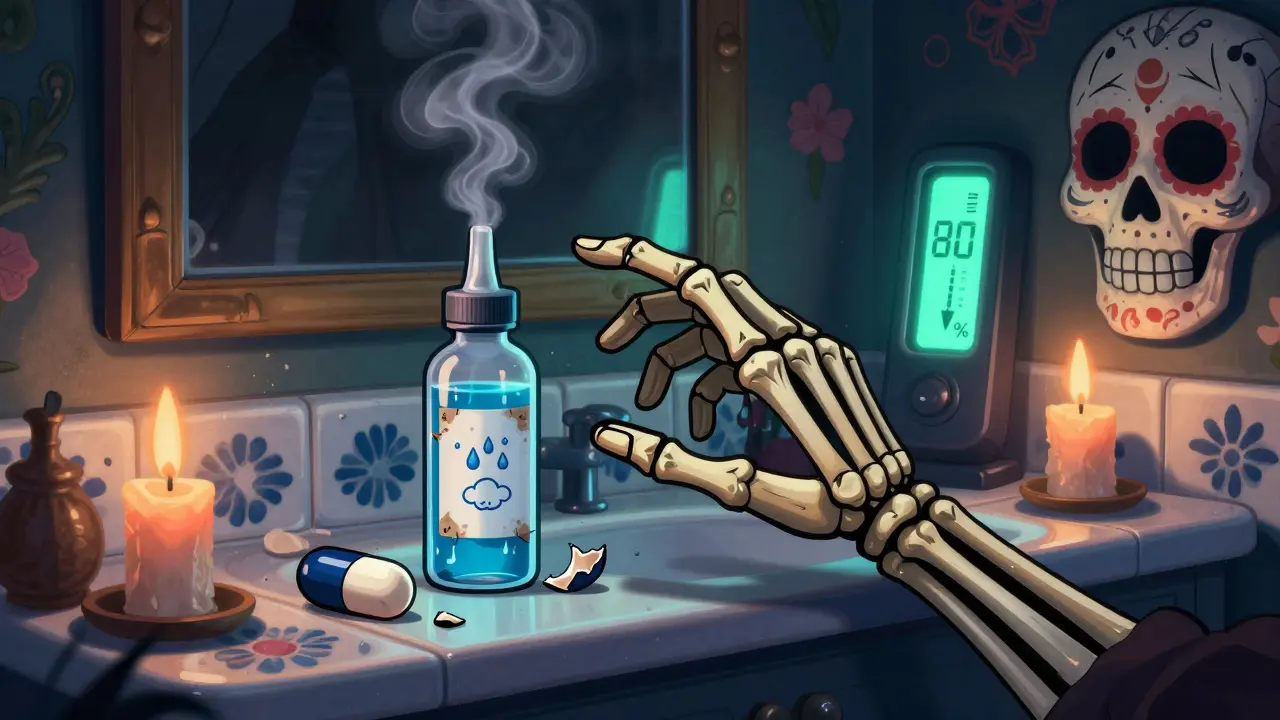
- Bathroom cabinets - Steam from showers raises humidity to 70-80%. Moisture ruins DPIs and degrades liquid solutions. St. Jude Children’s Research Hospital found that albuterol stored in a bathroom lost 35% of its potency in just 14 days.
- Car gloveboxes or dashboards - On a 30°C day, your car can hit 65°C inside. The NIH tested this in 2022: a closed car reached 70°C in 30 minutes. That’s enough to denature the medication completely.
- Refrigerators - Unless the label says so, don’t do it. Symbicort, ProAir, and most MDIs aren’t designed for cold. Condensation forms inside the canister. Moisture causes clogging. The American Thoracic Society explicitly bans refrigeration for multi-dose inhalers.
- Direct sunlight - UV light breaks down chemical bonds. Even if the temperature is fine, sunlight degrades the medication. Always keep inhalers in opaque containers.
- Together in one pocket - Storing a DPI next to a wet MDI? Big mistake. Moisture from the MDI’s propellant can leak and ruin the powder. Johns Hopkins found this caused 22% of DPI failures in patients who stored them together.
Where to Store Them-The Right Way
The ideal spot? A cool, dry, dark place. Somewhere stable.
- Bedroom drawer - Far from windows, away from heaters. Use a small plastic box with a lid. Add a silica gel packet to absorb moisture.
- Original packaging - Keep inhalers in their boxes. They’re designed to block light and reduce humidity swings.
- Room temperature - Between 15°C and 25°C is the sweet spot. That’s typical for most homes in Melbourne during spring and autumn. If it’s too hot outside, move your inhaler inside.
- For nebulizer solutions - Keep unopened ampules refrigerated (2°C-8°C) until first use. Once opened, they’re stable at room temperature for only 7 days. Mark the date on the box. Toss them after.
The CDC recommends a simple 3-step check:
- Use a digital hygrometer to confirm humidity stays between 40% and 50%.
- Store inhalers in an opaque container-like a small Tupperware or a dark cloth pouch.
- Attach a temperature strip like Timestrip. It changes color if exposed to unsafe heat. You’ll see it before it’s too late.
Traveling? Here’s How to Keep Them Safe
You’re heading to the coast. It’s 38°C outside. Your inhaler’s in your bag. You’re relying on it.
The American College of Physicians has a rule: the Rule of 15. No more than 15 minutes outside a temperature-controlled environment. That means if you’re parking your car, take your inhaler inside with you. Don’t leave it in the glovebox.
For longer trips, use an insulated case. The MediSafe case from Amazon, tested by the University of Arizona in 2023, keeps inhalers stable for up to 15 hours-even in 40°C heat. One user in Queensland used one for 18 months during summer. Zero issues.
For nebulizer users: carry ampules in a small cooler with a reusable ice pack. Not frozen. Just cool. And always bring extras. If one degrades, you’ll need a backup.
What’s New in 2026? Smart Storage is Here
Technology is catching up. In May 2023, the FDA cleared the first Bluetooth-enabled inhaler case: SmartInhale. It monitors temperature and humidity in real time and sends alerts to your phone if conditions go outside safe ranges. GlaxoSmithKline rolled out humidity-indicating packaging for Ellipta inhalers in late 2023. The capsule changes color if moisture has entered.
The FDA is moving toward mandatory environmental sensors in all rescue inhalers by 2026. That means future inhalers might have built-in chips that tell you if they’ve been exposed to unsafe conditions. Until then, don’t wait. Check your storage now.

Why This Matters More Than You Think
A 2023 study in Respiratory Care found that 78% of medication errors linked to inhalers and nebulizers came from improper storage. That’s not user error. That’s system failure. People aren’t being taught how to store these devices. They’re told to use them. Not how to protect them.
And it’s getting worse. A 2023 Lancet Planetary Health study projected that by 2030, 32% of Americans will face more than 60 days a year over 30°C. That’s not just hot weather. That’s medication degradation weather.
The American Lung Association says improperly stored inhalers contribute to 12% of asthma emergency visits. Dr. Michael Foggs of the American College of Allergy says 20% of preventable ER trips during summer are due to failed inhalers.
This isn’t about convenience. It’s about survival.
What to Do If You Suspect Your Inhaler Failed
You used it. Nothing came out. You’re panicking.
First, don’t panic. Use your backup-if you have one. Always keep a spare inhaler in a different location.
Then, check the canister. Is it cold? Warm? Is there condensation? Did it fall? Did it sit in the car?
If you suspect damage, replace it. Don’t wait. Don’t hope. The medication doesn’t expire on the label-it expires the moment it’s exposed to bad conditions.
Pharmacists at St. Jude recommend this: every time you refill, ask: “Is my storage setup correct?” They’ll check your home environment. Most don’t. But you should.
Final Checklist: Your Daily Storage Routine
- Keep inhalers away from bathrooms, kitchens, and windows.
- Store in a drawer or cabinet between 15°C and 25°C.
- Use opaque containers. Block the light.
- Check humidity. If it’s above 60%, add silica gel.
- Never leave inhalers in cars, especially in summer.
- Mark expiration dates on nebulizer ampules after opening. Toss after 7 days.
- Keep spare inhalers in a different location.
- Use a temperature strip if you’re unsure.
- Ask your pharmacist: “Is my storage method safe?”
Storage isn’t optional. It’s part of your treatment plan. Just like taking your medicine, you need to store it right. Otherwise, you’re not just wasting money. You’re risking your life.


This is why people die in asthma attacks. Not because they're weak. Not because they didn't take their meds. Because no one taught them storage is part of the treatment. You think your inhaler's fine in the glovebox? That's not negligence. That's a death sentence wrapped in convenience. And the system lets it happen. Again. And again. And again.
lol so now we're supposed to monitor humidity with a hygrometer and buy a $40 insulated case just to keep a $50 inhaler from melting?? 🤡 The FDA is pushing smart inhalers by 2026?? Bet they're already tracking your usage data through the Bluetooth chip... Big Pharma's next move: charge you $200/month for "environmental compliance monitoring". You're being gamed. Always have been. 😈
Oh wow. A whole article about keeping plastic canisters from exploding. And you call this science? 😏 Meanwhile, real asthma research is buried under 12 layers of corporate patents. But sure, let’s all panic about a silica gel packet. Meanwhile, the air outside is toxic, the meds are overpriced, and your ‘safe storage’ won’t fix the fact that your neighborhood has zero green space. You’re treating symptoms of a system collapse like it’s a DIY home project.
i read this and thought wow this is so important but then i remembered i leave my inhaler in my jeans pocket and its been like that for 3 years and i still breathe so idk maybe its just hype? also i think the fridge is fine i mean its cold right? why would they make it if it cant handle cold? 🤔
Okay, but let’s be real: if your inhaler is in the car and it’s 35°C, you’re already dead. The fact that we need a 2000-word guide to explain this is a national disgrace. Why isn’t this on every prescription label? Why isn’t every pharmacy handing out temperature strips? Why is the burden on the patient? This isn’t about storage-it’s about a healthcare system that doesn’t care if you live or die as long as you keep paying. And now I’m mad. 🤬
I just got my first nebulizer last month. I kept the ampules in the bathroom. I didn’t know. I’m crying right now. My kid had a seizure last week. I thought it was just bad asthma. Now I think… maybe it was me. 😔
I'm from Arizona. We've been living this for a decade. No one talks about it. My sister’s inhaler exploded in her purse last summer. Shattered glass. Burned her thigh. She still uses it. Because she can't afford a new one. And the government gives tax breaks to oil companies but won't fund a $2 silica gel packet for a child's life. This isn't about storage. It's about who gets to live.
I just wanted to say thank you for writing this. I’ve been a nurse for 18 years. I’ve seen too many kids come in with failed inhalers. One little boy, 6 years old, couldn’t breathe because his mom stored it on the windowsill. I cried in the break room. Please, please, please share this. It’s not just medical advice-it’s love. And love means protecting the things that keep people alive. 💕